
Would You Let an AI Prescribe Your Acne Cream? What Utah Just Allowed, and What It Means for You
By Andres Zuleta, MD, ThriveMed · Patient education · Want the deeper evidence review? Read my physician's analysis on drzuleta.com.
It is the night before a big day. You lean into the mirror, and there it is, a new breakout on your chin. The next dermatology opening is two months away, so you pick up your phone. Since October 5, 2026, in Utah, that phone can write the prescription. As a physician, I wanted to read the fine print before telling you what I think.
What is new
A company called Nolla Health started a one year pilot in Utah. Its app can now issue a first prescription for acne, not just a refill, for adults with mild to moderate acne. Utah's earlier AI pilots could only renew prescriptions a clinician had already written.
It runs under Utah's AI sandbox, through the Office of Artificial Intelligence Policy. The state agreed not to enforce certain licensing rules, but only for this one narrow task. And the agreement says, in plain words, that it is not an endorsement or an approval of the product.

How it works
- You verify your identity with a photo ID and a selfie. Only Utah adults qualify.
- You answer health questions.
- You photograph your face from five angles. Photos taken in poor light are rejected.
- An image model scores the severity from 0 (clear) to 4 (severe).
- Software matches that score and your answers to one of eight topical plans: creams and gels such as tretinoin, adapalene, benzoyl peroxide, clindamycin with benzoyl peroxide, and azelaic acid. No pills, no isotretinoin.
- Every plan is a morning product and an evening product. Niacinamide, a gentle soothing ingredient, is in six of the eight, and topical spironolactone appears in two, made by a compounding pharmacy.
Think of a vending machine with eight buttons, not a kitchen that can cook anything. That is the whole idea. It is not that the AI is a genius. It is that the task is small and well marked.

The guardrails
- Hard stops: under 18; pregnant, trying to get pregnant, or breastfeeding; a weakened immune system; severe kidney or liver disease; a past reaction to one of the medicines. If acne looks severe, a physician looks first, and the most severe cases are told to get in person care.
- Labeled as AI: prescriptions go out under a supervising physician, the pharmacist is told it came from AI, and gets a physician to contact.
- A person, anytime: you can message a licensed physician in the app.
Doctors step back slowly
Oversight loosens in stages, like a student driver. First the instructor's hands are near the wheel, then they move to the passenger seat, then they do spot checks.
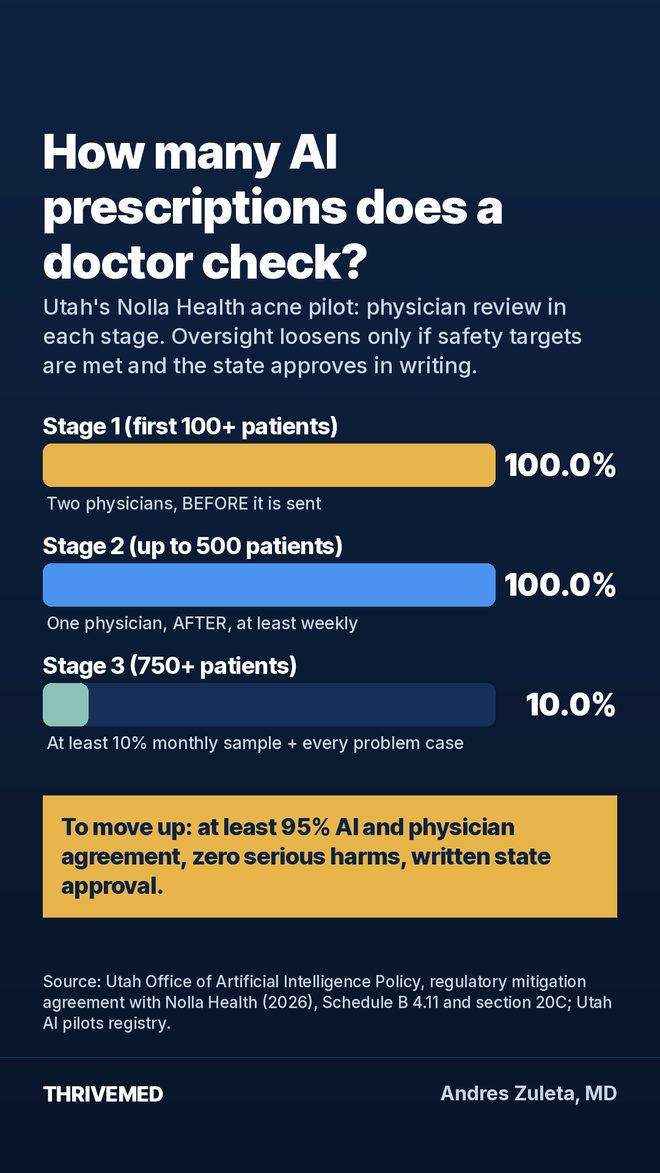
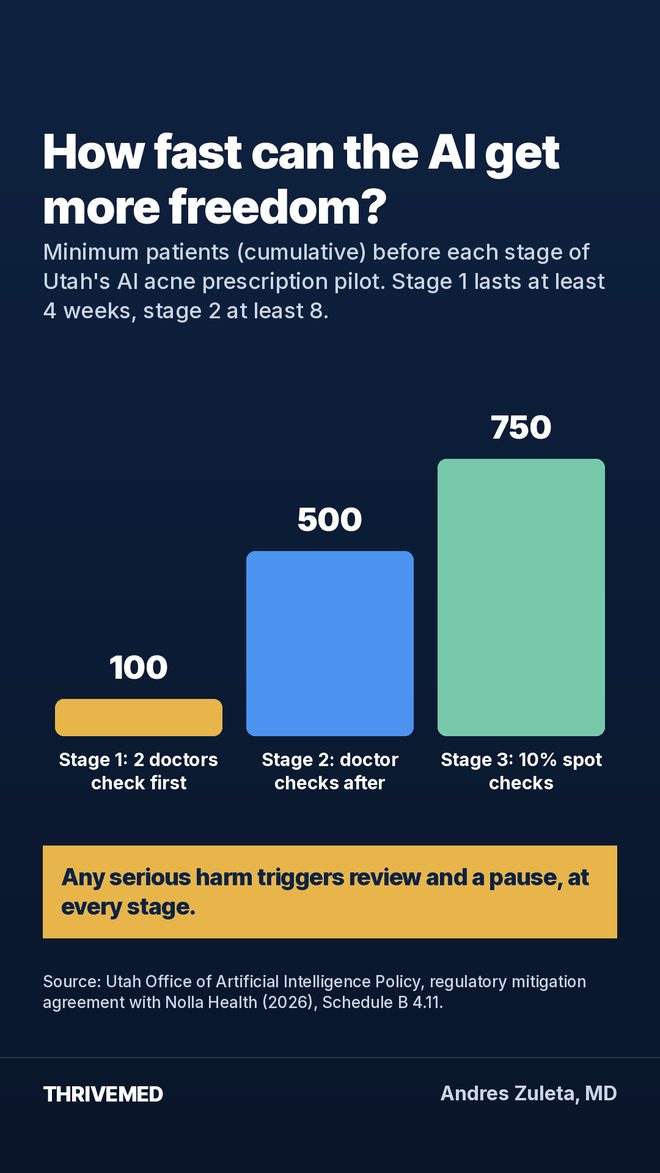
- Stage 1 (at least 4 weeks and 100 patients): two physicians check every prescription before it is sent.
- Stage 2 (at least 8 weeks, up to 500 patients): the AI sends it, and a physician reviews every case after, at least weekly.
- Stage 3 (750 patients and beyond): physicians review at least a 10% sample each month, plus every case with a side effect or escalation.
To move up, the AI has to agree with physicians at least 95% of the time, with zero missed hard stops and zero serious harms, and the state has to approve it in writing.
The evidence, honestly
The company says its severity model was tested on more than 10,000 cases it had never seen, and that in its last 1,000 treatments, clinicians agreed with its plan about 96% of the time. Those are the company's own numbers, and they are not published in a peer reviewed journal yet.
Agreement is like grading the homework, not the final exam. It tells us the AI picks what a doctor would pick. It does not yet tell us whose skin cleared, who got irritated, or who stopped. There is also no published data on how it performs across skin tones, though Utah requires monthly reports broken down by age, gender and race, and any harm reported within 24 hours.
What it means for you
These are medicines the American Academy of Dermatology already recommends first for acne, and acne affects nearly 50 million Americans a year. Faster access to a good first step matters, because untreated acne can scar. But a bounded tool is only safe if you stay inside its bounds.
How to be proactive
- Answer every health question honestly, especially about pregnancy and past reactions.
- Take your photos in good light. Better photos, better scores.
- Use a retinoid at night and sunscreen in the morning, and give it weeks, not days.
- If your skin burns, scars, or you get deep, painful bumps, ask for a person right away. You always can.
The smartest tool is the one that knows its limits, and so is the smartest patient. Be proactive.
Sources: Utah Office of Artificial Intelligence Policy and Division of Professional Licensing, regulatory mitigation agreement with Magic Health, Inc. and Magic Health Services, LLC (Nolla Health), 2026; Utah AI Authorized Pilots registry; Nolla Health, October 5, 2026; Reynolds et al., Guidelines of care for the management of acne vulgaris, J Am Acad Dermatol 2024; American Academy of Dermatology, January 31, 2024. Educational only, not medical advice. Video footage: Pexels, Pixabay and Mixkit (free licenses); app footage from Nolla Health's launch video (editorial excerpt).