
Would You Let a Robot Draw Your Blood? What the FDA Just Authorized, and What It Means for You
By Andres Zuleta, MD, ThriveMed · Patient education · Want the deeper evidence review? Read my physician's analysis on drzuleta.com.
You roll up your sleeve. The nurse taps your arm, frowns a little, and says, "let's try the other side." Most of us have been there. On August 19, 2026, the FDA authorized a robot to take that turn, and as a physician I wanted to look very closely before telling you what I think.
The short version
- What is new: the FDA authorized Aletta, made by the Dutch company Vitestro, as the first standalone robotic device that can draw blood from your arm without hands-on operator intervention. It came through the De Novo pathway (number DEN250046), the route for a brand new kind of low to moderate risk device.
- Who it is for: adults in outpatient settings, with a trained phlebotomist supervising, up to three devices at once.
- The evidence: in a trial in the Netherlands, it screened 1,743 people. In 110 (6%) it found no suitable vein and sent them to a human. In the other 1,633, it got blood on the first stick 94.5% of the time.
- The limits: the company funded the study, there was no side by side human group, results across skin tones have not been published, and it is not in US clinics yet.
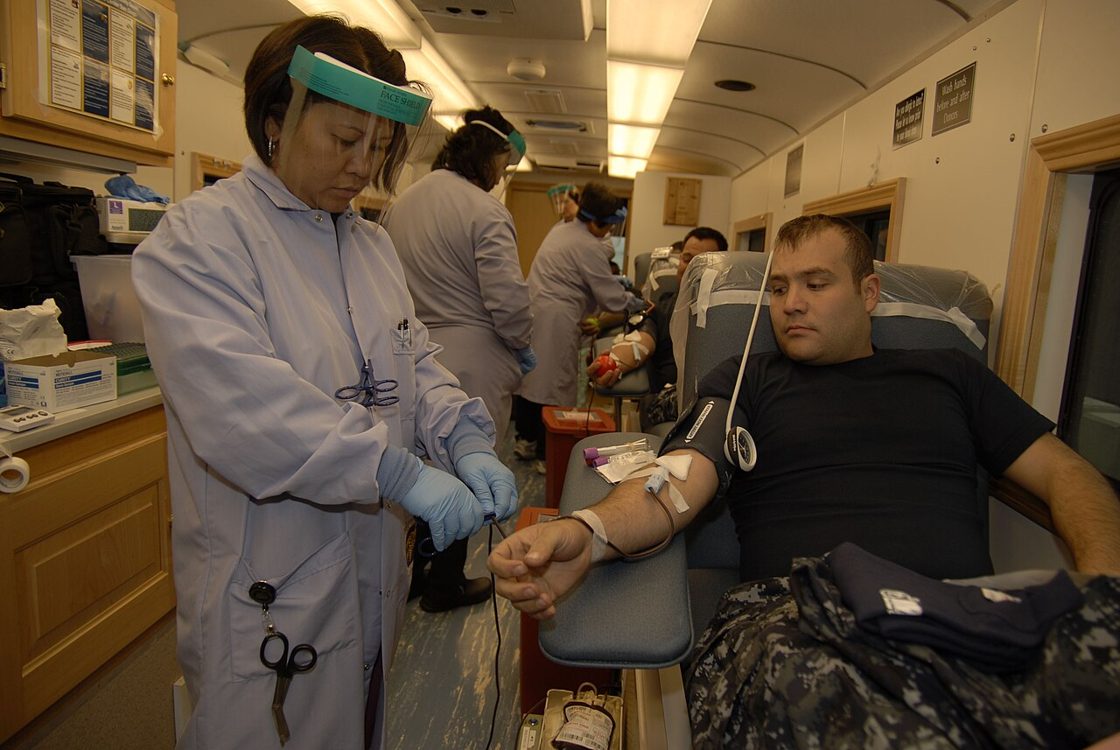
How a robot finds a vein
Think of shining a flashlight behind your hand and seeing the shadows of your veins. That is roughly what near-infrared light does: it tells the robot where to look. Then ultrasound looks under the skin and checks the vein's size, depth and direction. Doppler ultrasound listens to the blood flow, a bit like telling a calm, steady stream from a pulsing rush, so it can tell a vein from an artery. The company says its software uses AI to choose the spot.
Then the robot handles the rest: tourniquet pressure, cleaning the skin, the needle, changing the tubes, and the bandage. Two safety rules matter most to me. If it does not find a suitable vein, it does not try. And if you move too much, the needle detaches and the draw stops. A human still checks that the tubes are full and in the right order.
What the study found
The main study, called ADOPT, was published in the journal Clinical Chemistry in 2026.
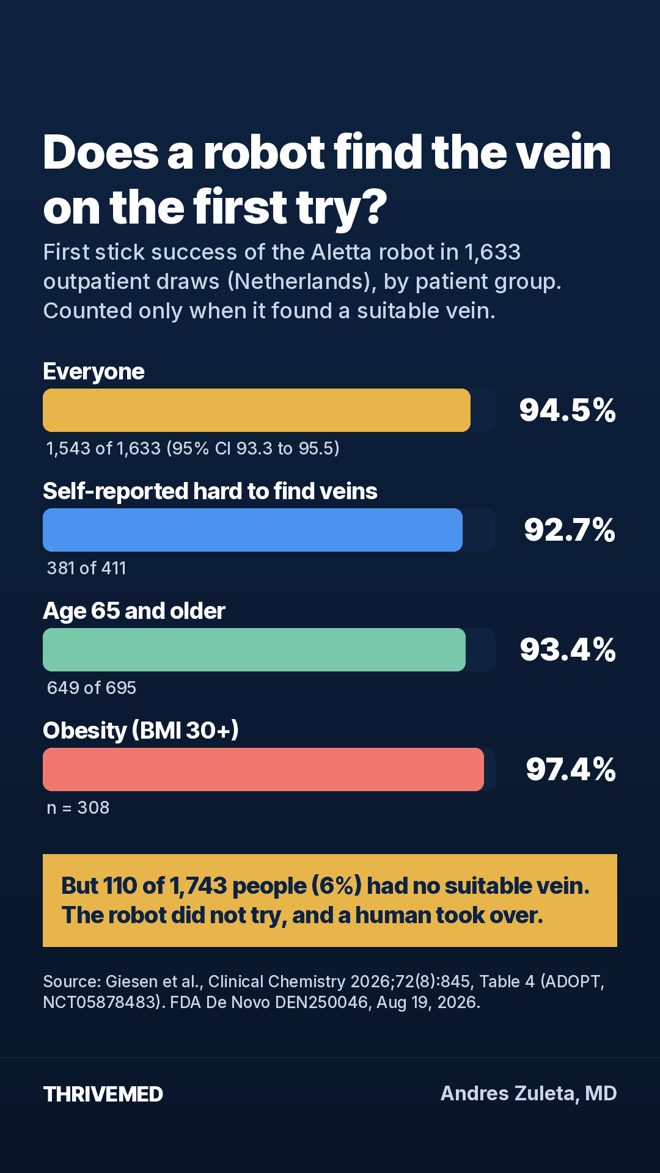
- First stick success: 94.5% (1,543 of 1,633), and above 92% in people with hard to find veins, people 65 and older, and people with obesity.
- The number behind the number: that rate only counts people where it found a suitable vein. Think of a basketball player's free throw percentage that only counts the shots they chose to take. Counting all 1,743 people screened, about 88 out of 100 had a successful first stick by the robot.
- Safety: side effects in 0.6% of draws, all mild, mostly feeling faint.
- Sample quality: only 0.3% of samples were hemolyzed (damaged in a way that can mean a redo), and in a separate group, lab results from robot and human draws matched.
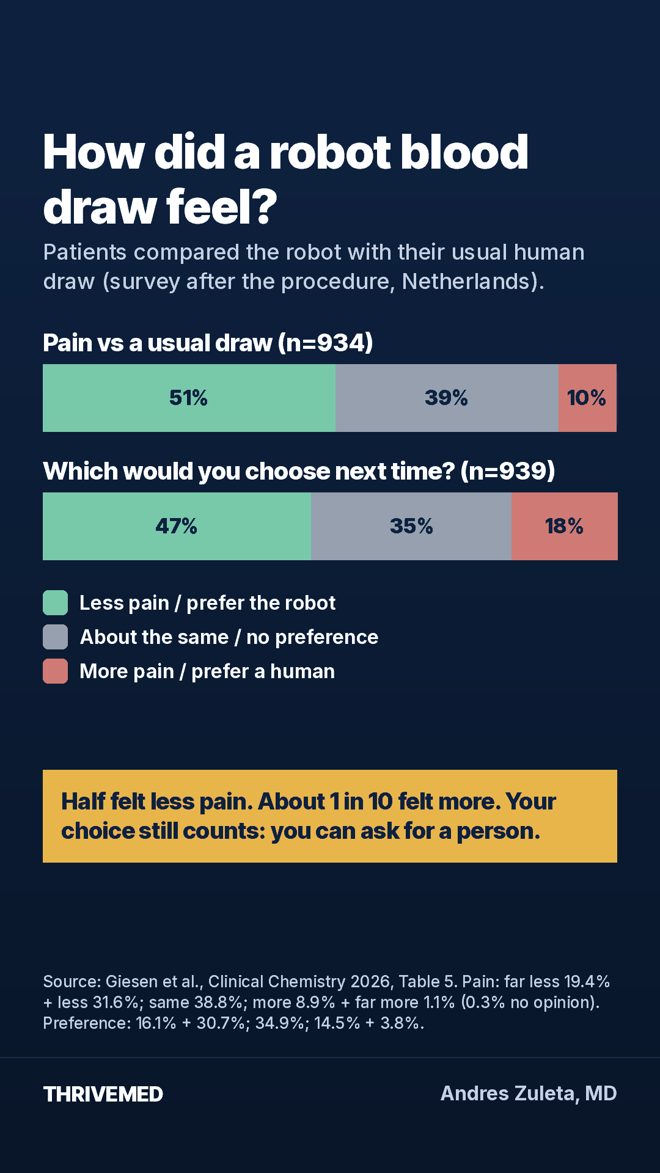
- How it felt: about half said it hurt less than a usual draw, about 4 in 10 said the same, and about 1 in 10 said more.
The honest part
- Who paid: Vitestro funded the study, and several authors work for the company.
- No head to head group: the main part had no human comparison group; results were compared to published numbers instead.
- Skin tone: an editorial in the same journal praised the performance but called generalizability across skin tones unproven. The FDA says the data it reviewed included varying skin tones; I want to see that published.
- Not here yet: it is authorized for adults in outpatient settings, and Vitestro plans a US multicenter trial before US commercial availability.
What it means for you
One phlebotomist can watch up to three robots, like a lifeguard watching three lanes. With about 143,900 phlebotomists in the US and roughly 18,000 openings projected every year, that could mean shorter waits and more tests done on time. And the people with the trickiest veins may get more of the expert's attention, not less. I do not see a robot replacing a person. I see a person with better tools.
Four things you can do at your next blood draw
- Drink water beforehand, if your test allows it.
- Keep your arm warm. Veins are easier to find.
- Say which arm worked last time, and if you are a hard stick, say so at the start. If you tend to feel faint, ask to lie down.
- If you are offered a robot draw, ask what happens if it cannot find a vein. You can always ask for a person.
Sources
- FDA press release, "FDA Authorizes First-Of-Its-Kind Robotic Blood Draw Device," Aug 19, 2026: fda.gov
- FDA De Novo DEN250046 (decision Aug 19, 2026): FDA database
- Giesen LFP, et al. Clinical Chemistry 2026;72(8):845. doi:10.1093/clinchem/hvag029. Trial registry NCT05878483
- El-Khoury JM. Clinical Chemistry 2026;72(8):819-820 (editorial). doi:10.1093/clinchem/hvag045
- Vitestro, Aug 20, 2026: announcement
- US Bureau of Labor Statistics, Occupational Outlook Handbook, Phlebotomists: bls.gov
Want a proactive plan for your own health? Join Thrive Nation. For the deeper evidence review, read my physician's analysis on drzuleta.com.
Educational only, not medical advice. Photos: U.S. Navy (public domain). Charts: ThriveMed, from the cited data.