
Who Figured Out How to Build Peptides? Bruce Merrifield and the Bead, 1963
By Andres Zuleta, MD, ThriveMed · Patient and family education
On May 26, 1959, a young chemist in New York named Bruce Merrifield opened his lab notebook and wrote one sentence: "There is a need for a rapid, quantitative, automatic method for the synthesis of long chain peptides."
He had a very personal reason to write it. He had just spent eleven months building a chain only five amino acids long, and at the end he kept just 7% of it. This is Episode 5 of my 15-part series, The Peptide Breakthroughs, and it is the story of how one idea in that notebook changed the way peptides are made.
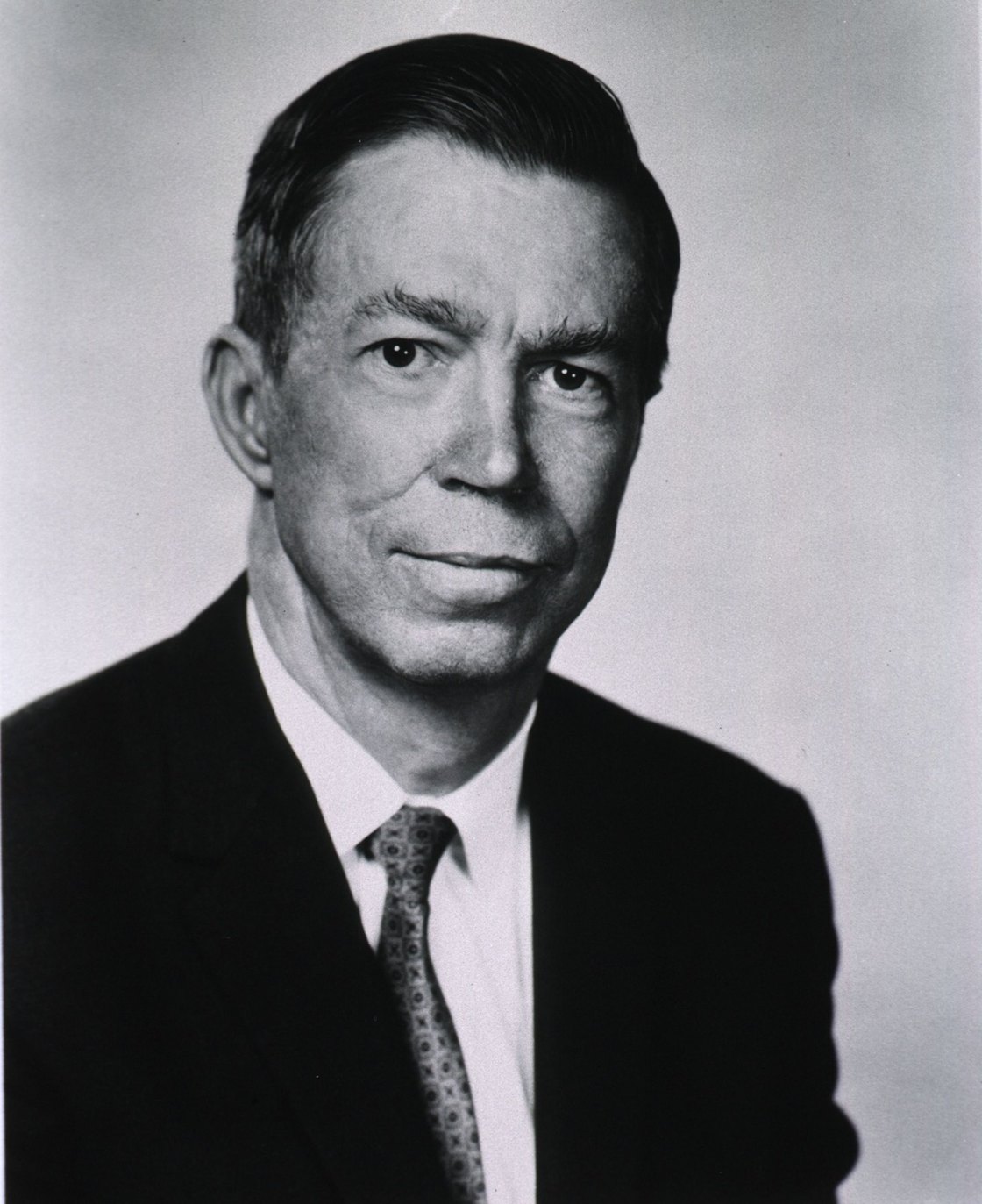
R. Bruce Merrifield in 1969, the year he received the Lasker Award (National Library of Medicine, public domain).
The short version
- The discovery: in 1963 Merrifield showed that you can build a peptide while its first link is anchored to a tiny plastic bead. Each step becomes a rinse instead of a full cleanup.
- The results: a machine to do it (1965), insulin's chains built on beads (1966), a whole enzyme of 124 amino acids in about three weeks (1969), and the 1984 Nobel Prize in Chemistry.
- The limits: every step has to be nearly perfect, because small misses add up over a long chain.
- The possibilities: the same idea now builds DNA strands for research, and peptide medicines like enfuvirtide and tirzepatide are made with solid support steps today.
Watch the 5-minute story.
Why building a peptide used to take months
A peptide is a short chain of amino acids, like beads on a string. Back then, every time chemists added one amino acid, they had to pull the whole chain out of the mixture, purify it and crystallize it before adding the next one. Imagine cooking where, after every single ingredient, you scrape dinner into a clean pot and start again. You lose a little food each time, and dinner takes all week. That is why five links took Merrifield eleven months.
The idea: add, rinse, repeat
His answer was to stop moving the chain. He tied its first link to a tiny bead of plastic resin, about 50 micrometers across when dry, smaller than a grain of sand. Then he added the next amino acid, rinsed away everything that did not attach, and repeated. Because the chain never leaves the bead, the cleanup between steps is just filtering and washing. At the very end, the finished chain is cut free.
Think of a charm bracelet clipped to the table. You add a charm, shake off the loose bits, add the next one, and unclip the bracelet when it is done. You rinse the pan instead of re-cooking the meal.
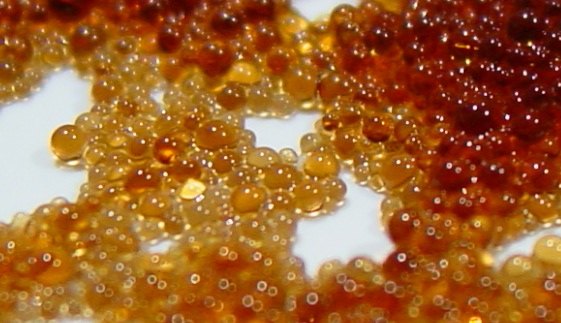
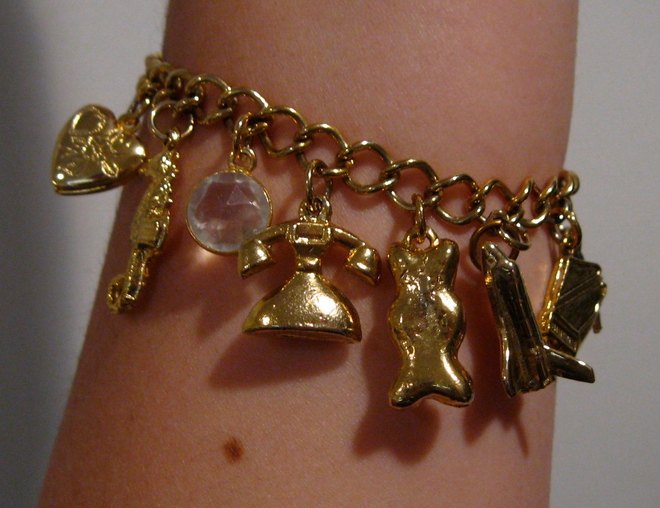
Left: resin beads (Wikimedia Commons, public domain). Right: the analogy, a charm bracelet (Mabsal, Wikimedia Commons, public domain).
Three months became three years
Merrifield expected about three months to get it working. It took three years, with nothing to publish. Years later he wrote: "At the end of the first two years the results were so poor, I wonder what made me think that this approach would ever succeed. But from the outset I had a strong conviction that this was a good idea, and I am glad that I stayed with it long enough."
His boss made that possible. Wayne Woolley was a brilliant biochemist who had been born with diabetes, was kept alive by insulin, and went blind in his twenties. He kept working by feel and memory, and he let Merrifield persist.
When the 1963 paper finally came out, it described a chain of four amino acids. Some chemists said the method was "not chemistry at all." One called it an "ingenious trick."
The machine, and the results
So Merrifield built a machine. In 1965, with John Stewart and Nils Jernberg, he made the first automated peptide synthesizer: bottles, valves, a vessel full of beads, and a programmer run by a stepping drum, a lot like the pin drum in a music box. The original programmer is in the Smithsonian's collection.
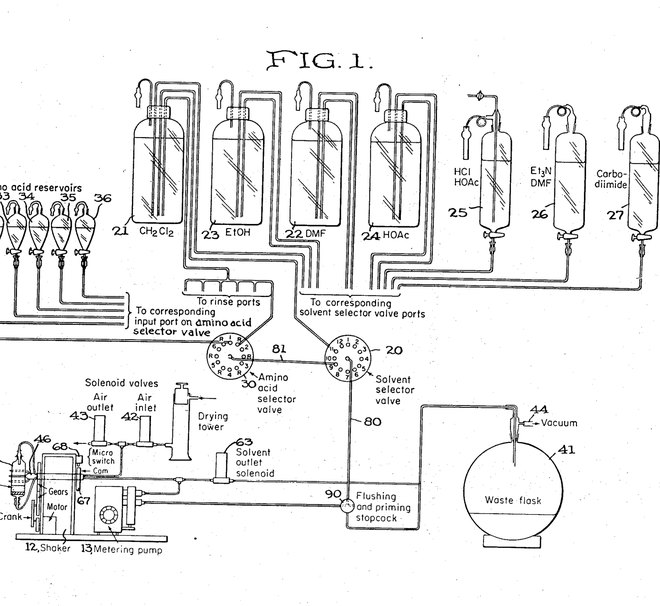
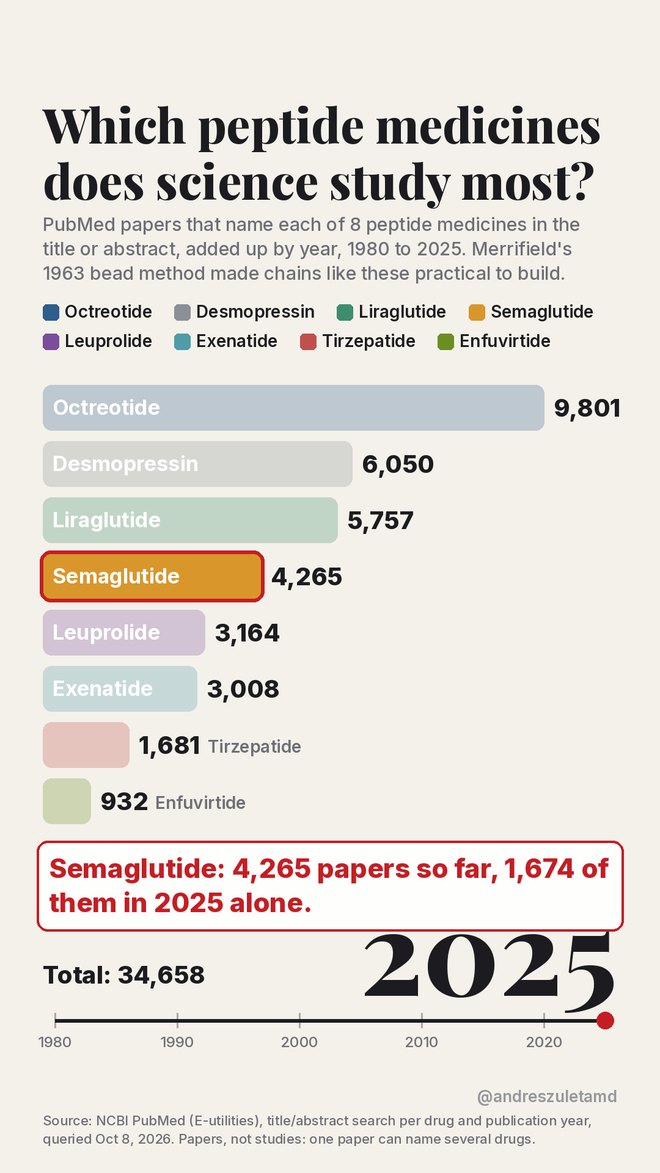
Left: the synthesizer in US Patent 3,531,258, issued September 29, 1970 (public domain). Right: research papers that name 8 peptide medicines, added up by year to 2025 (NCBI PubMed, searched October 8, 2026).
In 1966 his lab built the chains of insulin on beads, the same molecule from Episode 4. In 1969 they built a whole enzyme, ribonuclease A, from scratch: 124 amino acids, 369 chemical reactions and 11,931 lab steps, in about three weeks. In 1984 he received the Nobel Prize in Chemistry, on his own. When the call from Stockholm came, a picture of Wayne Woolley hung over his desk.
The honest part
Building on beads only works if every step is nearly perfect, because misses compound. The Nobel committee put it in numbers: at 90% success per step, 100 steps leave only 0.003% of the right chain; at 99.5% per step, you keep 61%. Even that famous 1969 enzyme came out at about 3% after purification, and Merrifield wrote that he could not claim it was completely pure. Today, long peptides are often built in pieces and then joined.
What it made possible
The committee said the method made thousands of different peptides available, and the same idea is used to build short DNA strands for research. Enfuvirtide, an HIV medicine of 36 amino acids, is made as three fragments built on a solid support and then joined. Tirzepatide, 39 amino acids, is made at kilogram scale with a process that combines solid support and solution steps. As the Smithsonian puts it, much of today's industrial production of complex molecules still relies on Merrifield's reaction.
Two ideas you can use
- Purity is the whole game. A peptide is only as good as every step that built it. For anything called a peptide, a fair question is: how was it made, and how was it tested? For one approved peptide medicine, enfuvirtide, European regulators checked that its impurity limits were justified by safety studies.
- Give good ideas time. Three years with nothing to show, and someone let him keep going. Give yourself, and the people around you, room to fail.
Read my deep dive on drzuleta.com: the physician read on solid phase peptide synthesis
Want a proactive plan for your own health? Join Thrive Nation.
The Peptide Breakthroughs: Previous, Episode 4: the first protein ever read. Next, Episode 6: the race to find the brain's hormones.
Sources: Merrifield RB, J Am Chem Soc 1963;85:2149-2154 (doi.org/10.1021/ja00897a025); Merrifield notebook #321, May 26, 1959 (Science History Institute); Merrifield and Stewart, Nature 1965;207:522; Marglin and Merrifield, J Am Chem Soc 1966;88:5051; Gutte and Merrifield, J Am Chem Soc 1969;91:501; TIME, 1969; Nobel press release, Oct 17, 1984, and Merrifield's Nobel lecture, Dec 8, 1984 (nobelprize.org); Science History Institute, "Wayne Woolley's Marvelously Equipped Mind," May 18, 2021; Rockefeller University, Natural Selections; Smithsonian National Museum of American History; Mitchell AR, LLNL UCRL-PROC-231884, 2007; EMA EPAR, Fuzeon; Frederick MO et al., Org Process Res Dev 2021;25:1628. Chart data: NCBI PubMed, searched Oct 8, 2026.
Educational only, not medical advice.