
The Lizard That Fixed GLP-1: Gila Monster Venom and Exendin-4 (1982 to 2005)
By Andres Zuleta, MD, ThriveMed · Patient and family education
The Gila monster is a shy, beaded lizard of the American Southwest. It spends up to 95 percent of its life underground and can go a long time between meals. It is also the reason one of your own hormones became a medicine.
This is Episode 9 of my 15-part series, The Peptide Breakthroughs. In Episode 8 we met GLP-1, the hormone your gut sends after a meal to tell your pancreas to release insulin. We ended on a problem: natural GLP-1 lasts only a minute or two in the blood. This is the story of how a lizard helped solve it.
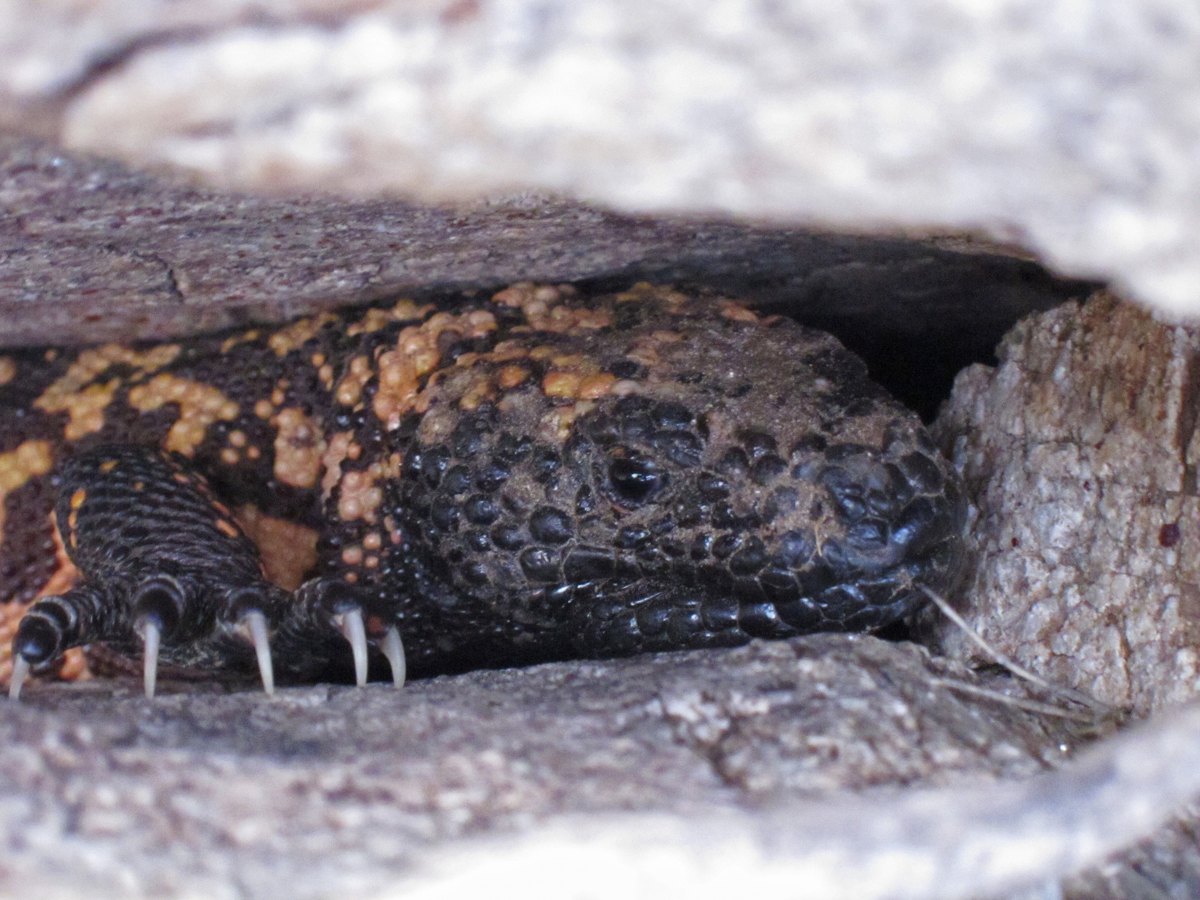
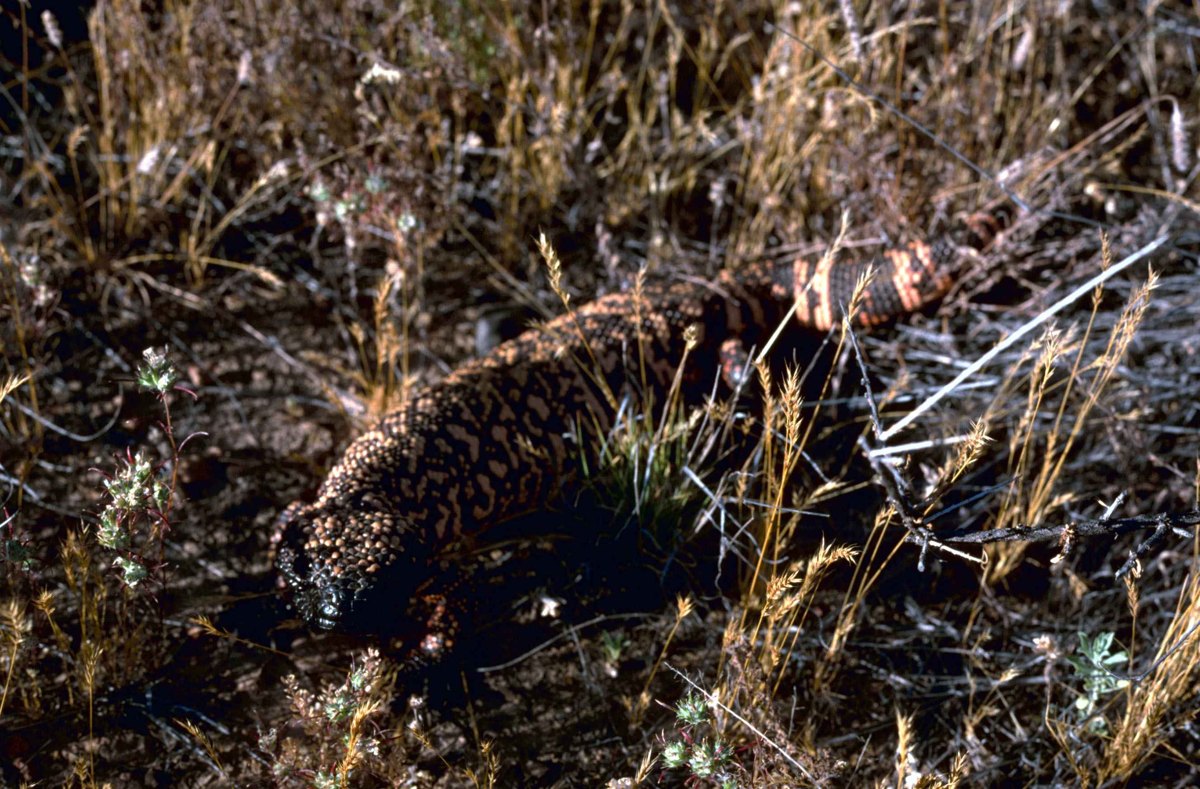
Left: Gila monster, photo by Michael Wifall (CC BY-SA 2.0). Right: Gila monster, photo by Gary M. Stolz, U.S. Fish and Wildlife Service (public domain).
The short version
- The problem: an enzyme called DPP-4 snips the first two amino acids off GLP-1, so it works for only a minute or two.
- The clue: in 1982, a team at the National Institutes of Health showed that Gila monster venom switches on pancreas cells, as if a hormone-like peptide were inside.
- The find: in 1992, John Eng, an endocrinologist at the Bronx VA, found exendin-4 in Gila monster venom. It opens the same receptor as GLP-1.
- The difference: at position two, GLP-1 has alanine, right where the enzyme cuts. Exendin-4 has glycine, and the enzyme slides past. In mice it kept working for more than four hours.
- The medicine: Eng patented it himself, Amylin licensed it in 1996, and in April 2005 a lab-made copy, exenatide, was approved for type 2 diabetes.
Watch the 5-minute story.
The two minute problem
GLP-1 is a short peptide made in the gut. When food arrives, it tells the pancreas to release insulin, mostly when blood sugar is high. That made it look like an ideal medicine. But in 1993, researchers in Germany showed that an enzyme in the blood, DPP-4, removes the first two amino acids of GLP-1. It only cuts when the second amino acid is alanine or proline, and GLP-1 has alanine. Later work in people confirmed how fast it happens: the active hormone is gone in a minute or two.
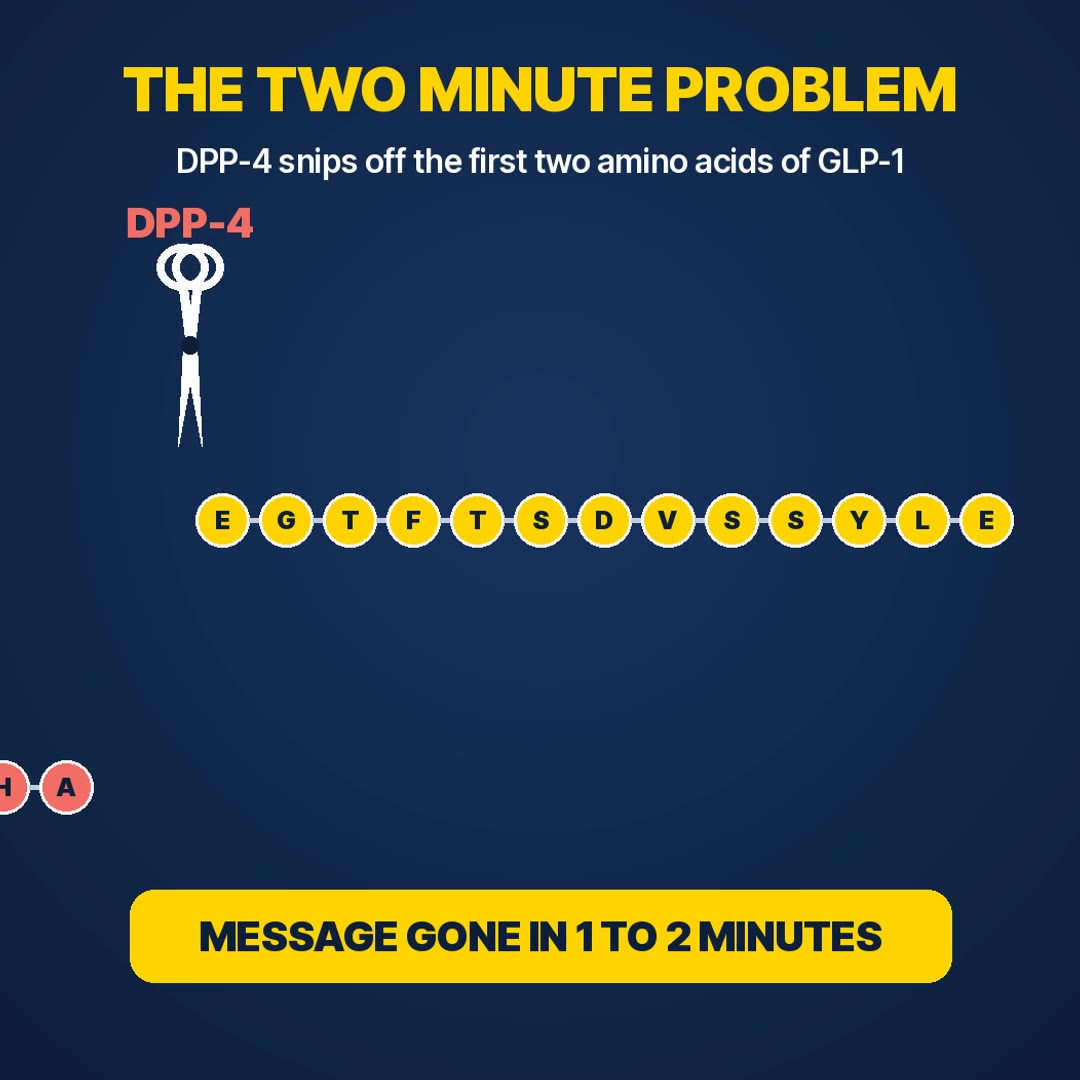
The two minute problem: DPP-4 snips off the first two amino acids of GLP-1 (ThriveMed explainer, based on Mentlein et al., 1993, and Deacon et al., 1995).
A hormone that disappears that quickly is good design for the body. It lets the gut send a quick message about one meal. For a medicine, it is a dead end. Something had to last longer.
Venom in the Bronx
In 1982, Jean-Pierre Raufman and colleagues at the NIH tested Gila monster venom on pancreas cells from guinea pigs. The venom made the cells release their enzymes, as if it contained a peptide that acts like a hormone.
John Eng worked at the Solomon A. Berson Research Laboratory at the VA Medical Center in the Bronx, where his mentor was Rosalyn Yalow, the Nobel laureate from Episode 6. He had built a chemical screen for peptides that start with the amino acid histidine, the signature of the glucagon family that GLP-1 belongs to. He needed a rich source to test it on, so he ordered lizard venom from a company in Utah.
In 1990, working with Raufman, Eng found exendin-3 in the venom of the Mexican beaded lizard. In 1992 he found exendin-4 in the venom of the Gila monster, Heloderma suspectum. Both are 39 amino acids long and differ only at positions two and three.
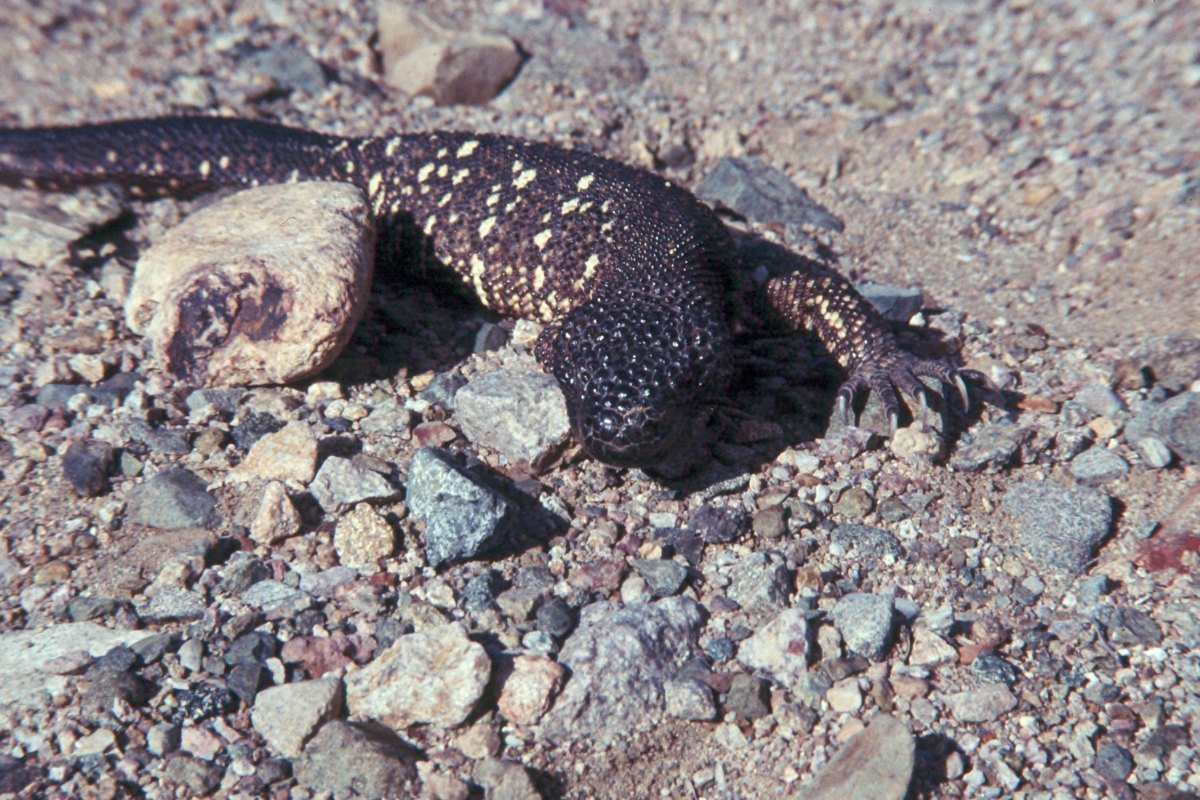
The Mexican beaded lizard, source of exendin-3 (1990). Photo: Warren Garst (CC BY-SA 4.0), via Wikimedia Commons.
Same lock, one letter different
About half of exendin-4's amino acids match human GLP-1. In 1993, a team in Marburg, Germany, working with Eng, showed that exendin-4 binds the GLP-1 receptor on insulin-making beta cells and boosts insulin release when sugar is present. It was a lizard key for a human lock.
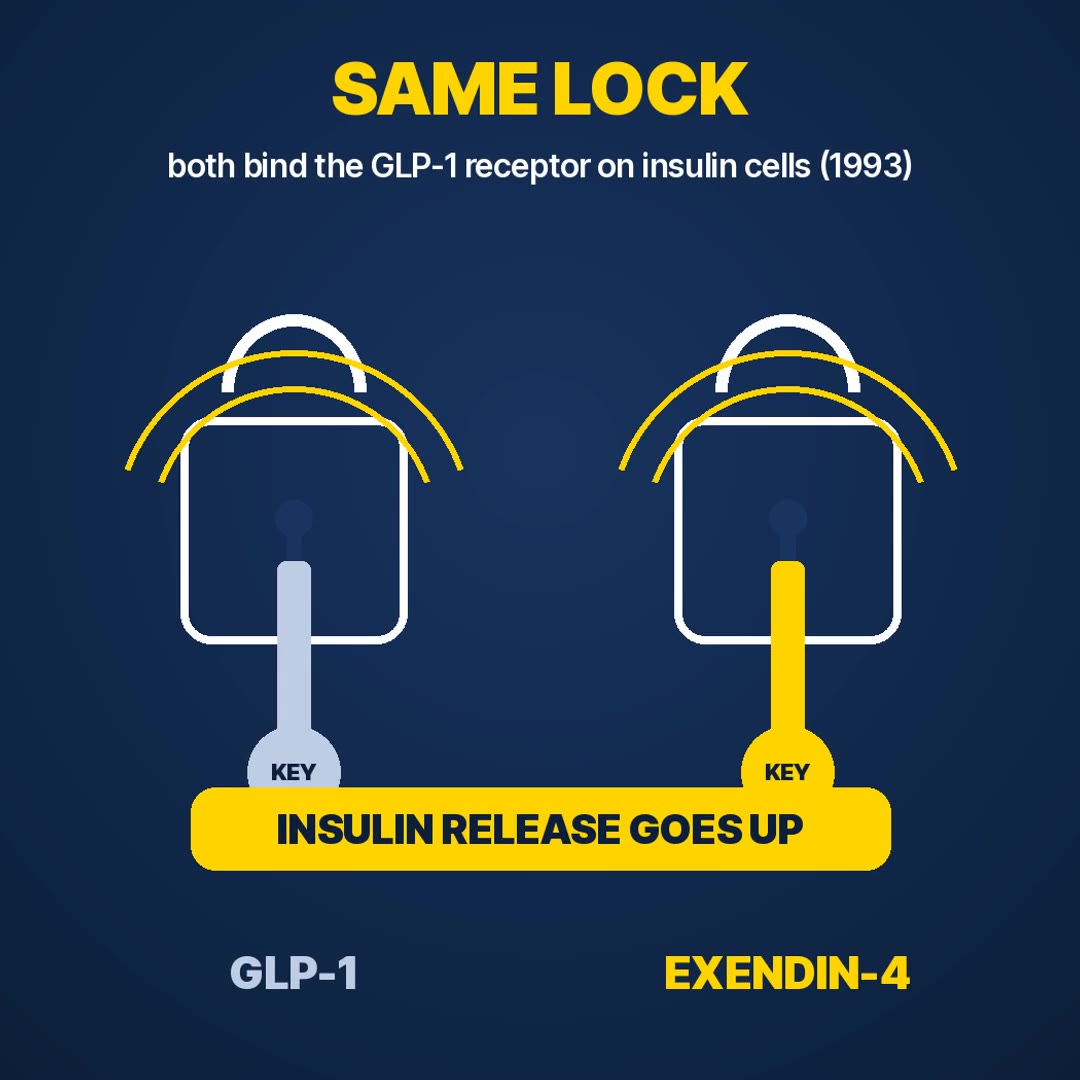
Same lock: GLP-1 and exendin-4 both activate the GLP-1 receptor on insulin cells (ThriveMed explainer, based on Goke et al., 1993).
The difference that matters sits at position two. GLP-1 has alanine there, exactly where DPP-4 cuts. Exendin-4 has glycine, and the enzyme does not cut it. In 1999, researchers at Amylin tested both in diabetic mice: GLP-1's sugar lowering was gone within an hour, while exendin-4's lasted more than four hours.
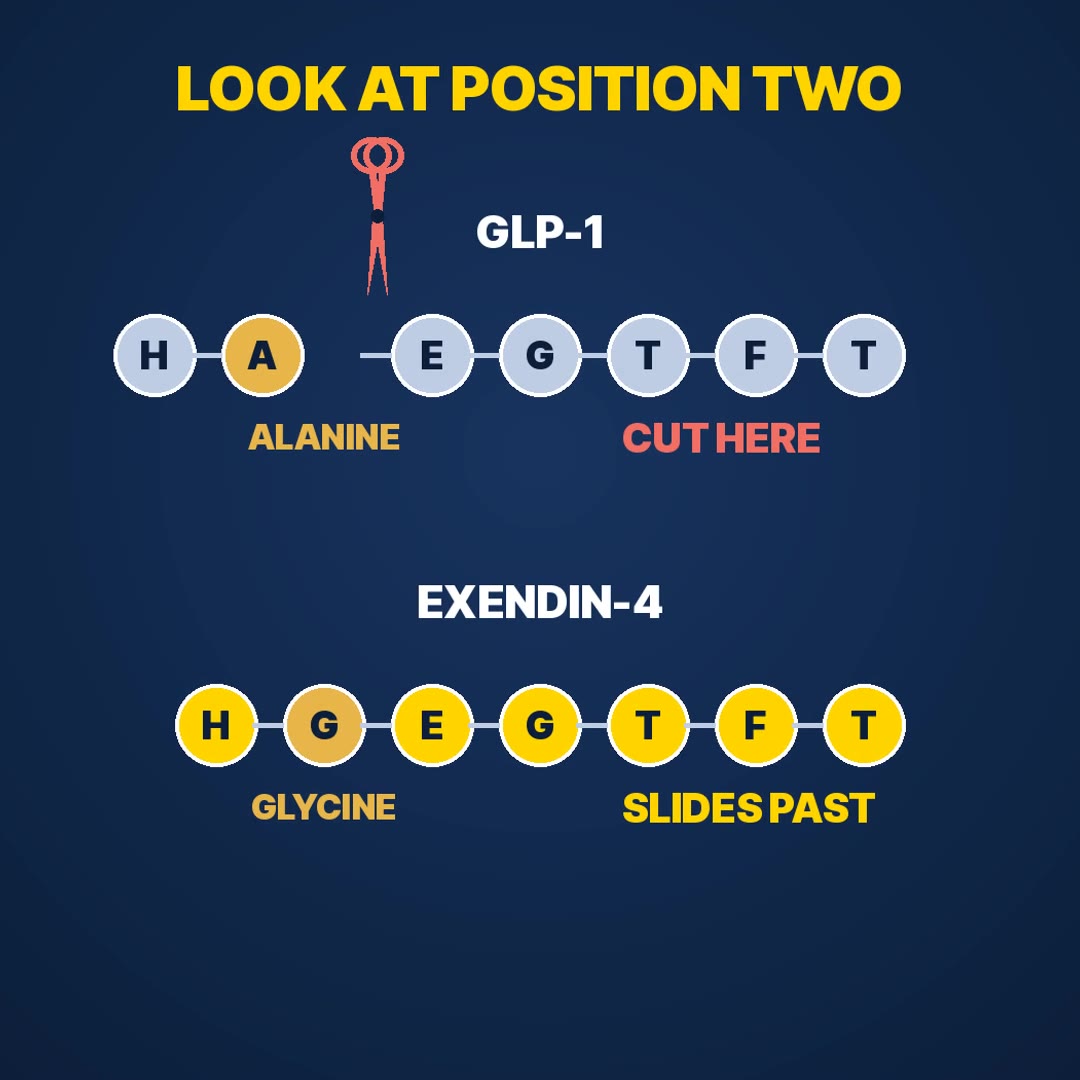
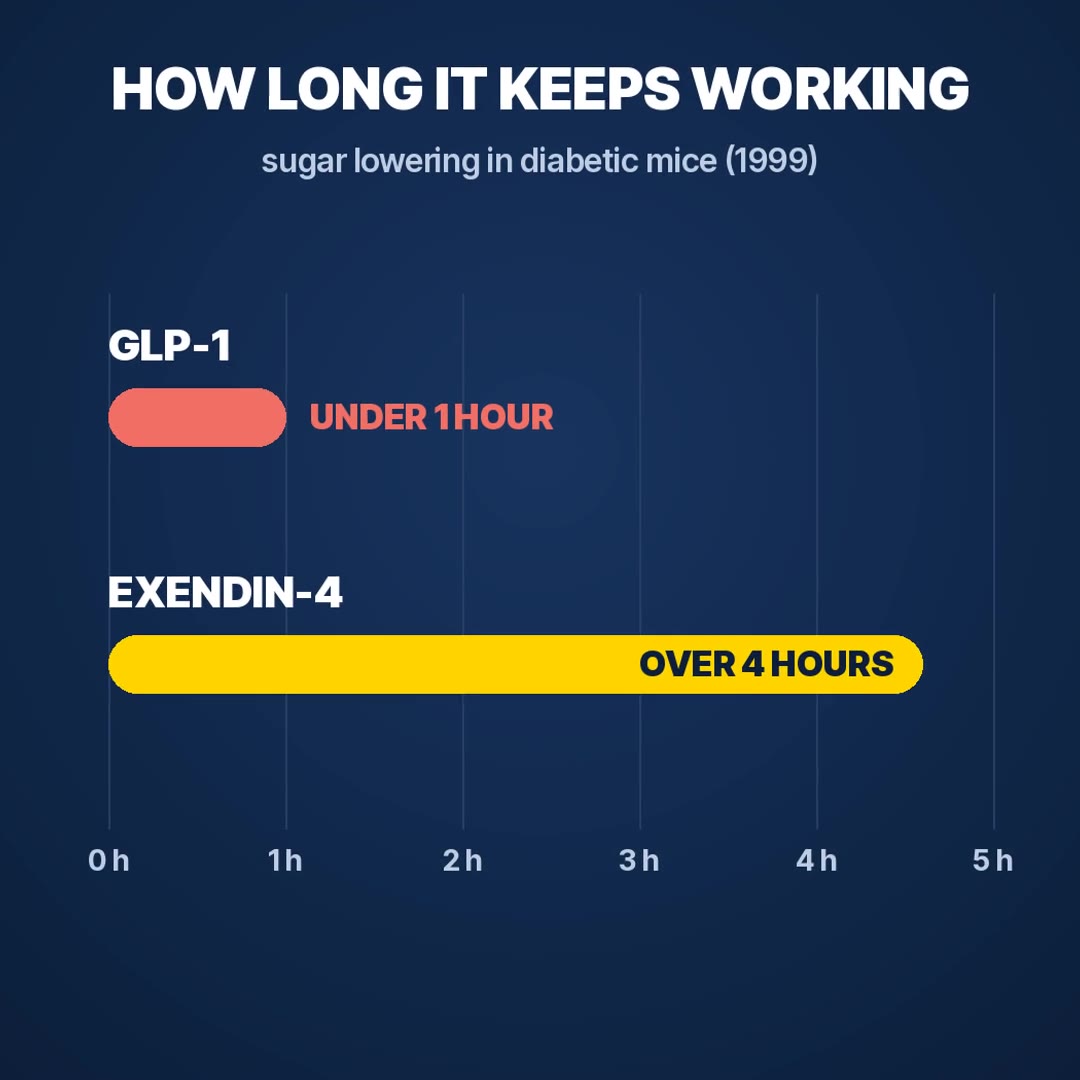
Left: position two decides whether the enzyme cuts (based on Eng et al., 1992, and Mentlein et al., 1993). Right: how long each kept working in diabetic mice (based on Young et al., 1999).
He paid for the patent himself
Eng asked the VA to patent his discovery. The VA declined; at the time, he later explained, inventions had to be specific to veterans. So he paid for the patent himself. US Patent 5,424,286 was filed in May 1993 and issued in June 1995. He took it to drug companies, and most said no. In 1996, Amylin, a small company in San Diego, licensed it.
Amylin made exendin-4 in the lab, amino acid by amino acid, using the chemical peptide synthesis we met in Episode 5. The lab-made version was named exenatide. In a 2003 study in people with type 2 diabetes, exenatide injected twice a day with meals lowered both fasting and after-meal blood sugar, and its effect depended on glucose. In April 2005, the FDA approved exenatide, the first in a new class called incretin mimetics: the first medicine made to act like GLP-1.
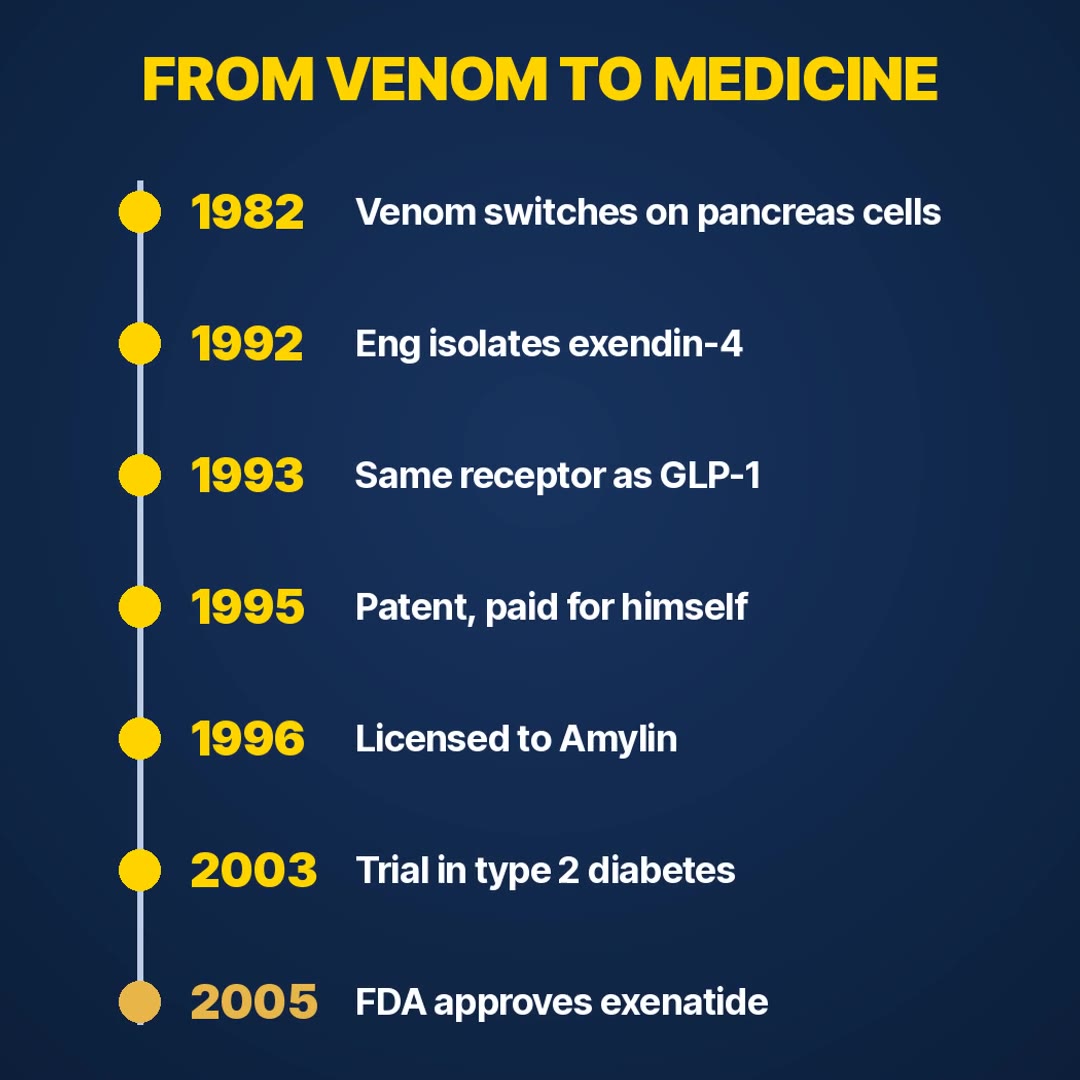
From venom to medicine, 1982 to 2005 (ThriveMed explainer, based on the sources below).
The honest part
- Hours, not days. Exenatide lasted hours, so it had to be injected twice a day.
- Side effects are real. In the trials, nausea was the most common side effect, along with other stomach and gut effects.
- It is a prescription medicine, used under a doctor's care, and it is made in a lab, not from lizards.
- Many hands. Raufman's venom work, Eng's screen, the Marburg team, NIH and NIA researchers and Amylin's scientists all moved it forward.
What the research looks like now
Exendin-4 started a new kind of medicine. Among the medicines that began in venom or leech saliva, it is now the second most studied in PubMed, behind captopril, which came from a Brazilian pit viper. And the two minute problem now has two answers: drugs that resist the enzyme, and pills that block it.
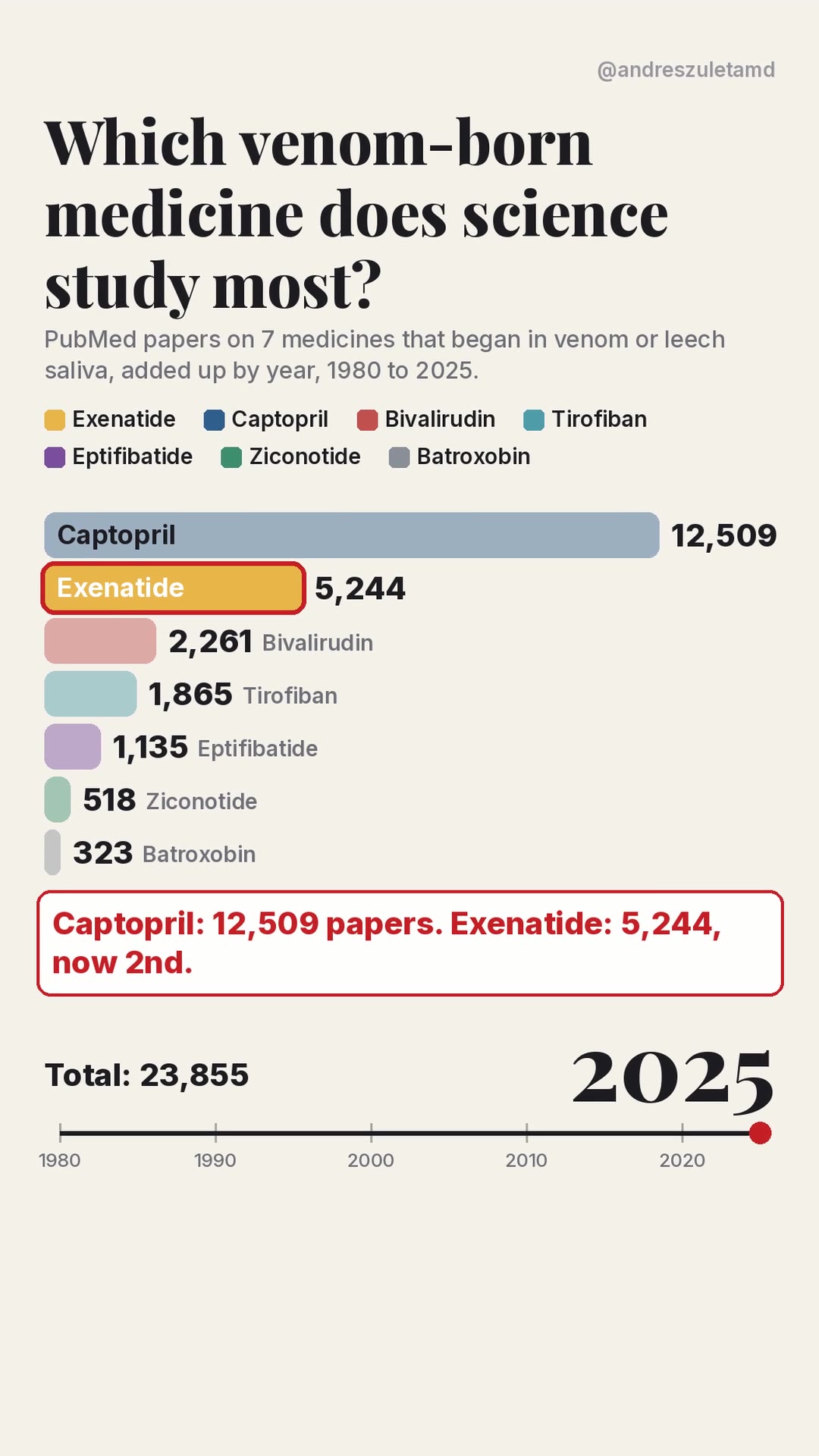
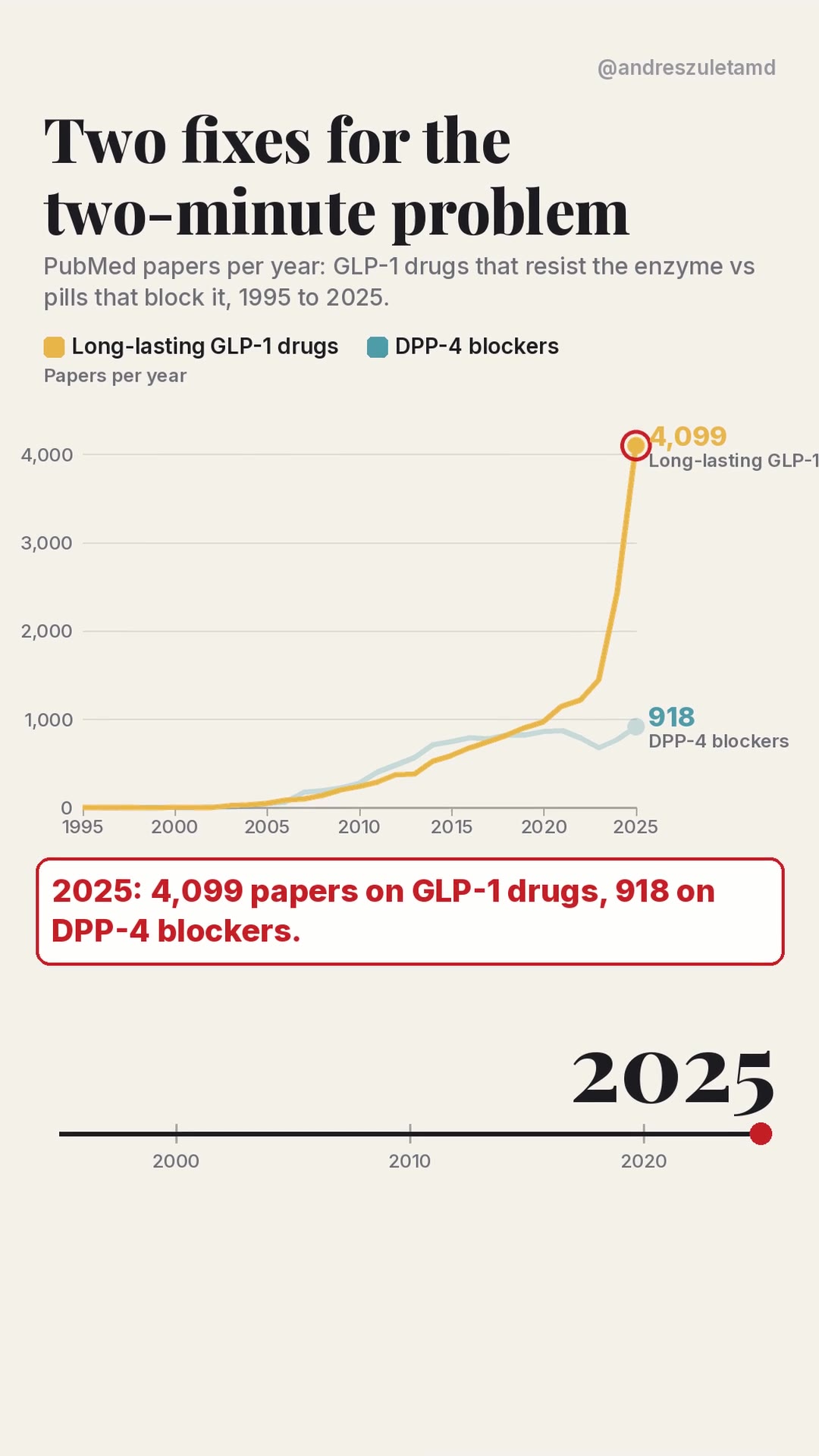
Left: PubMed papers on 7 medicines that began in venom or leech saliva, added up by year. Right: papers per year on GLP-1 drugs versus DPP-4 blockers (NCBI PubMed, title and abstract search, queried Oct 11, 2026; papers, not studies).
Two ideas you can use
- Many of your hormones are meant to be brief. A quick signal for one meal is cleared in minutes on purpose. It is one reason a single blood test can miss what your body is doing across a day.
- Stay curious about odd places. A medicine for a very human problem came from a lizard that barely eats. Good questions often start with something that looks irrelevant.
Next in the series, Episode 10: how scientists made GLP-1 last a day, and then a week.
Want a proactive plan for your own health? Join Thrive Nation.
For the physician's version of this story: A lizard, one amino acid and a self-paid patent: a physician's read
Sources
- Raufman JP, Jensen RT, Sutliff VE, Pisano JJ, Gardner JD. Actions of Gila monster venom on dispersed acini from guinea pig pancreas. Am J Physiol 1982;242:G470.
- Eng J, Andrews PC, Kleinman WA, Singh L, Raufman JP. Purification and structure of exendin-3. J Biol Chem 1990;265:20259.
- Eng J, Kleinman WA, Singh L, Singh G, Raufman JP. Isolation and characterization of exendin-4 from Heloderma suspectum venom. J Biol Chem 1992;267:7402.
- Goke R, Fehmann HC, Linn T, et al. Exendin-4 is a high potency agonist at the GLP-1 receptor. J Biol Chem 1993;268:19650.
- Mentlein R, Gallwitz B, Schmidt WE. Dipeptidyl peptidase IV cleaves GLP-1. Eur J Biochem 1993;214:829.
- Deacon CF, et al. Degradation of GLP-1 in people. Diabetes 1995;44:1126.
- Young AA, et al. Glucose-lowering and insulin-sensitizing actions of exendin-4. Diabetes 1999;48:1026.
- US Patent 5,424,286 (John Eng), issued June 13, 1995.
- Kolterman OG, et al. Synthetic exendin-4 (exenatide) in type 2 diabetes. J Clin Endocrinol Metab 2003;88:3082.
- Amylin Pharmaceuticals and Eli Lilly, FDA approval of exenatide, April 2005.
- National Institute on Aging, "Exendin-4: From lizard to laboratory...and beyond."
- The New York Times, Sep 21, 2002, and May 1, 2005.
Photos: Michael Wifall (CC BY-SA 2.0), Warren Garst (CC BY-SA 4.0), via Wikimedia Commons; Gary M. Stolz, U.S. Fish and Wildlife Service (public domain). Explainers and charts: ThriveMed.
Educational only, not medical advice. Andres Zuleta, MD, ThriveMed.