
By Andres Zuleta, MD, ThriveMed · Patient and family education
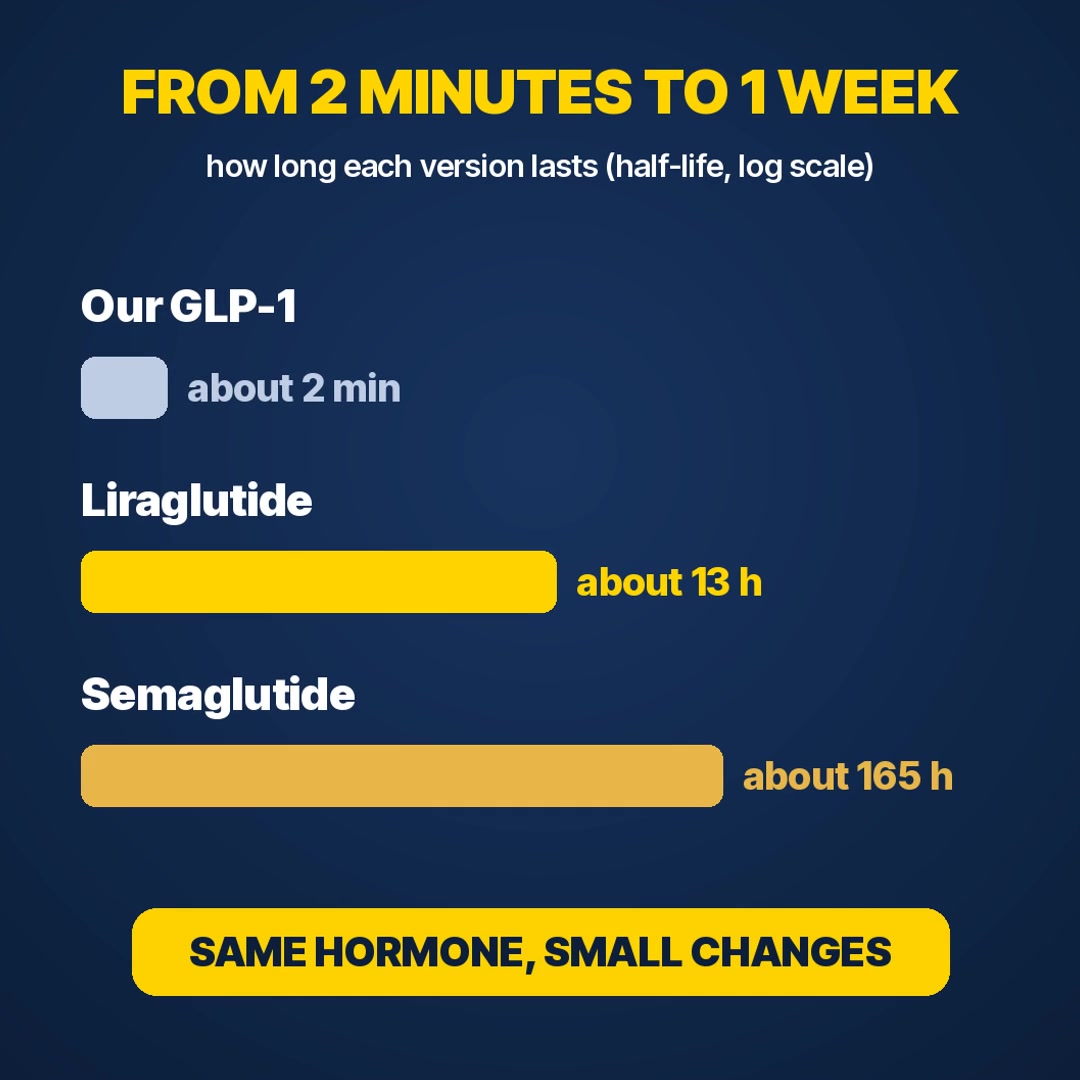
Our own GLP-1 lasts about two minutes in the blood. Today, a medicine built from it lasts about a week. The trick that closed that gap was a protein already in our blood.
This is Episode 10 of my 15-part series, The Peptide Breakthroughs. In Episode 8 we met GLP-1, the gut hormone that tells the pancreas to release insulin after a meal. In Episode 9, a peptide from Gila monster venom resisted the enzyme that cuts GLP-1, but it still lasted only hours, so it was injected twice a day. This is the story of how scientists made GLP-1 last a whole day, and then a whole week.
The short version
- The goal: in the 1990s, a team at Novo Nordisk in Denmark, led by Lotte Bjerre Knudsen, set out to make a GLP-1 that stays active for 24 hours after one injection under the skin.
- The idea: attach a fatty acid tail, so GLP-1 rides on albumin, the most abundant protein in our blood.
- A day: liraglutide lasted about 13 hours after injection. It was approved in Europe in 2009 and in the US in January 2010, the first once a day GLP-1 medicine.
- A week: semaglutide got one more amino acid swap and a longer tail. Its half-life is about 165 hours. The FDA approved it in December 2017.
Watch the 5-minute story.
Why two minutes was the problem
Two things clear GLP-1 fast. An enzyme called DPP-4 snips off its first two amino acids, and the kidneys filter small peptides out of the blood. Injected into a vein, natural GLP-1 has a half-life of about one and a half minutes. Even injected under the skin, its half-life is only about an hour to an hour and a half.
A bus in the blood
Albumin is a large protein that carries many things through our blood, including fatty acids. I like to think of it as a bus. If GLP-1 carried a fatty acid tail, it could hop on. While it rides, it is too big for the kidneys to filter, and the enzyme has a hard time reaching it. Then it hops off, a little at a time, and does its job.
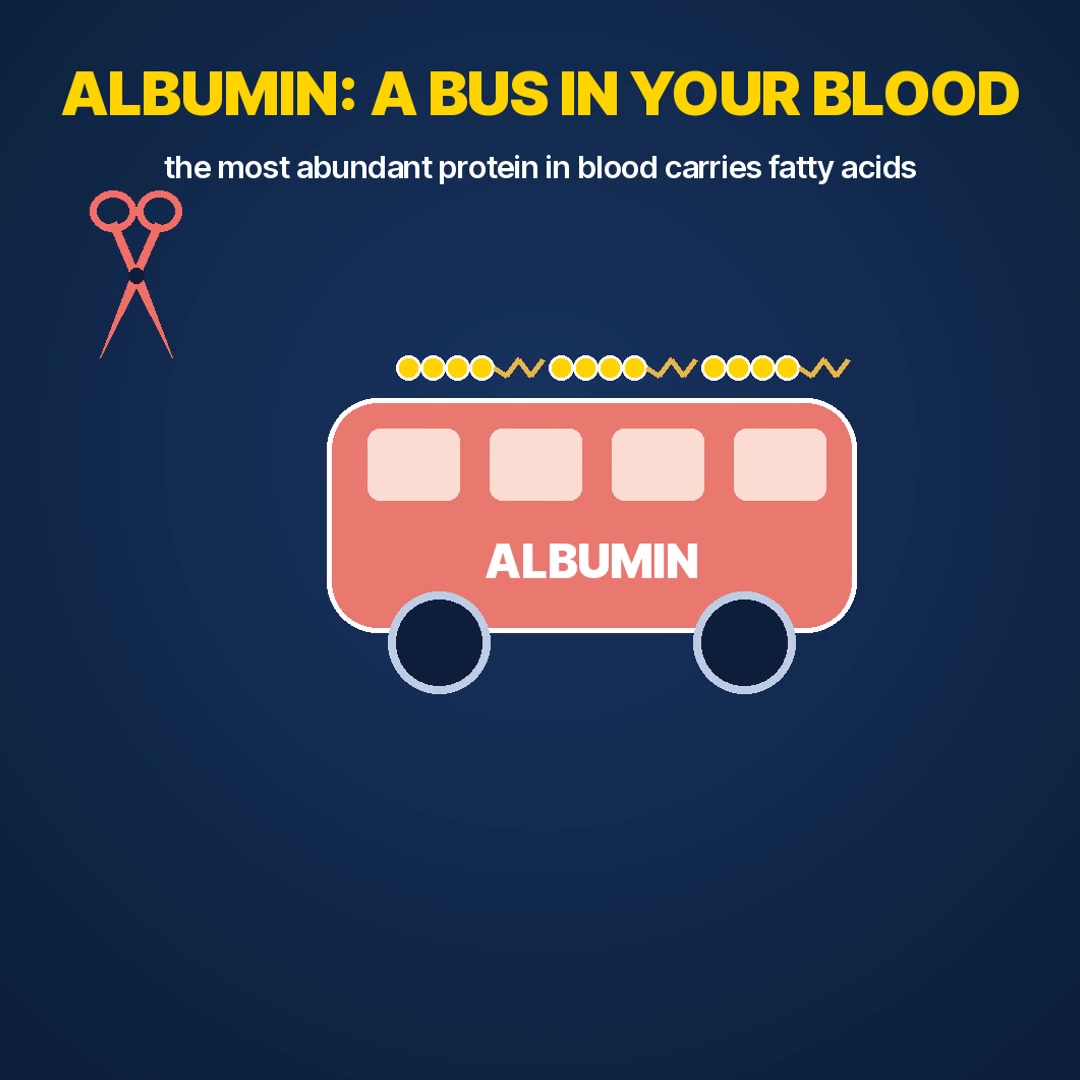
In 2000, the Novo Nordisk team published that fatty acids of 12 carbons or longer made GLP-1 act far longer, long enough for once a day dosing. They chose to stay very close to human GLP-1: they swapped a single amino acid and attached a 16 carbon fatty acid through a small linker. They called it liraglutide. In healthy volunteers, its half-life was about 13 hours.
The catch: the bus can hold on too tightly
Only GLP-1 that is off the bus can switch on its receptor. If albumin holds on too tightly, too little is free to work. So the chemistry was always a balance between protection and activity.
From a day to a week
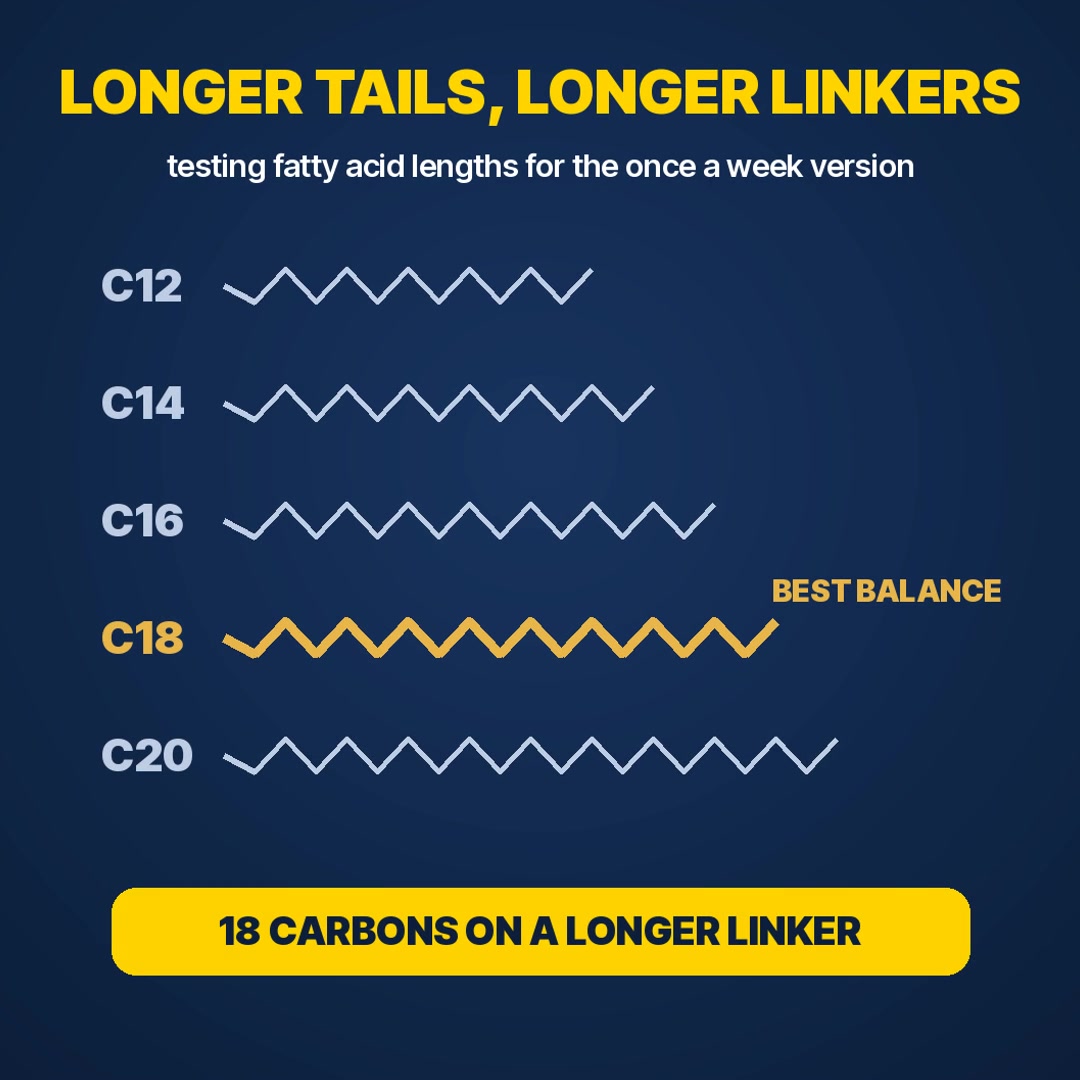
For the once a week version, the team went back to position two, the exact spot where DPP-4 cuts, the same spot that mattered in the lizard story. They swapped the alanine there for a building block the enzyme cannot cut, called Aib (aminoisobutyric acid). Then they tested longer tails and longer, flexible linkers. The winner was an 18 carbon fatty acid on a longer linker, which grips albumin more strongly but still lets go. They went through about 4,000 compounds to find it. They called it semaglutide. Its half-life is about 165 hours, about a week, and the FDA approved it in December 2017 for type 2 diabetes as a once weekly injection.
The honest part
- Liraglutide and semaglutide are prescription medicines, used under a doctor's care.
- Nausea and other stomach effects are the most common side effects.
- Large heart outcome trials, LEADER and SUSTAIN-6, came later and studied people with type 2 diabetes.
- The right choice always depends on the person.
What the research looks like now
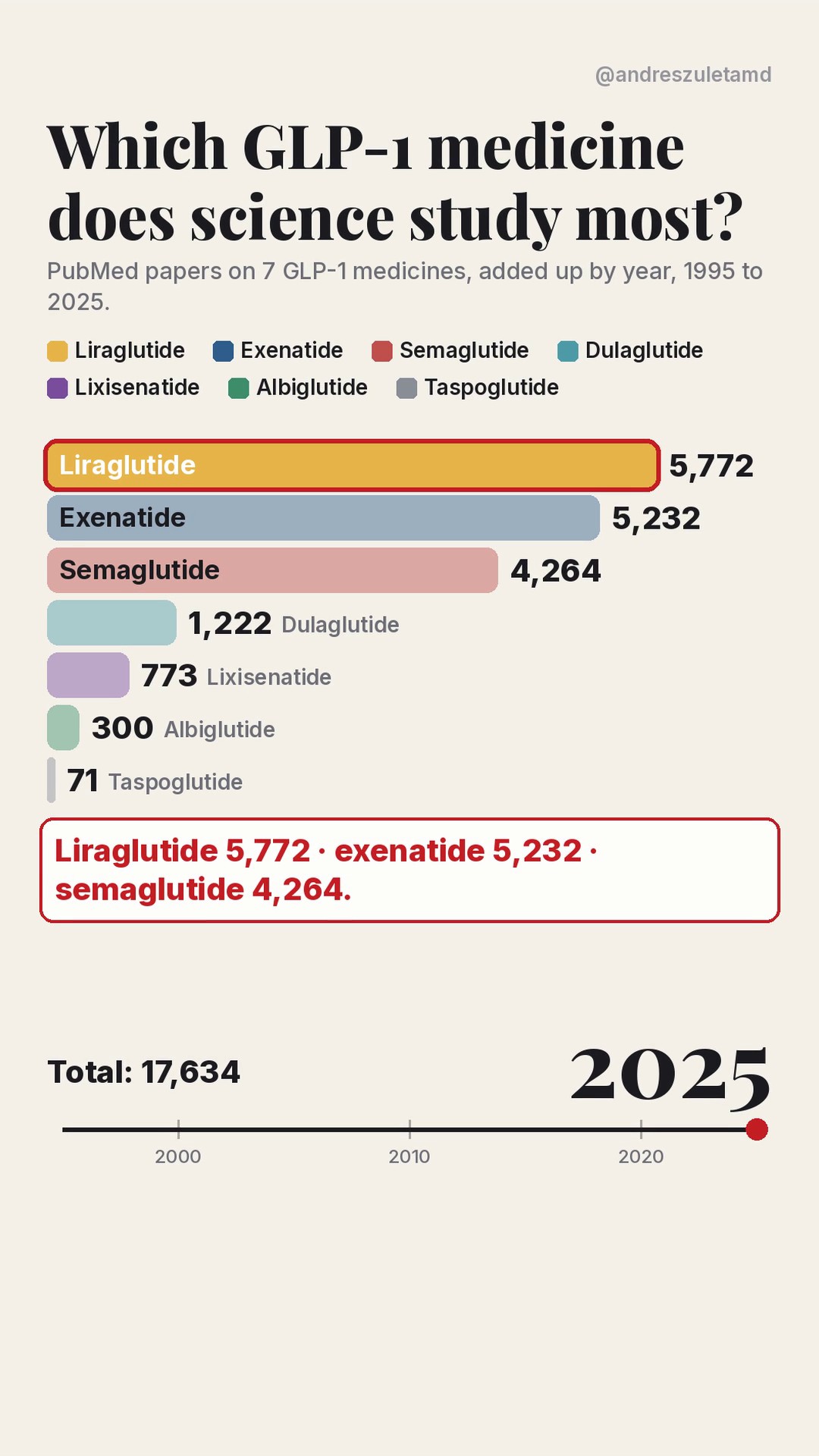
In PubMed, liraglutide now has 5,772 papers, more than any other GLP-1 medicine. Semaglutide, approved seven years later, already has 4,264, and since 2024 it gets more new papers each year than liraglutide.
Many hands
Credit belongs to many hands: Lotte Bjerre Knudsen, the chemist Jesper Lau, and many teams at Novo Nordisk, building on the GLP-1 discoveries before them. In 2024, Knudsen shared the Lasker award with Joel Habener and Svetlana Mojsov.
Two ideas you can use
- Timing matters. How long a signal lasts can matter as much as the signal itself.
- Small changes can be huge. One swapped amino acid and one fatty tail changed a hormone that lasts minutes into a medicine that lasts a week.
A physician's take on the same story, for clinicians: A fatty tail and a protein bus: a physician's read
Next time: how a medicine made for blood sugar opened a door to appetite and body weight.
Sources
- Knudsen LB, et al. Potent derivatives of glucagon-like peptide-1 with pharmacokinetic properties suitable for once daily administration. J Med Chem 2000;43:1664. PMID 10794683.
- Knudsen LB, Lau J. The discovery and development of liraglutide and semaglutide. Front Endocrinol 2019;10:155. PMID 31031702.
- Elbrønd B, et al. Pharmacokinetics of NN2211 (liraglutide) in healthy men. Diabetes Care 2002;25:1398. PMID 12145241.
- Lau J, et al. Discovery of the once-weekly GLP-1 analogue semaglutide. J Med Chem 2015;58:7370. PMID 26308095.
- Granhall C, et al. Semaglutide pharmacokinetics. Clin Pharmacokinet 2019;58:781. PMID 30565096.
- Marso SP, et al. LEADER. N Engl J Med 2016;375:311. PMID 27295427. Marso SP, et al. SUSTAIN-6. N Engl J Med 2016;375:1834. PMID 27633186.
- Drugs@FDA: NDA 022341 (liraglutide, January 25, 2010); NDA 209637 (semaglutide, December 5, 2017).
- Lasker Foundation, 2024 Lasker-DeBakey Clinical Medical Research Award (Habener, Mojsov, Knudsen).
- PubMed counts: NCBI E-utilities, title and abstract search, queried October 12, 2026. Papers, not studies.
Educational only, not medical advice. Andres Zuleta, MD, ThriveMed.