
A Hormone Hiding Inside a Gene: How GLP-1 Was Found (1964 to 1987)
By Andres Zuleta, MD, ThriveMed · Patient and family education
In the late summer of 1983, a chemist in Boston studied a printout of a gene, a long string of letters, and saw something others had missed. Years later she said, "I just looked at it, and it was obvious." What she saw became the starting point for a whole family of modern medicines.
This is Episode 8 of my 15-part series, The Peptide Breakthroughs. It is the story of GLP-1: a gut hormone that was hiding, for years, inside a gene everyone thought they understood.


Left: Svetlana Mojsov (photo: The Rockefeller University). Right: Joel Habener (photo: Lasker Foundation, 2024 award).
The short version
- The puzzle: in 1964, researchers found that sugar you swallow releases much more insulin than the same sugar put straight into a vein. The gut had to be sending the pancreas a message, an "incretin."
- The clue: in 1982, Joel Habener's team at Massachusetts General Hospital read the glucagon gene of an anglerfish and found a second, similar sequence right next to glucagon. In 1983, Graeme Bell named the hidden pieces GLP-1 and GLP-2.
- The insight: Svetlana Mojsov saw that the active GLP-1 starts later than everyone assumed, 31 amino acids, not 37, and built it by hand.
- The proof: in 1987, labs in Boston, Copenhagen and London showed the short form releases insulin, in a rat pancreas, in pig gut and in people.
- The honest part: natural GLP-1 lasts only a minute or two in the blood, credit was messy, and today's GLP-1 medicines are prescription medicines with real side effects.
Watch the 5-minute story.
A puzzle about eating
In 1964, two research groups ran a simple comparison. Give a person sugar by mouth, and the pancreas releases a lot of insulin. Put the same sugar straight into a vein, and it releases much less. The only difference was the gut. So the gut must be sending the pancreas a message when food arrives, something like a text that says: food is on the way, get ready. Scientists called that kind of message an incretin. For twenty years, nobody could pin down the main one.
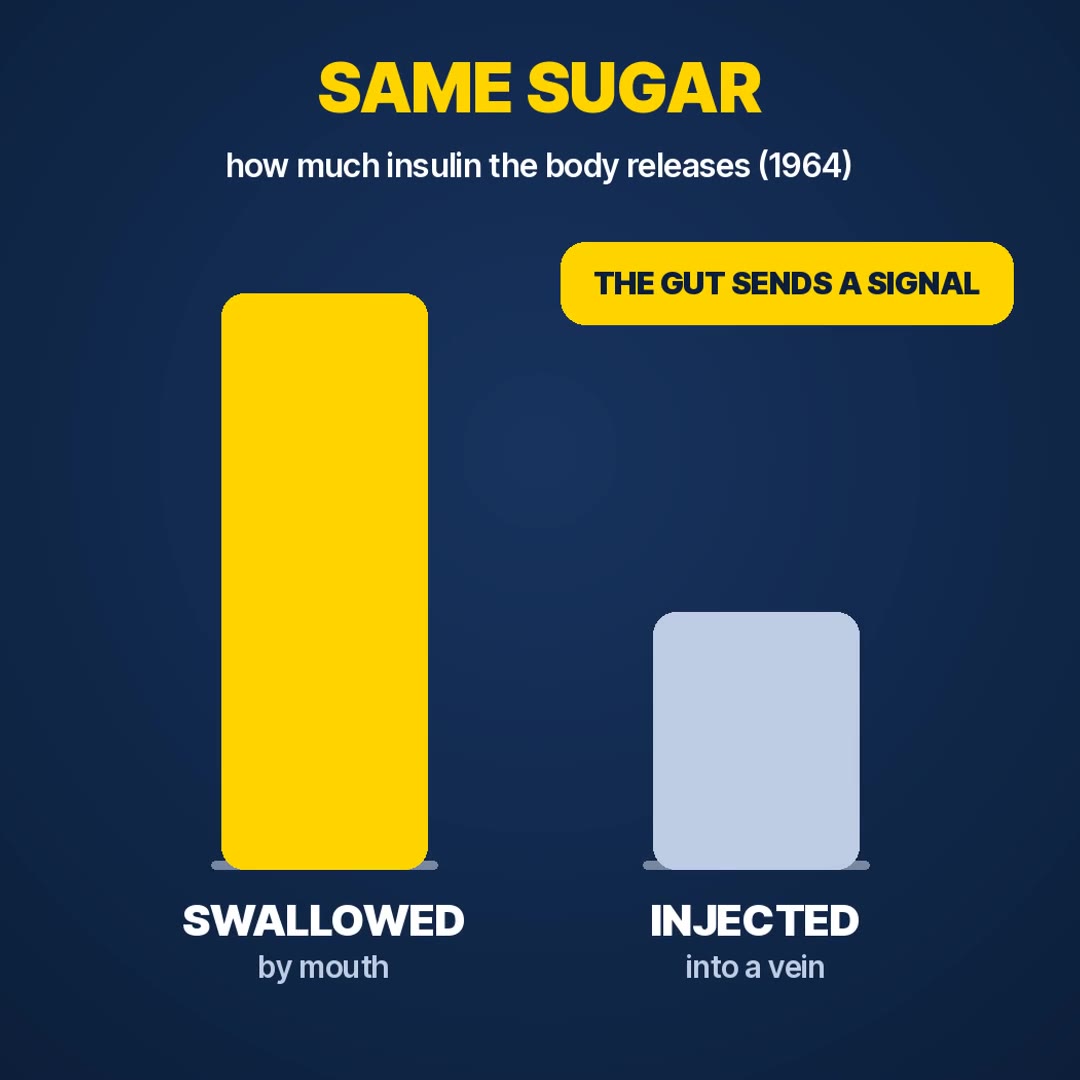
Same sugar, more insulin when you swallow it (ThriveMed explainer, based on Elrick et al. and McIntyre et al., 1964).
The clue from a fish
Glucagon is the hormone that raises blood sugar, insulin's partner. In Boston, Joel Habener wanted to read its gene. At the time, the new rules for recombinant DNA (from Episode 7) limited work on mammal genes, so his team turned to the anglerfish, which has a special organ packed with glucagon.
In January 1982 they reported a surprise. The gene held glucagon and, right after it, a second, similar sequence, with the kind of cut sites the body uses to slice a long chain into pieces. Think of a sentence with hidden words inside it. A year later, Graeme Bell's group in California found the same thing in hamsters and in humans, two glucagon-like pieces, and named them GLP-1 and GLP-2. The hidden sequence even resembled secretin, the very first hormone ever found, from Episode 1.
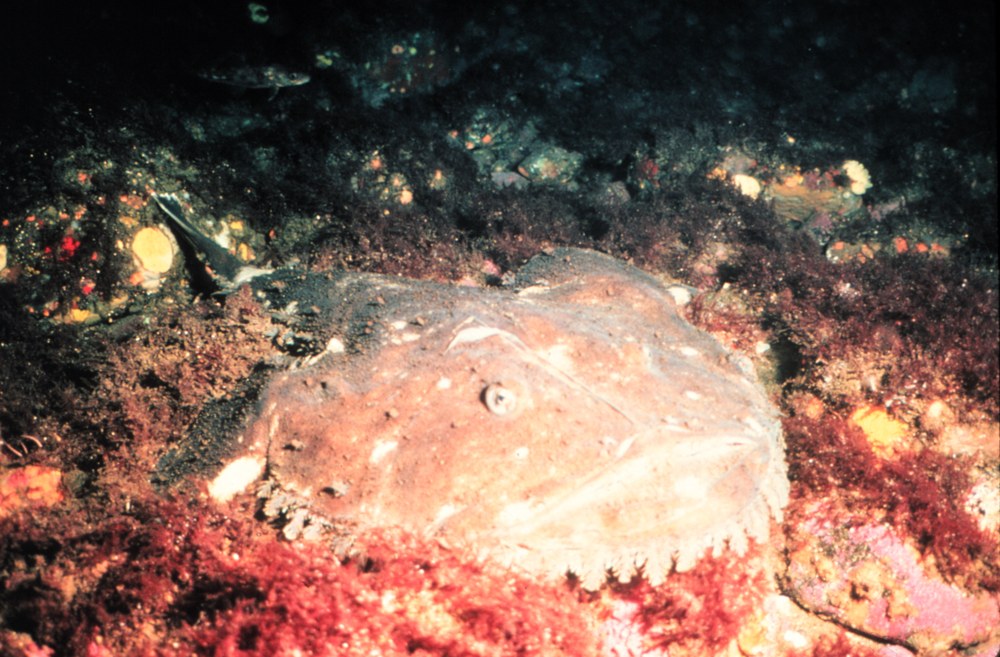
An anglerfish (goosefish), Georges Bank. Photo: NOAA National Undersea Research Program (public domain).
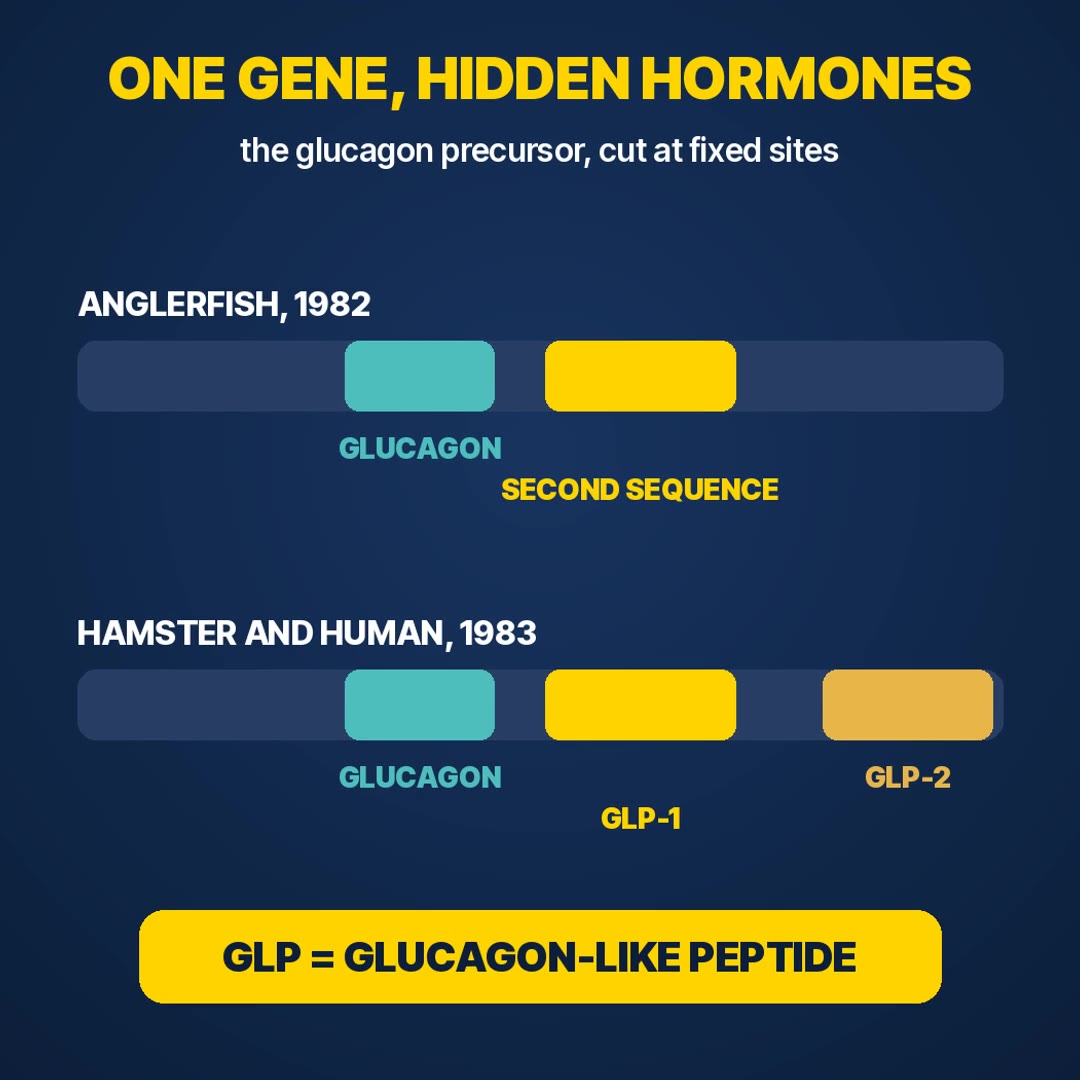
One gene, several messages: the glucagon precursor is cut at fixed sites (ThriveMed explainer, based on Lund et al., 1982, and Bell et al., 1983).
The chemist who saw it
Svetlana Mojsov grew up in the former Yugoslavia. At The Rockefeller University she was the first woman graduate student in the lab of Bruce Merrifield, whose bead method for building peptides we met in Episode 5. People said glucagon could not be built that way. She built it.
In 1983 she moved to Massachusetts General Hospital to run a lab that made peptides. Looking at Bell's sequence, she saw a likely cut point that others had missed. The active GLP-1, she reasoned, should start later and be shorter: 31 amino acids, not 37. She made pieces of it by hand on the bead, made antibodies against them, and set up a radioimmunoassay, Rosalyn Yalow's method from Episode 6. With those tools she showed that the short form really exists in the gut.
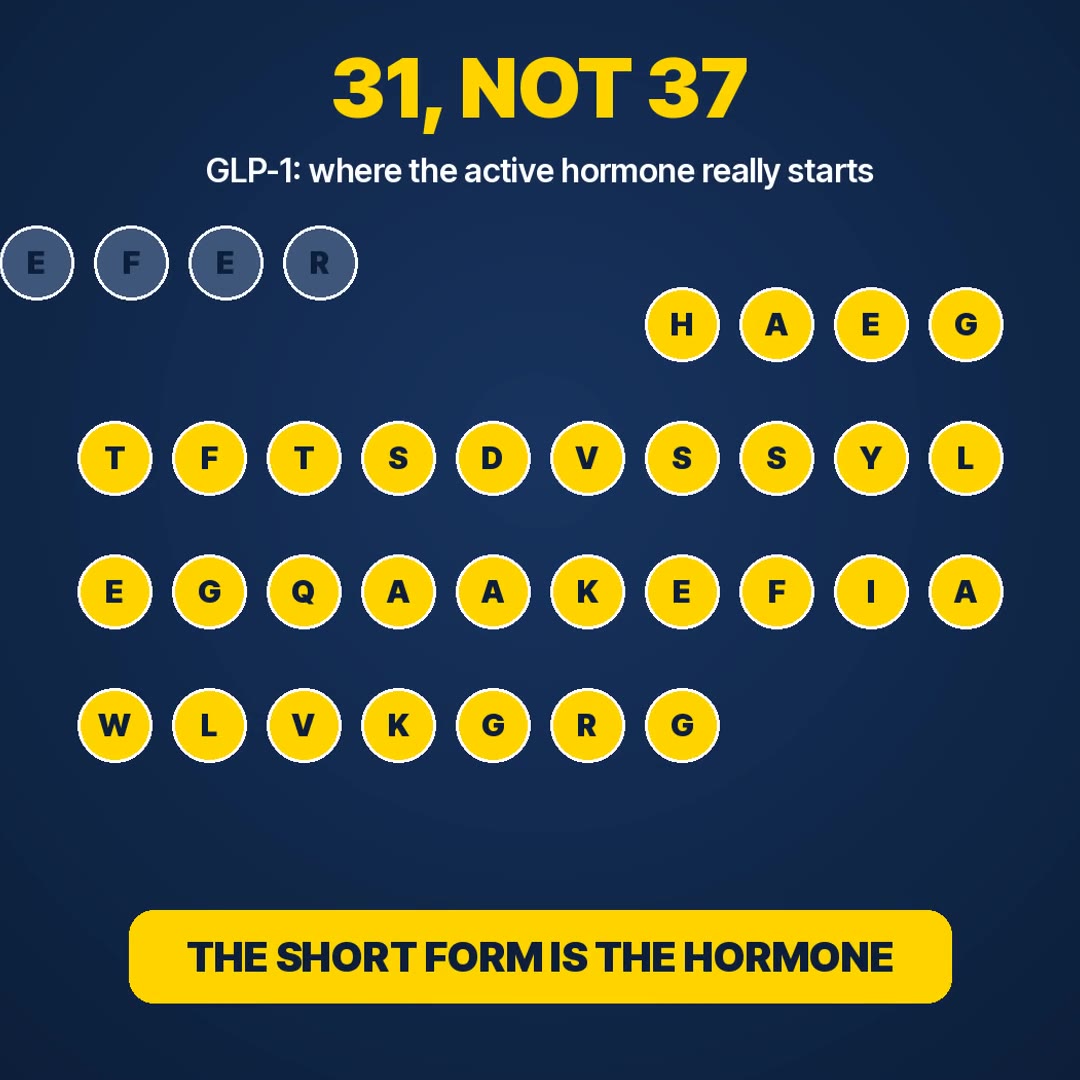
31, not 37: the short form is the hormone (ThriveMed explainer, based on Mojsov et al., 1986 and 1987).
1987: three cities, one answer
In February 1987, Mojsov, Gordon Weir and Habener published the test. In a rat pancreas, the short form made insulin release jump at tiny amounts. The long form did nothing, even at ten thousand times more. Weeks earlier, Jens Holst's team in Copenhagen had found the same short peptide in pig gut, on their own, and shown it releases insulin. In December, Stephen Bloom's team in London gave it to seven volunteers: their insulin rose and their blood sugar fell. The missing message finally had a name.
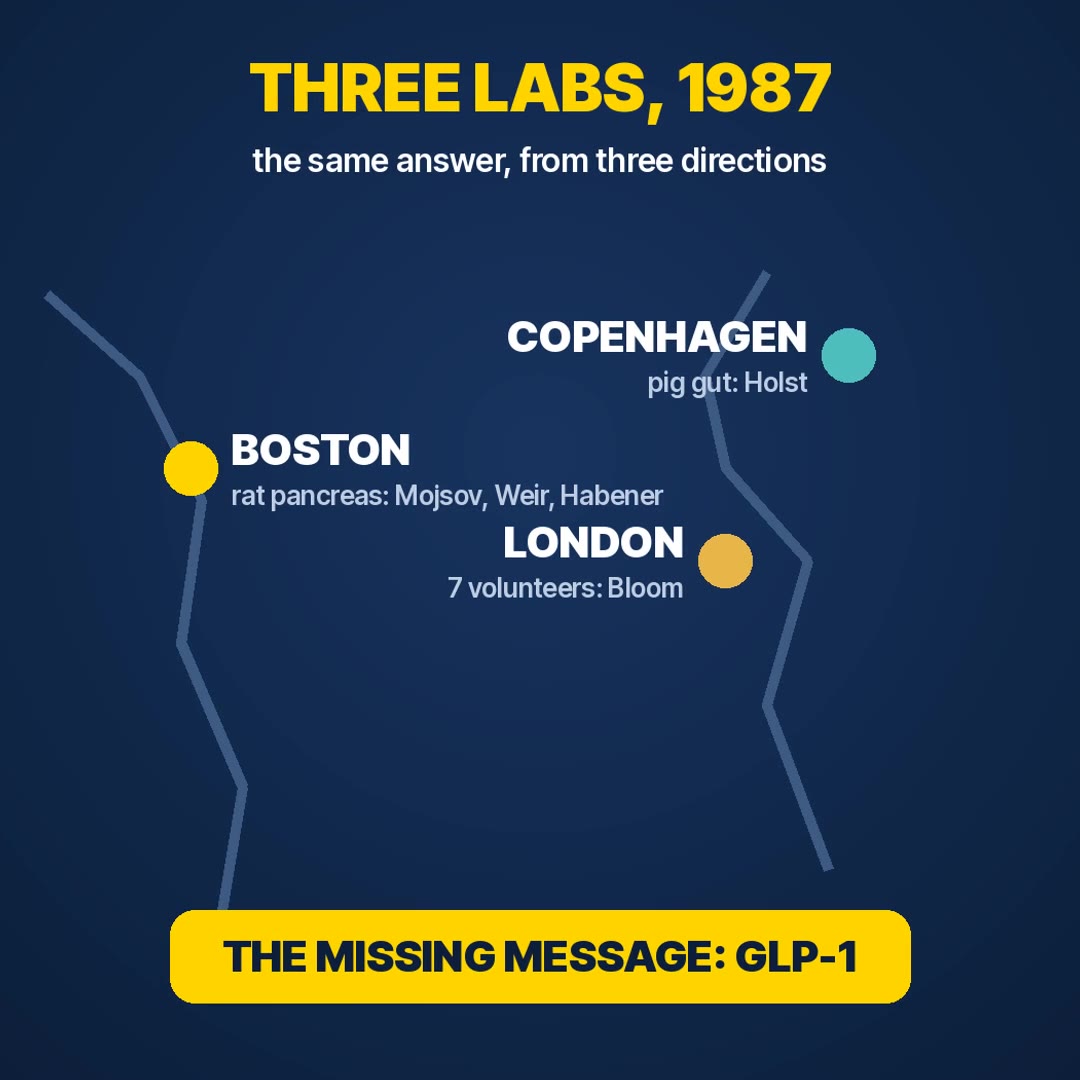
Three labs, three directions, one answer (ThriveMed explainer, based on Mojsov et al., Holst et al. and Kreymann et al., 1987).
A thermostat, not an on switch
Then came the most elegant part. GLP-1 pushes insulin mostly when blood sugar is high. In 1993, a German team gave it to ten people with poorly controlled type 2 diabetes. Their fasting sugar came down to normal within four hours, and then insulin eased off. It works like a thermostat, not an on switch. GLP-1 also lowers glucagon, slows the stomach and signals fullness.
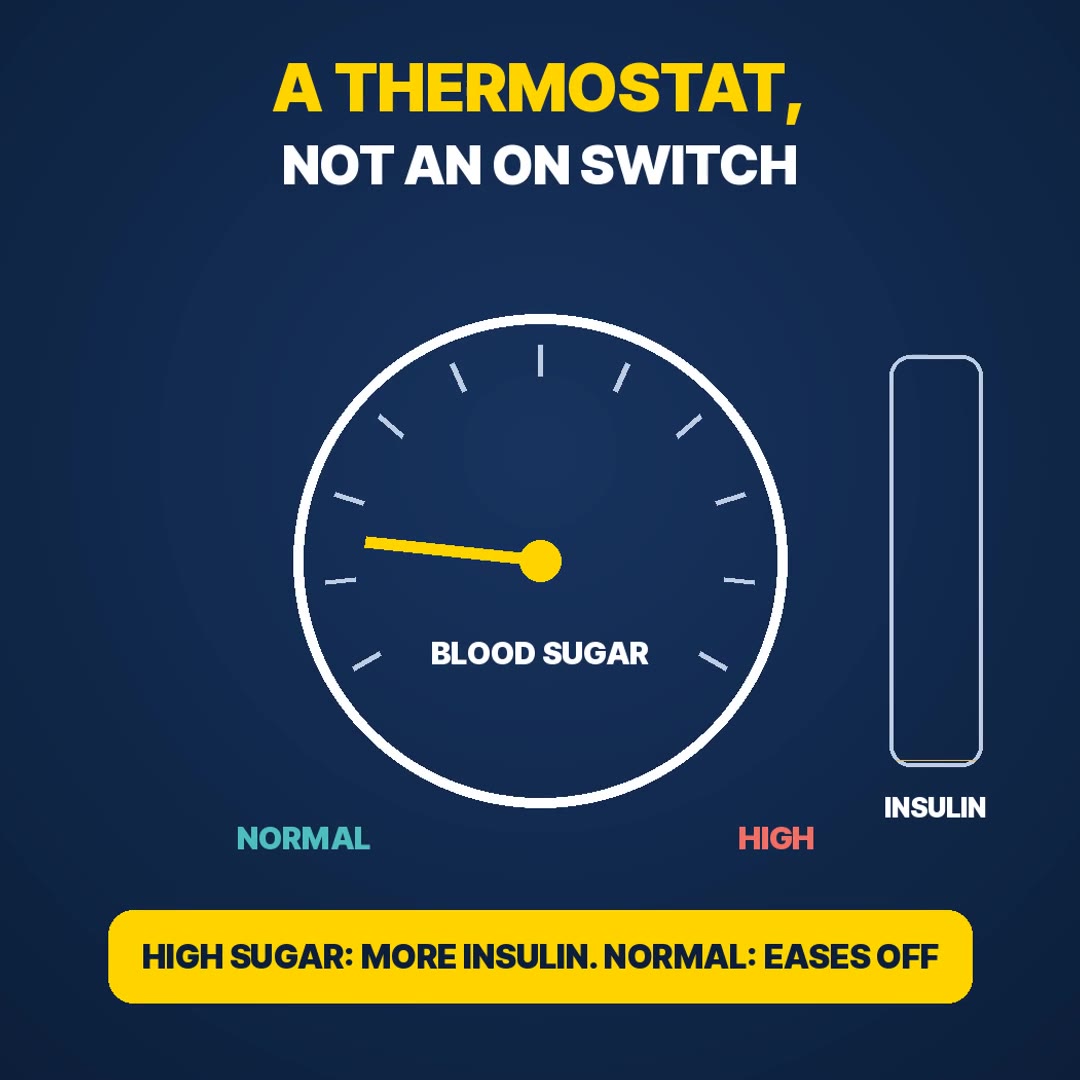
High sugar: more insulin. Normal sugar: it eases off (ThriveMed explainer, based on Nauck et al., 1993).
The honest part
Natural GLP-1 lasts only one to two minutes in the blood before an enzyme, DPP-4, cuts it. A signal that vanishes that fast is perfect for the body and very hard to use as a medicine. Solving that took years more, and it is the story of the next episode.
Credit was messy, too. Many people built this, including Habener, Mojsov, Bell, Holst, Bloom, Daniel Drucker and Michael Nauck. Mojsov's role was overlooked for years, and she had to fight to be named on the patents. In 2024 she shared the Lasker award with Joel Habener and Lotte Bjerre Knudsen.
Today's GLP-1 medicines are prescription medicines with real side effects, most often nausea and other stomach effects, and they are used under a doctor's care.
What the research looks like now
GLP-1 started with a single paper in 1980. By 2025, PubMed listed 32,117 papers naming it, more than glucagon itself, and research has spread from diabetes to weight, the heart, the kidneys and the brain.
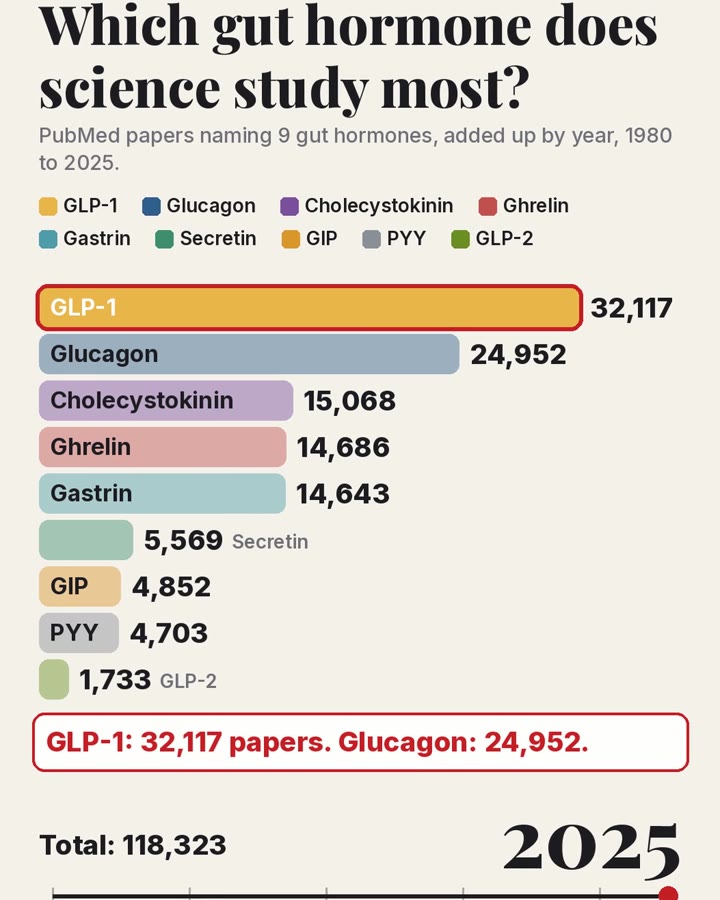
PubMed papers naming nine gut hormones, added up by year, 1980 to 2025 (NCBI PubMed, title and abstract search, queried Oct 11, 2026; papers, not studies).
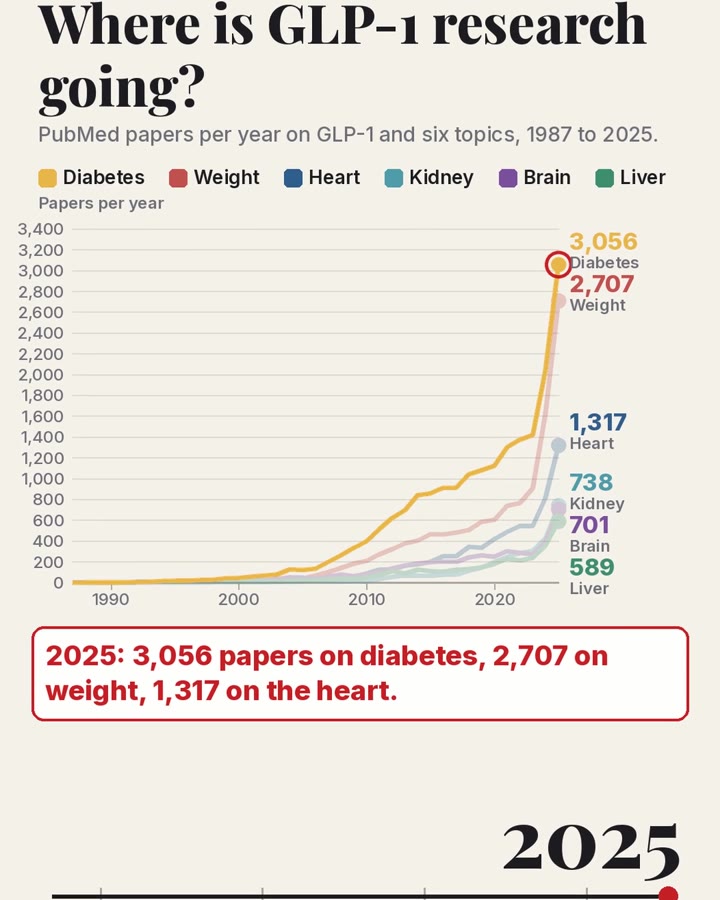
GLP-1 papers per year by topic, 1987 to 2025 (NCBI PubMed, queried Oct 11, 2026; one paper can count in several topics).
Two ideas you can use
- Your gut is not just a tube. Every time you eat, it talks to your pancreas and your brain with hormones. What and how you eat changes those signals.
- Look closely at what everyone thinks they already understand. A gene that had been studied for years was hiding a second hormone.
A fish, a printout and one careful chemist uncovered a message your gut sends every day. Next time: the lizard venom that helped solve the two minute problem. Be proactive.
Read my physician's read on drzuleta.com: GLP-1 was hiding in plain sight, a physician's read
Sources
- Elrick H et al. J Clin Endocrinol Metab 1964;24:1076. McIntyre N, Holdsworth CD, Turner DS. Lancet, Jul 4, 1964.
- Lund PK, Goodman RH, Dee PC, Habener JF. PNAS, Jan 1982;79:345-349.
- Bell GI, Santerre RF, Mullenbach GT. Nature, Apr 21, 1983;302:716-718. Bell GI et al. Nature 1983;304:368-371.
- Mojsov S et al. J Biol Chem 1986;261:11880-11889. Mojsov S, Weir GC, Habener JF. J Clin Invest, Feb 1987;79:616-619.
- Holst JJ et al. FEBS Lett, Jan 26, 1987;211:169-174. Kreymann B, Williams G, Ghatei MA, Bloom SR. Lancet, Dec 5, 1987.
- Drucker DJ et al. PNAS, May 1987;84:3434-3438. Nauck MA et al. Diabetologia 1993;36:741-744.
- Holst JJ. The physiology of glucagon-like peptide 1. Physiol Rev 2007;87:1409-1439. Deacon CF et al. Diabetes 1995;44:1126.
- Lasker Foundation, 2024 Lasker-DeBakey Clinical Medical Research Award essay. The Rockefeller University, profiles of Svetlana Mojsov (2023, 2025). JCI 2024;134:e186225.
Photos: Svetlana Mojsov, The Rockefeller University; Joel Habener, Lasker Foundation; anglerfish, NOAA NURP (public domain). Explainers and charts: ThriveMed.
Educational only, not medical advice. Andres Zuleta, MD, ThriveMed.