
8,000 Pounds of Pancreas for One Pound of Insulin: When Bacteria Started Making Human Insulin (1972 to 1982)
By Andres Zuleta, MD, ThriveMed · Patient and family education
In 1978, a Genentech scientist toured an insulin plant in Indiana and saw a line of train cars filled with frozen pancreases from pigs and cattle. According to Genentech's own history, it took 8,000 pounds of pancreas glands, from about 23,500 animals, to make one pound of insulin.
Four years later, the FDA approved a new insulin. It was made by bacteria. This is Episode 7 of my 15-part series, The Peptide Breakthroughs, and it is the story of how a sandwich, a small ring of DNA and a few stubborn scientists turned bacteria into tiny insulin factories.
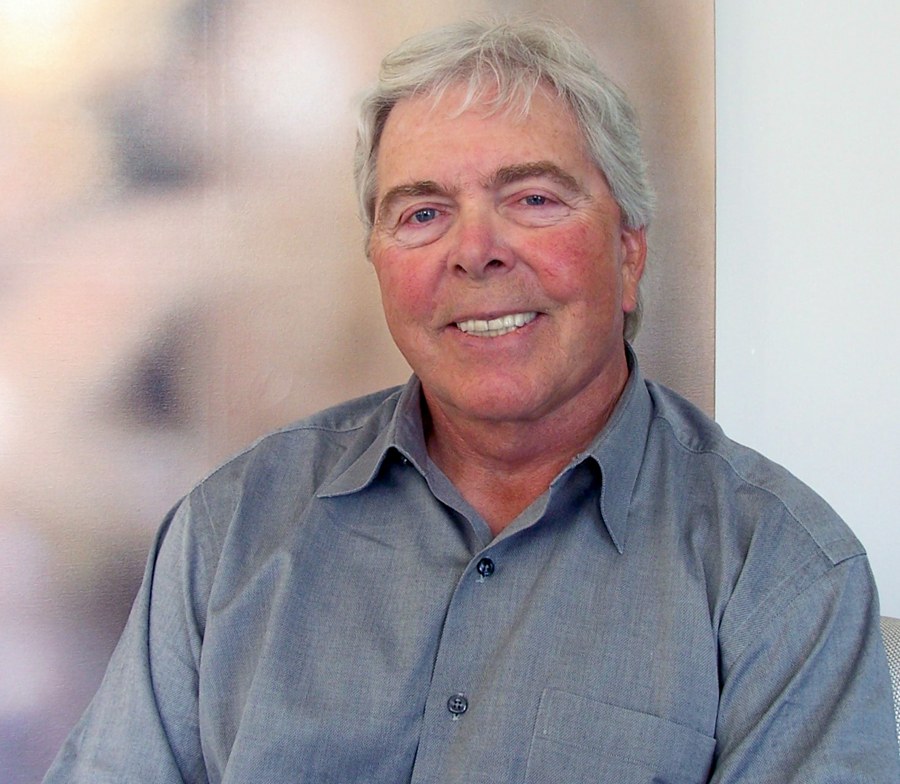
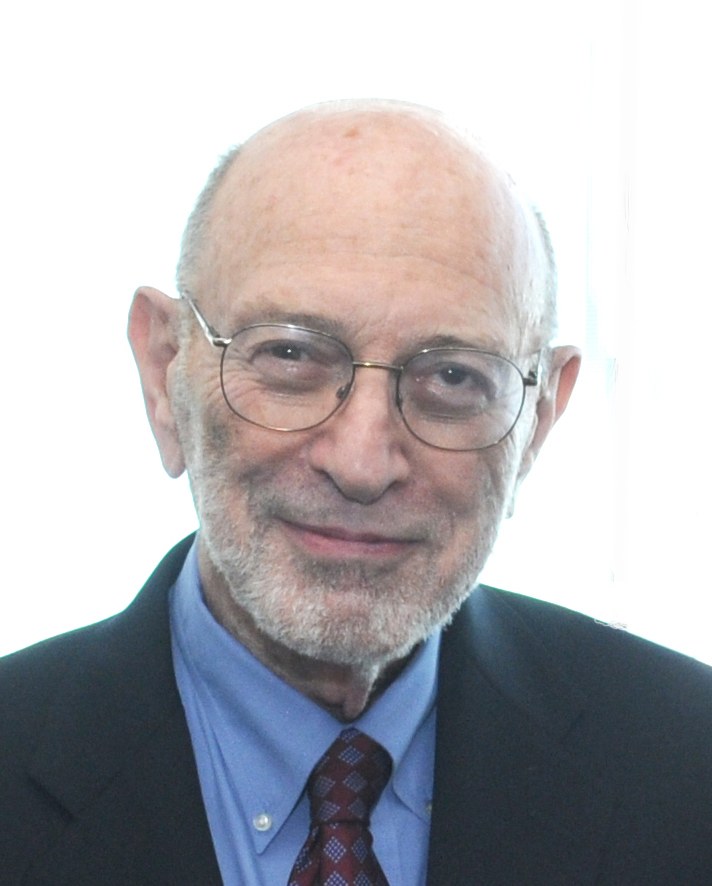
Left: Herbert Boyer (photo by Jane Gitschier, CC BY 2.5). Right: Stanley Cohen (photo by Otha deWayne Howse, CC BY-SA 3.0). Both via Wikimedia Commons.
The short version
- The idea: in November 1972, Stanley Cohen and Herbert Boyer sketched an experiment on deli napkins in Honolulu. In 1973 they showed a new piece of DNA could be pasted into a small ring of bacterial DNA and copied by the bacteria. That was the start of recombinant DNA.
- The proof: in 1977, a team at City of Hope and a young company called Genentech got bacteria to make a human hormone, somatostatin, the brain's brake on growth hormone from Episode 6.
- The medicine: in 1978 the same approach made the two chains of human insulin. On October 28, 1982, the FDA approved Humulin, human insulin made by bacteria, the first medicine made with recombinant DNA.
- The honest part: the first batch was tiny, regulators were careful, and insulin is still a prescription medicine with a real risk, low blood sugar.
Watch the 5-minute story.
Insulin from animals
Since 1922, people with diabetes had used insulin taken from slaughterhouse animals, mostly pigs and cattle. The FDA's historian wrote that after 1922 "virtually all insulin for human use was harvested from slaughterhouse animals." In Episode 4 we watched Frederick Sanger read insulin's sequence: 51 amino acids in two chains. Pig insulin differs from ours in just one position, and cattle insulin in three. So here was the question: could we make the human version itself, instead of borrowing it?
A sandwich in Honolulu
In November 1972, two scientists were at a meeting on plasmids in Honolulu: Stanley Cohen from Stanford and Herbert Boyer from the University of California, San Francisco. A plasmid is a small ring of DNA that bacteria copy on their own. Boyer worked with an enzyme that cuts DNA at one exact spot and leaves "sticky" ends. Cohen knew how to get plasmids into bacteria. Late one evening, at a deli near Waikiki, Cohen later recalled "warm corned beef sandwiches and cold beer," and they "sketched out an experimental plan on napkins."
Think of it as cut and paste. Snip the ring open, paste in a new piece of DNA, and put the ring back into the bacteria. Every time the bacteria divide, they copy your piece too. Less than six months later it worked, and the paper appeared in November 1973.
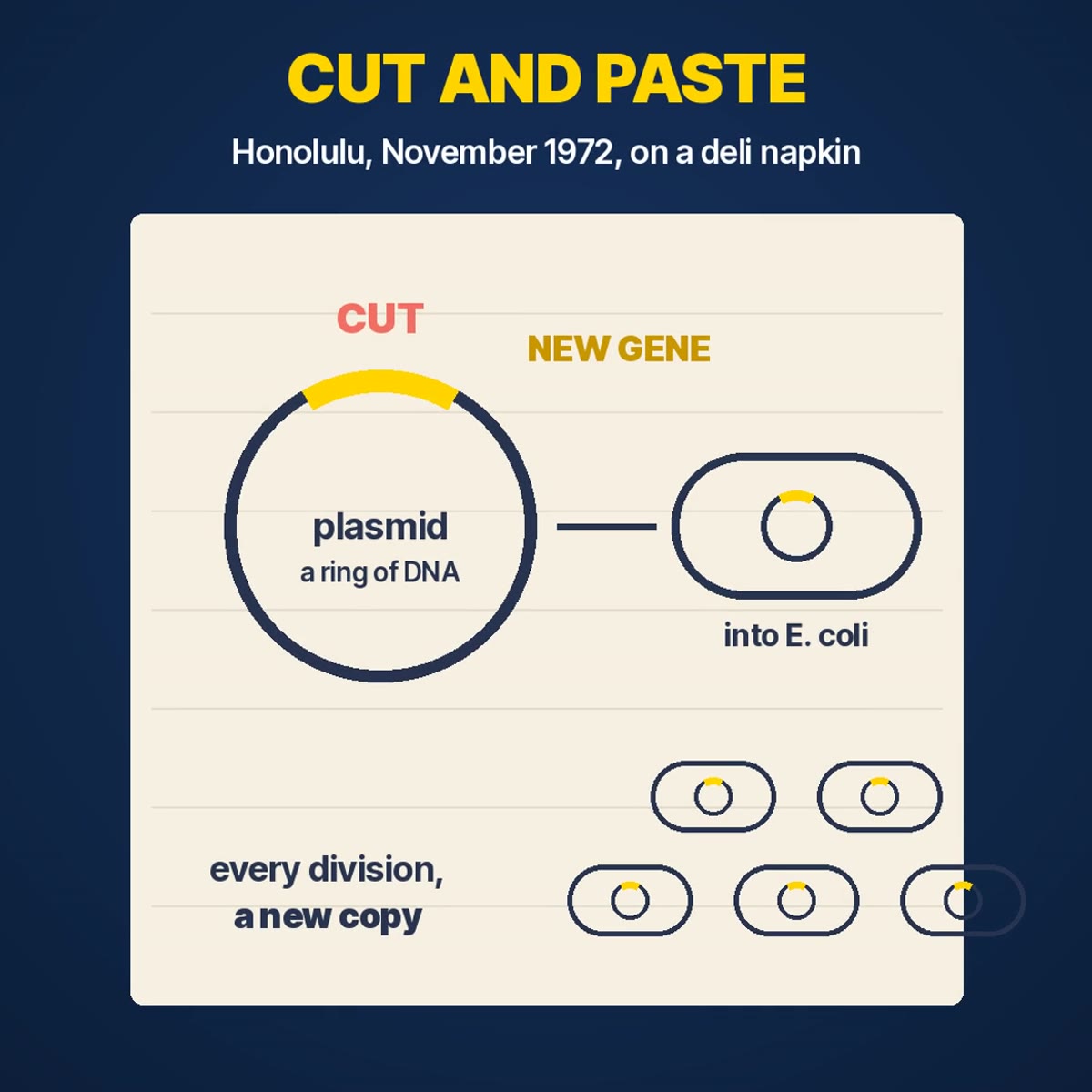
Cut and paste: a ring of DNA is cut open, a new gene is pasted in, and E. coli copies it (ThriveMed explainer).
It worried people, scientists included. In 1975 they met at Asilomar in California to write safety recommendations before going further.
Ten minutes that became three hours
In 1976, a 29-year-old venture capitalist named Robert Swanson asked Boyer for a meeting. Boyer agreed to ten minutes. The meeting lasted three hours, and that year they founded Genentech.
Their first test was a small hormone: somatostatin, 14 amino acids. At City of Hope near Los Angeles, Keiichi Itakura and Arthur Riggs built the gene by chemistry, and the team placed it in E. coli. In December 1977 they published the result in Science: the first working peptide made from a gene built by chemistry. When the work was described to a Senate subcommittee, the president of the National Academy of Sciences, Philip Handler, called it "a scientific triumph of the first order." The first isolation of somatostatin had needed nearly half a million sheep brains for 5 milligrams; the bacteria made the same amount from about 2 gallons of culture.
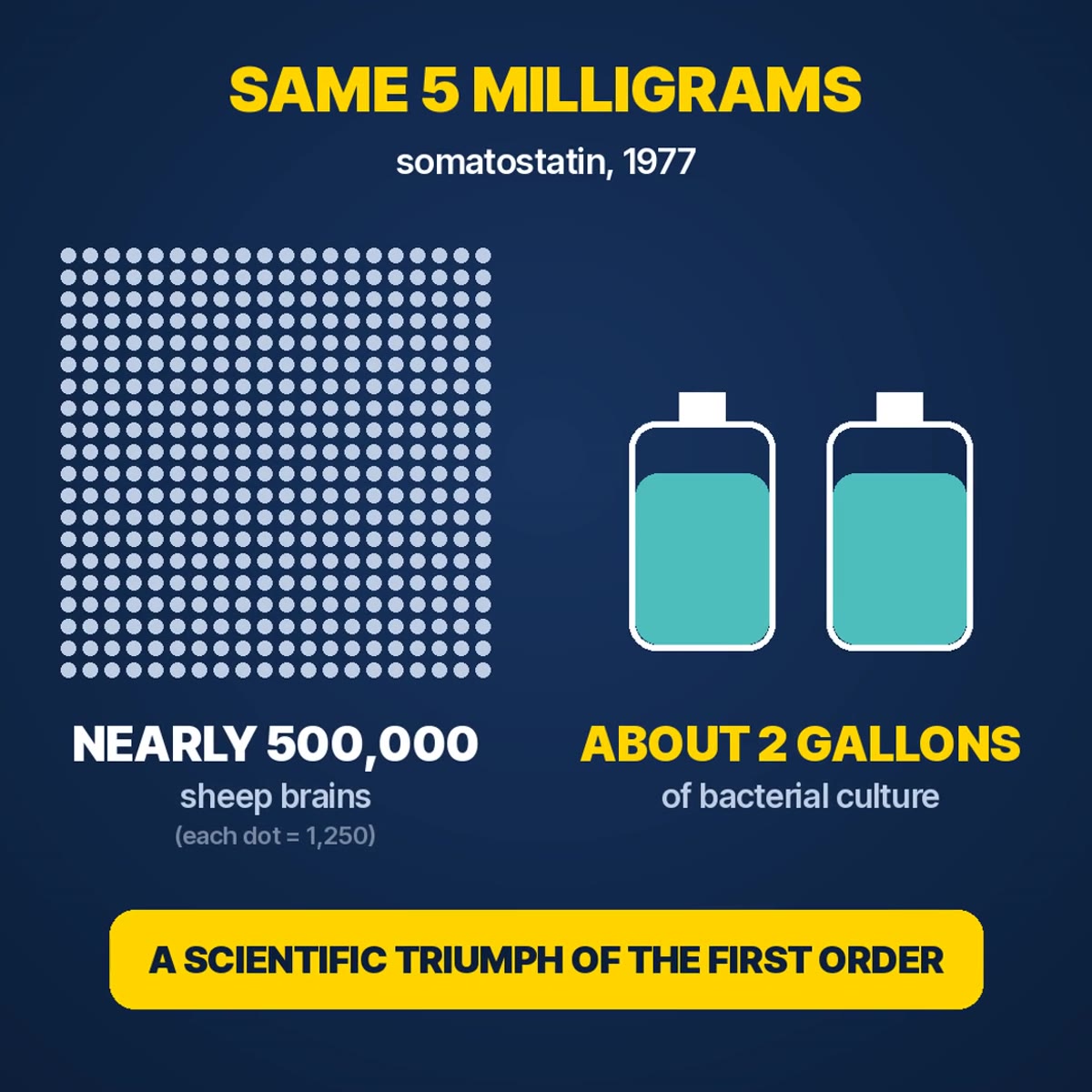
The same 5 milligrams of somatostatin: nearly half a million sheep brains in 1973, about 2 gallons of bacterial culture in 1977 (ThriveMed explainer, from Time's 1977 report of Handler's testimony).
Insulin: two chains, two bacteria
Insulin was a much bigger job: 51 amino acids in two chains, A (21) and B (30). At City of Hope, Roberto Crea and Keiichi Itakura built two genes by chemistry, designed from the human sequence. At Genentech, which had about twelve employees, David Goeddel and Dennis Kleid put each gene into its own strain of bacteria, like making the two halves of a zipper in two different rooms. Arthur Riggs and Goeddel worked out how to purify the chains and join them. In the early hours of August 21, 1978, Goeddel joined the two chains into human insulin. They confirmed it with radioimmunoassay, Rosalyn Yalow's method from Episode 6. Genentech and City of Hope announced it on September 6, 1978.
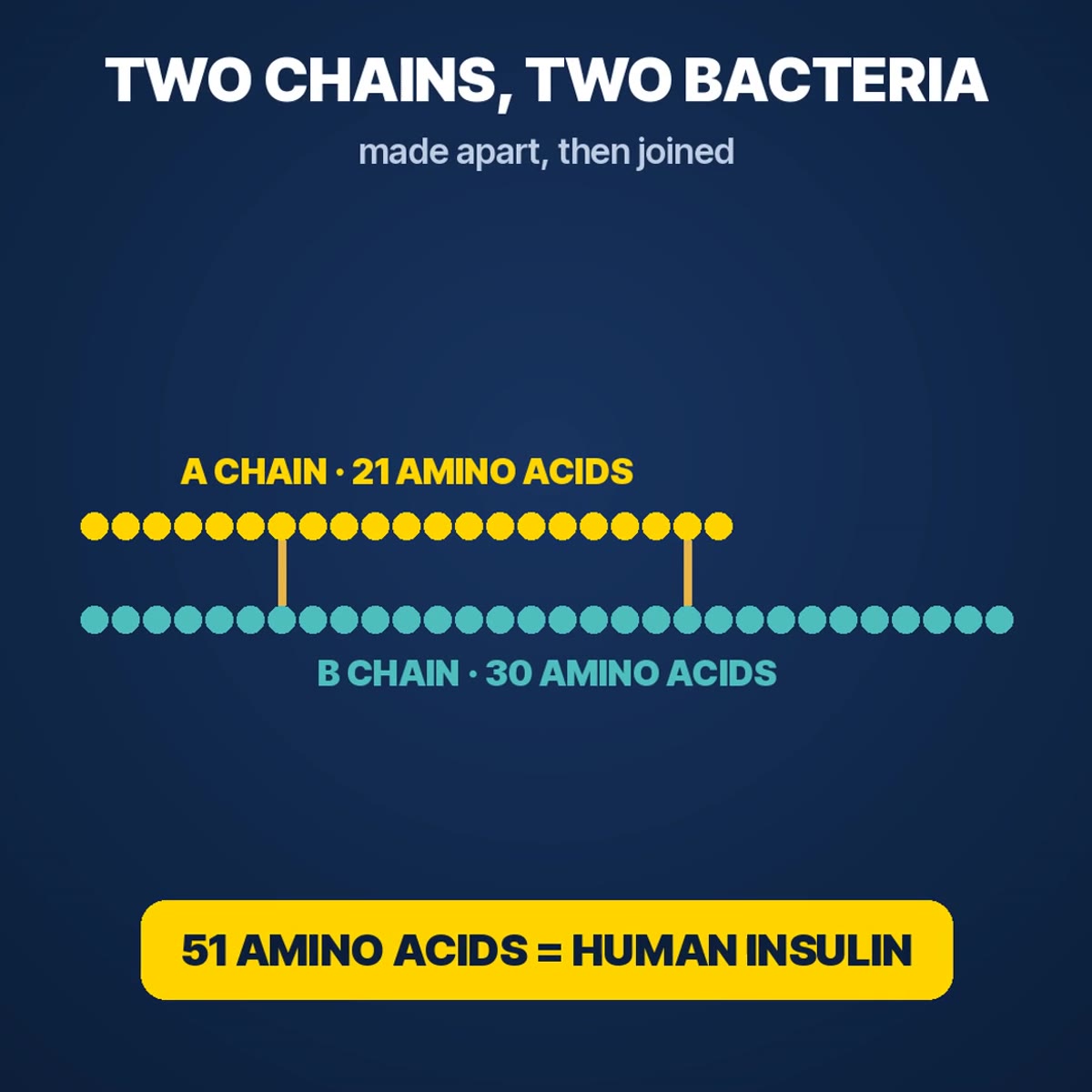
Insulin's A chain (21 amino acids) and B chain (30) were made in separate bacteria, then joined (ThriveMed explainer).
The honest part
That first success was tiny. According to Genentech's history, the bacteria had to make about 50 times more before it could become a real medicine. Regulators were careful too. The FDA ran a full new-drug review: the bacteria were a special lab strain that could not survive outside, the two chains were made in separate fermentations, and a clinical trial followed 243 patients.
On October 28, 1982, the FDA approved Humulin, human insulin made by bacteria and produced by Eli Lilly. It was the first medicine made with recombinant DNA, approved five months after the application, when such reviews usually took far longer. The FDA's historian later wrote that it has almost completely replaced animal insulin. It is still a prescription medicine; its main risk is low blood sugar, and it is used under a doctor's care. I name Humulin here only because it was the historical first, not as a recommendation.
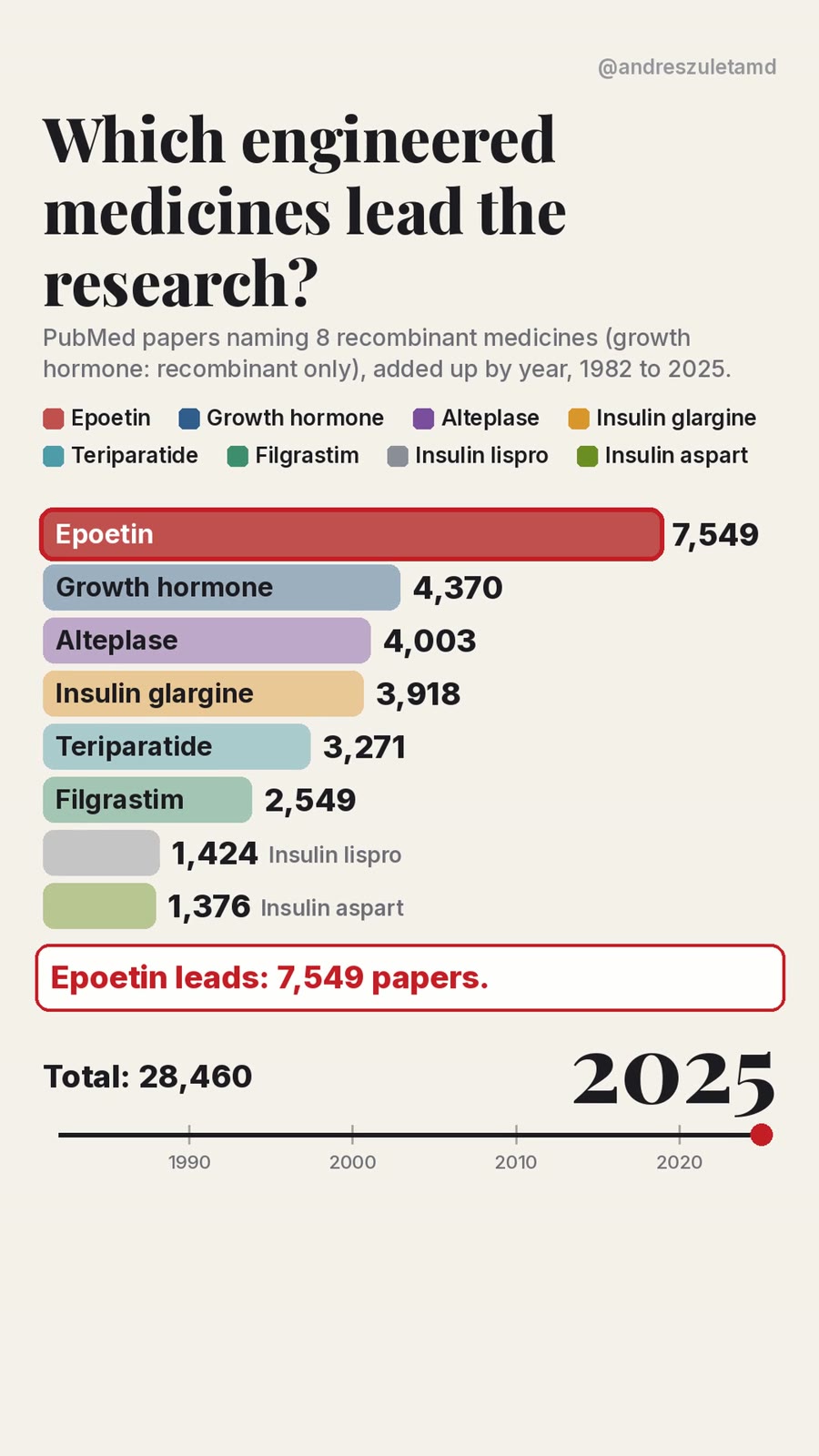
Research papers naming 8 medicines made by engineered cells, added up by year to 2025 (NCBI PubMed, searched October 10, 2026). Epoetin, made in mammalian cells, leads.
The ripple
The method spread. In 1985, growth hormone taken from human cadavers was withdrawn after it was linked to a fatal brain disease, and growth hormone made this way filled the gap. In 1996, the first redesigned insulin, insulin lispro, was approved. Today, some peptide medicines start in microbes such as yeast, while others are built on beads, the method from Episode 5. In 1980, Boyer and Cohen, with Paul Berg and Dale Kaiser, received the Lasker Award for making recombinant DNA "a brilliant reality."
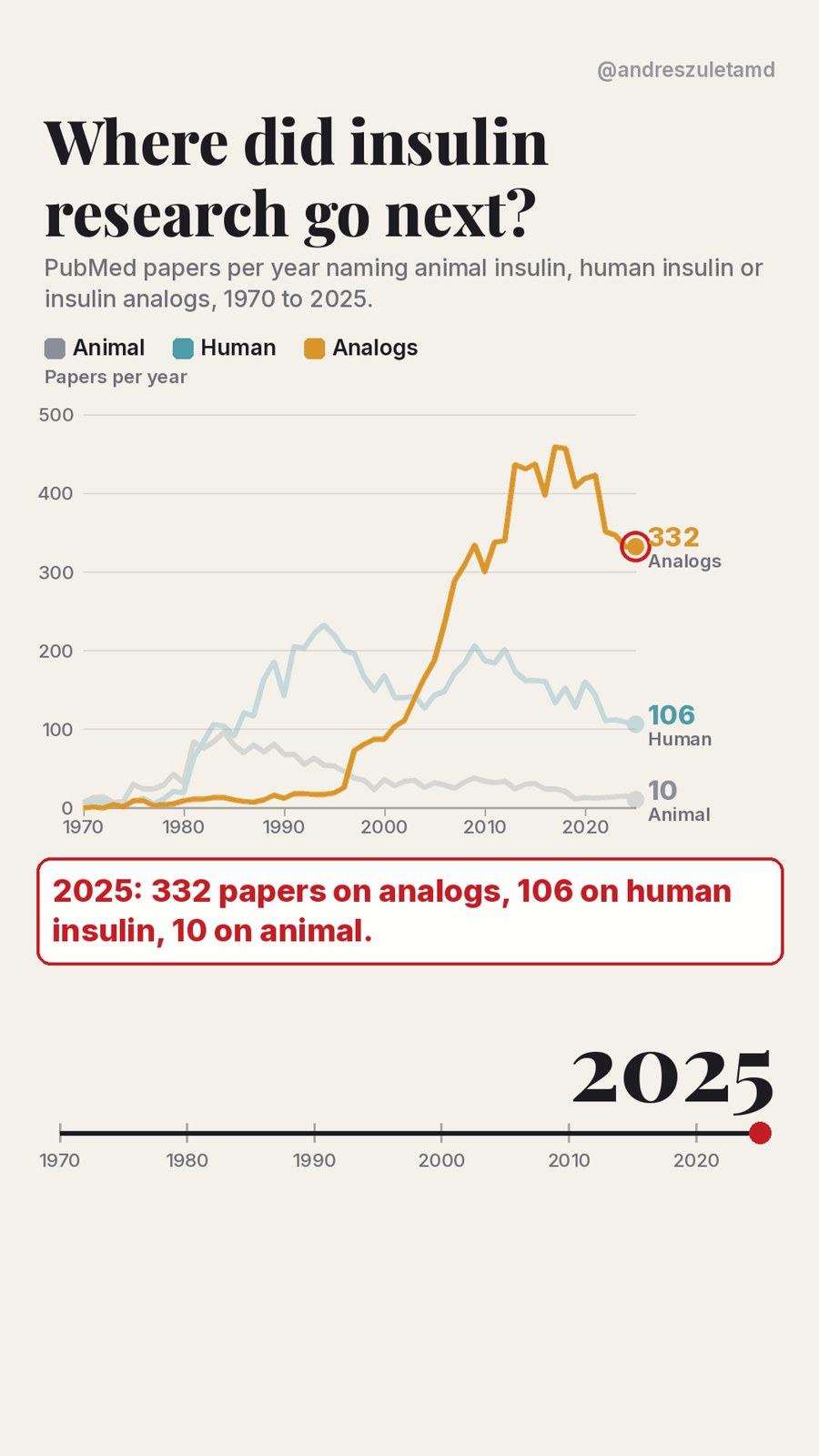
Papers per year naming animal insulin, human insulin or insulin analogs, 1970 to 2025 (NCBI PubMed, searched October 10, 2026; "human insulin" also catches papers on the body's own hormone).
Three ideas you can use
- Life shares one code. The same DNA instructions work in a bacterium and in you. That is why any of this was possible.
- Ask how a medicine is made, and how it was tested. It is a fair question for any new prescription.
- A first result is not a medicine. Between the lab and your pharmacy there is scale-up, testing and review. That gap protects you.
Read my deep dive on drzuleta.com: a physician's read on recombinant insulin
Want a proactive plan for your own health? Join Thrive Nation.
The Peptide Breakthroughs: Previous, Episode 6: the race to find the brain's hormones. Next, Episode 8: the gut hormone hiding inside the glucagon gene.
Sources: Cohen SN, Chang ACY, Boyer HW, Helling RB, PNAS 1973;70:3240 (Nov 1973); Cohen SN, "DNA cloning: a personal view after 40 years," PNAS 2013;110:15521; Science History Institute, biographies of Herbert Boyer and Stanley Cohen; Genentech, "Our Founders" and "Cloning Insulin" (company history); Itakura K et al., Science 1977;198:1056 (Dec 9, 1977); Time, "Science: E. coli at Work," Nov 1977; Crea R et al., PNAS 1978;75:5765; Goeddel DV et al., PNAS 1979;76:106; Genentech press release, Sep 6, 1978; S. W. Junod, FDA History Office, "Celebrating a Milestone: FDA's Approval of First Genetically-Engineered Product" (2007); FDA Purple Book, BLA 018780 (original approval Oct 28, 1982); L. K. Altman, New York Times, Oct 30, 1982; Lasker Foundation, 1980 Basic Medical Research Award; insulin lispro first approval June 14, 1996 (openFDA). Chart data: NCBI PubMed, searched Oct 10, 2026. Photos: Wikimedia Commons (CC BY 2.5, CC BY-SA 3.0).
Educational only, not medical advice.