
300,000 Brains for One Milligram: The Race to Find the Brain’s Hormones (1969 to 1977)
By Andres Zuleta, MD, ThriveMed · Patient and family education
Late in 1968, a lab in Houston held one milligram of a substance nobody had ever seen. That is less than a grain of rice. To get it, Roger Guillemin's team had worked through the hypothalamus of 300,000 sheep.
A few hundred miles away in New Orleans, his former colleague Andrew Schally was racing for the same molecule, using pig brains. This is Episode 6 of my 15-part series, The Peptide Breakthroughs, and it is the story of how two rivals read the first messages your brain sends to the rest of your body.
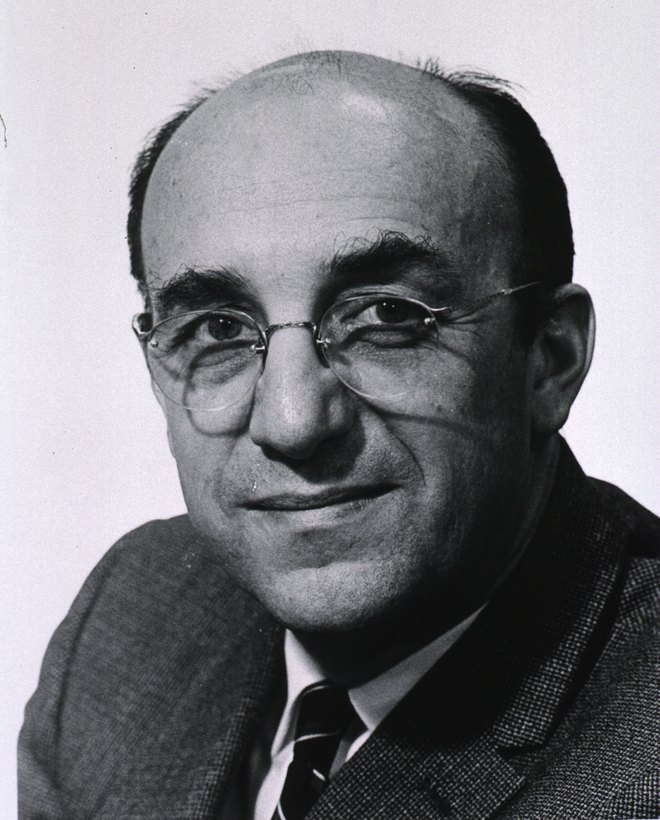
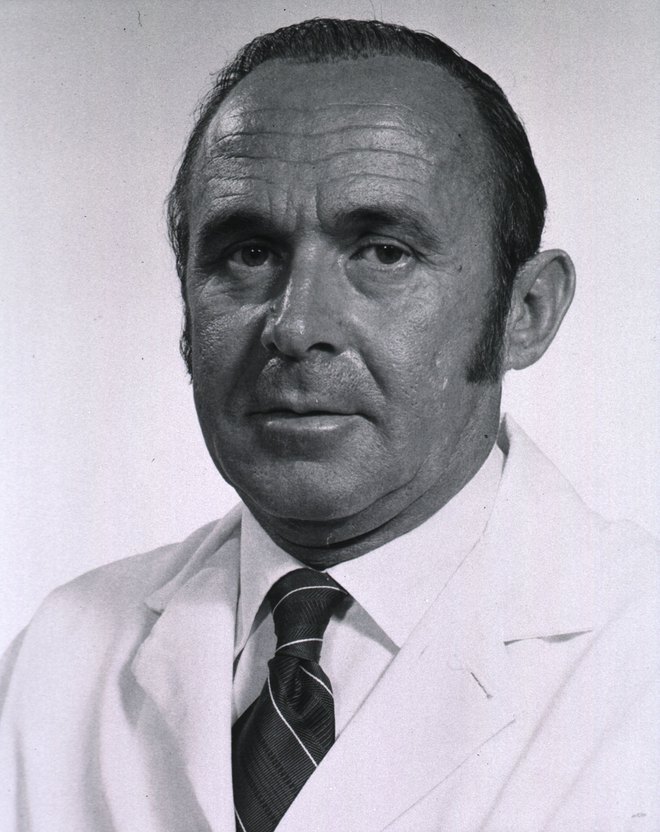
Left: Roger Guillemin. Right: Andrew V. Schally. Both photos from the Lasker Awards Archives, National Library of Medicine (public domain).
The short version
- The discovery: between 1969 and 1973, two labs decoded three hormones made in the brain: TRH (three amino acids), GnRH (ten) and somatostatin (fourteen). All three are peptides.
- The cost: Guillemin's group collected more than 5 million sheep brains. Schally's lab received about a million pig hypothalami from a meat company.
- The prize: in 1977 Guillemin and Schally shared half of the Nobel Prize in Physiology or Medicine. The other half went to Rosalyn Yalow, the physicist whose method let scientists measure hormones at trillionths of a gram.
- Today: medicines modeled on these hormones, such as leuprolide and octreotide, are prescription treatments with real benefits and real side effects.
Watch the 5-minute story.
Who gives your body its orders?
Your pituitary is a gland the size of a pea at the base of your brain. It sends hormones that drive your thyroid, your adrenal glands and your ovaries or testes. Think of it as a manager. But by the 1950s, scientists suspected the manager took orders from above, from a small region of the brain called the hypothalamus. Tiny blood vessels connecting the two had been found in 1930. The idea was that the brain sends chemical memos down those vessels. Nobody had ever seen one.
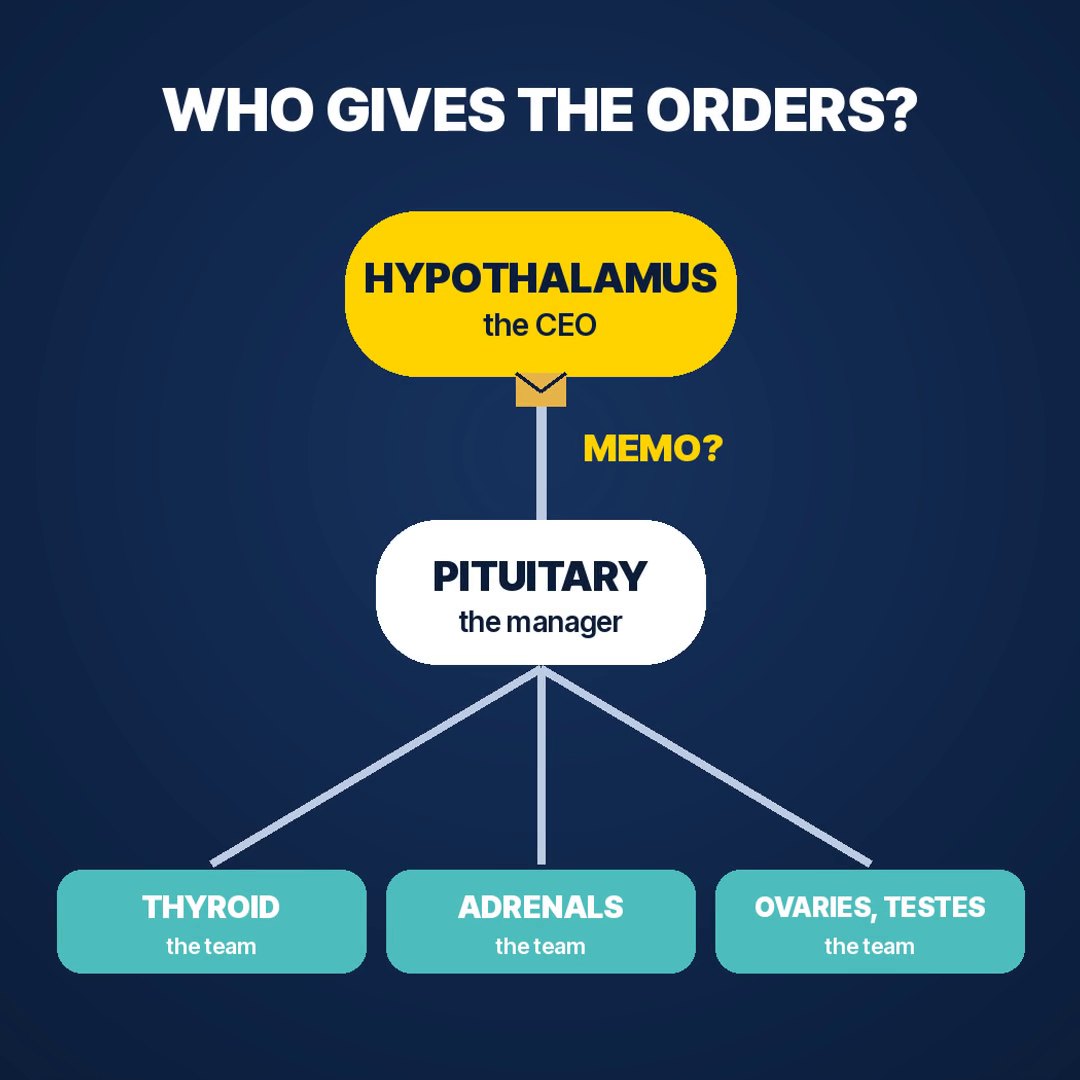
The chain of command: the hypothalamus writes the memo, the pituitary acts on it, and other glands respond (ThriveMed explainer).
Two colleagues, then two labs
Guillemin, born in France and trained as a physician, and Schally, born in Poland, worked together at Baylor in Houston from 1957. In 1962 Schally left to lead his own laboratory at the Veterans Administration hospital in New Orleans. From then on they hunted the same molecules separately. The Nobel committee later called it "a formidable race."
The problem was scale. Each fragment of hypothalamus held only "a few nanogram quantities" of a hormone, billionths of a gram. So both labs went enormous. Guillemin's group handled "more than 50 tons of hypothalamic fragments."
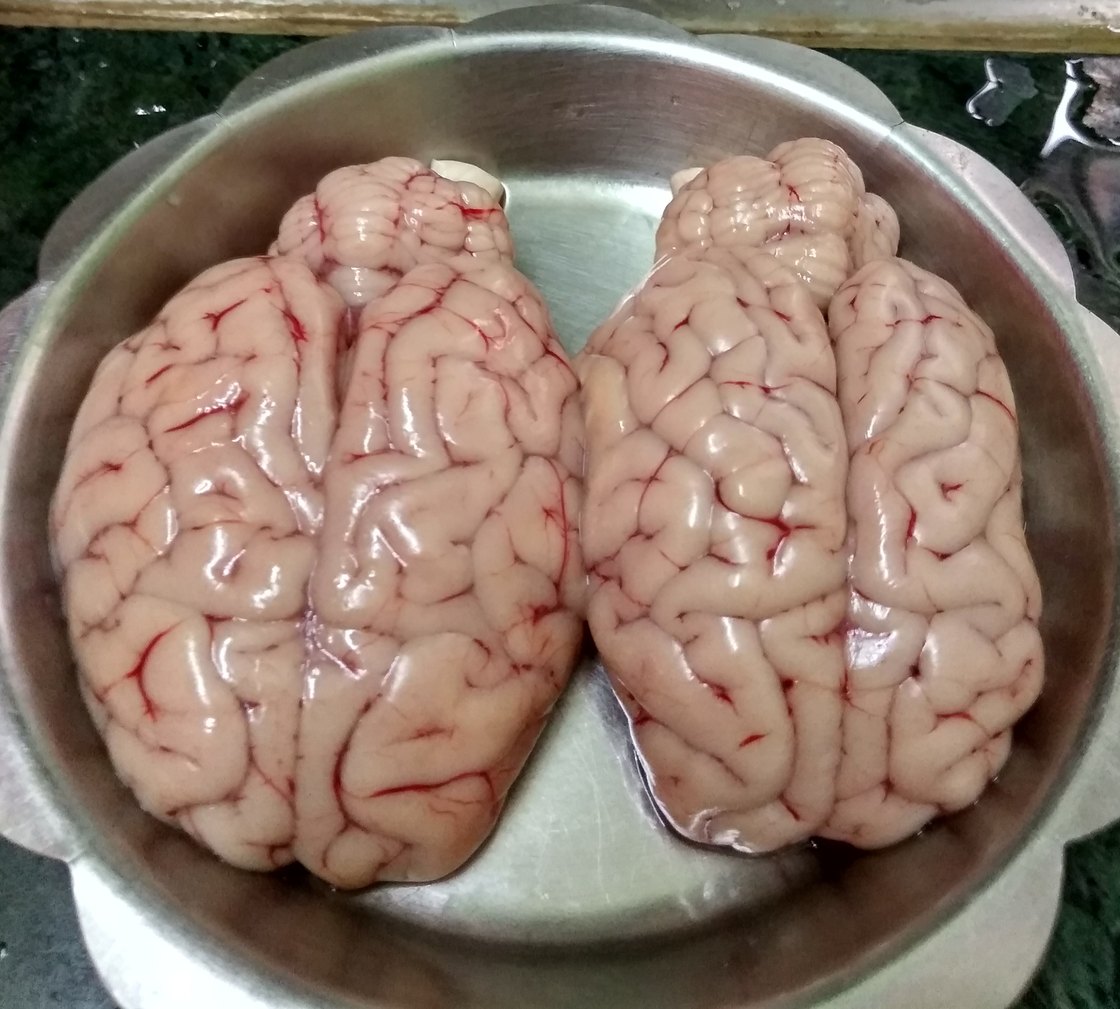
A sheep brain. Guillemin's lab collected more than 5 million of them (Wikimedia Commons, CC0).
Three messages, decoded
1969, TRH. The first memo turned out to be just three amino acids. Guillemin called it "deceivingly simple." It tells the pituitary to release thyroid stimulating hormone, TSH. Schally's group published on November 6, 1969, and Guillemin's on November 12. Six days apart. Schally later wrote that they shared the credit.
1971, GnRH. Schally's team decoded gonadotropin releasing hormone first, ten amino acids, from 800 micrograms collected from 165,000 pigs. Guillemin's team followed shortly after. One small peptide controls the pituitary hormones of fertility. Both labs made it in the lab using the bead method from Episode 5.
1973, somatostatin. Guillemin's team was looking for a hormone that would release growth hormone. They found the opposite: a 14 amino acid peptide that stops it. It was the first known brain hormone that tells the pituitary to hold back.
Measuring the invisible
None of this works if you cannot measure tiny amounts of hormone. That is where Rosalyn Yalow comes in. As a graduate student, her physics department chairman looked at her A minus in a lab course and said it "confirms that women do not do well at laboratory work." She became a nuclear physicist anyway, and at the Bronx VA hospital, starting in what she called a janitor's closet, she and Solomon Berson invented radioimmunoassay. It works like musical chairs: tagged and real hormone compete for the same antibody seats, and the seats left over tell you how much real hormone is there. It could measure insulin at 10 to 20 picograms, trillionths of a gram.
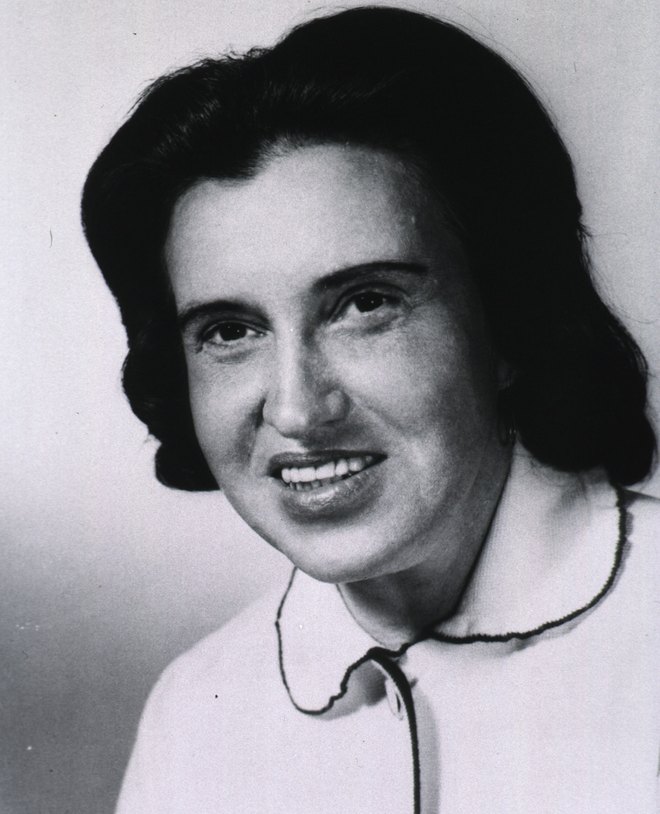
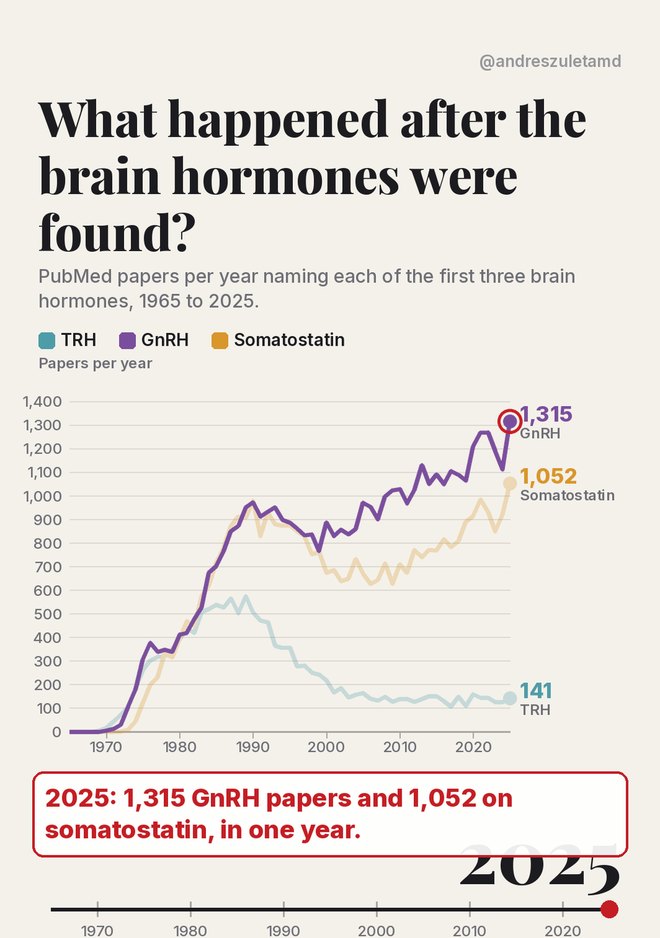
Left: Rosalyn Yalow (National Library of Medicine, public domain). Right: research papers per year on TRH, GnRH and somatostatin, 1965 to 2025 (NCBI PubMed, searched October 9, 2026).
In 1977, the Nobel committee wrote that the brain "more and more moves forward as an endocrine organ." Berson had died in 1972 and could not share the prize.
From brain hormones to medicines
Rhythm matters. In 1978 researchers showed something surprising: the pituitary answers GnRH only when it arrives in pulses. Given nonstop, the signal goes quiet. Like a doorbell: ring it now and then and someone answers; hold it down and they stop coming. Leuprolide, a nine amino acid copy of GnRH first approved in 1985, works by holding the doorbell down. It is used for advanced prostate cancer, endometriosis, uterine fibroids and puberty that starts too early. Lowering those hormones has real effects, such as hot flashes and bone loss with long use.
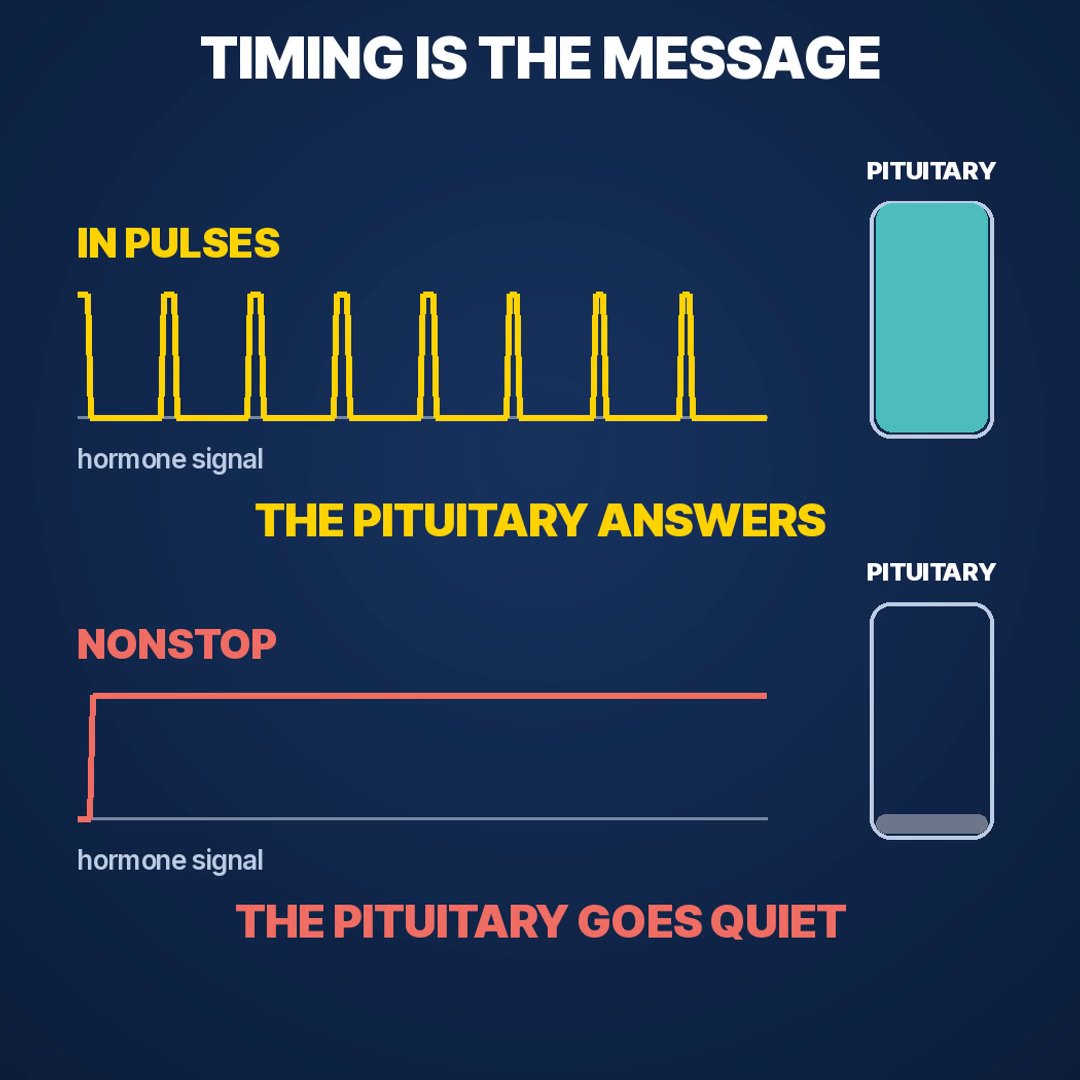
Same hormone, two rhythms: pulses keep the signal on, nonstop exposure turns it off (ThriveMed explainer).
Redesign matters. Natural somatostatin lasts only 1 to 3 minutes in the blood, too short to be practical as a medicine. Octreotide, a redesigned copy of 8 amino acids first approved in 1988, has a half-life of 1.7 to 1.9 hours. It is used for acromegaly and to control symptoms of certain hormone-secreting tumors, under a doctor's care.
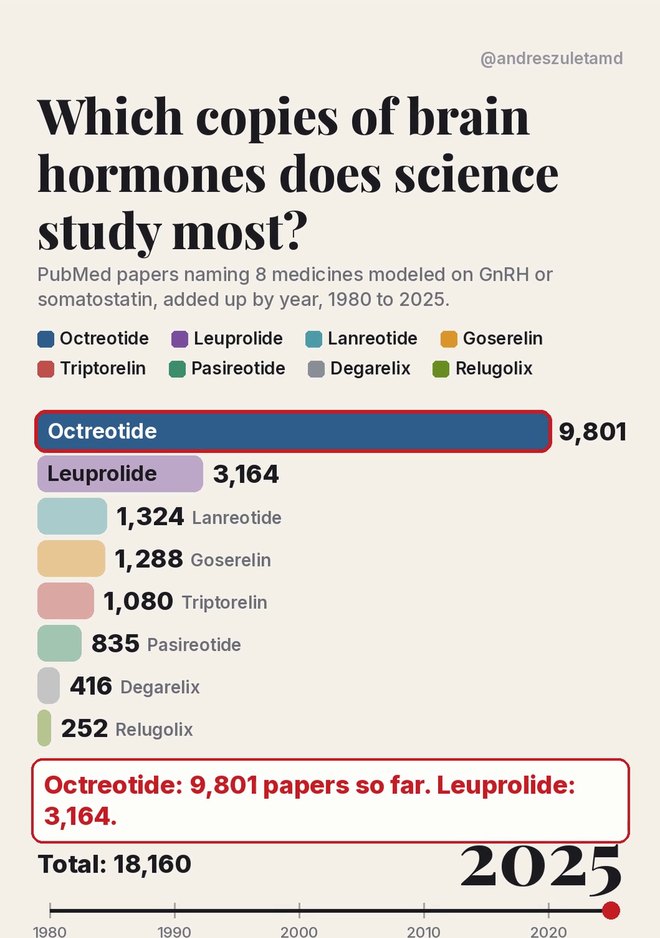
Research papers naming 8 medicines modeled on GnRH or somatostatin, added up by year to 2025 (NCBI PubMed, searched October 9, 2026).
Three ideas you can use
- Ask where the signal starts. A thyroid or fertility lab result is a message. The useful question is whether it starts in the gland, the pituitary or the brain. TSH, for example, is a pituitary hormone answering a brain hormone.
- Timing is information. The same hormone can switch a system on or off depending on its rhythm.
- Be stubborn about what matters. Yalow called herself "a stubborn, determined graduate student." Two labs worked through millions of brains for a few milligrams.
Read my deep dive on drzuleta.com: a physician's read on the hypothalamic hormones
Want a proactive plan for your own health? Join Thrive Nation.
The Peptide Breakthroughs: Previous, Episode 5: the bead that built modern peptides. Next, Episode 7: when bacteria started making human insulin.
Sources: Nobel Prize in Physiology or Medicine 1977, press release (Karolinska Institutet) and Nobel lectures by R. Guillemin and A. V. Schally, Dec 8, 1977, and Nobel biographies (nobelprize.org); Boler J et al., Biochem Biophys Res Commun 1969;37:705 (Nov 6, 1969); Burgus R et al., C R Acad Sci D 1969;269:1870 (Nov 12, 1969); Matsuo H et al., BBRC 1971;43:1334; Schally AV et al., Science 1971;173:1036; Brazeau P et al., Science 1973;179:77; Belchetz PE et al., Science 1978;202:631; Yalow RS, Berson SA, J Clin Invest 1960;39:1157; leuprolide: NIH NLM StatPearls (NBK551662), NIH LiverTox and FDA review records (first approval 1985); octreotide: FDA label, NDA 019667 (initial US approval 1988). Chart data: NCBI PubMed, searched Oct 9, 2026. Photos: National Library of Medicine (public domain), Wikimedia Commons (CC0).
Educational only, not medical advice.