
1902: The Year Peptides Were Born Twice, and the First Hormone Was Found
By Andres Zuleta, MD, ThriveMed · Patient and family education
On a winter afternoon in London, two scientists cut every nerve to a small loop of intestine and dripped a little acid inside. The pancreas answered anyway. That one result, on January 16, 1902, gave medicine its first hormone. The same year, in Berlin, a chemist gave a new family of molecules its name: peptides.
This is Episode 1 of my series The Peptide Breakthroughs. Below I walk you through the discovery, the results, the limits and the possibilities in plain language, plus one thing you can try at your next meal.
The short version
The discovery: in 1901 Emil Fischer and Ernest Fourneau made the first free dipeptide, two glycines joined together. On September 22, 1902, Fischer named the whole family peptides, from the Greek for digestion.
The results: in London, William Bayliss and Ernest Starling found secretin, the first hormone ever discovered. In 1970 it was shown to be a chain of 27 amino acids. The first hormone was a peptide all along.
The limits: "first" is complicated, peptide chemistry stayed slow and hard for about 50 years, and an extract in a glass was not yet a medicine.
The possibilities: more than 80 peptide drugs have now reached the market, and the receptor today's GLP-1 medicines act on belongs to the "secretin family."
Watch: 1902, the year peptides were born twice
Short on time? Watch the 37-second version on YouTube Shorts.
1. The discovery
When acid from the stomach reaches the small intestine, the pancreas releases a juice rich in bicarbonate to neutralize it. In 1902 the leading view, from Ivan Pavlov's school in Russia, was that only nerves could carry that message.
Bayliss and Starling tested it directly. They cut every nerve to a loop of intestine and placed acid inside. The pancreas still responded. A colleague who was there remembered Starling saying, "Then it must be a chemical reflex," and called it "a great afternoon." An extract of the gut lining, injected into the blood, did the same thing even more strongly. They called the messenger secretin.
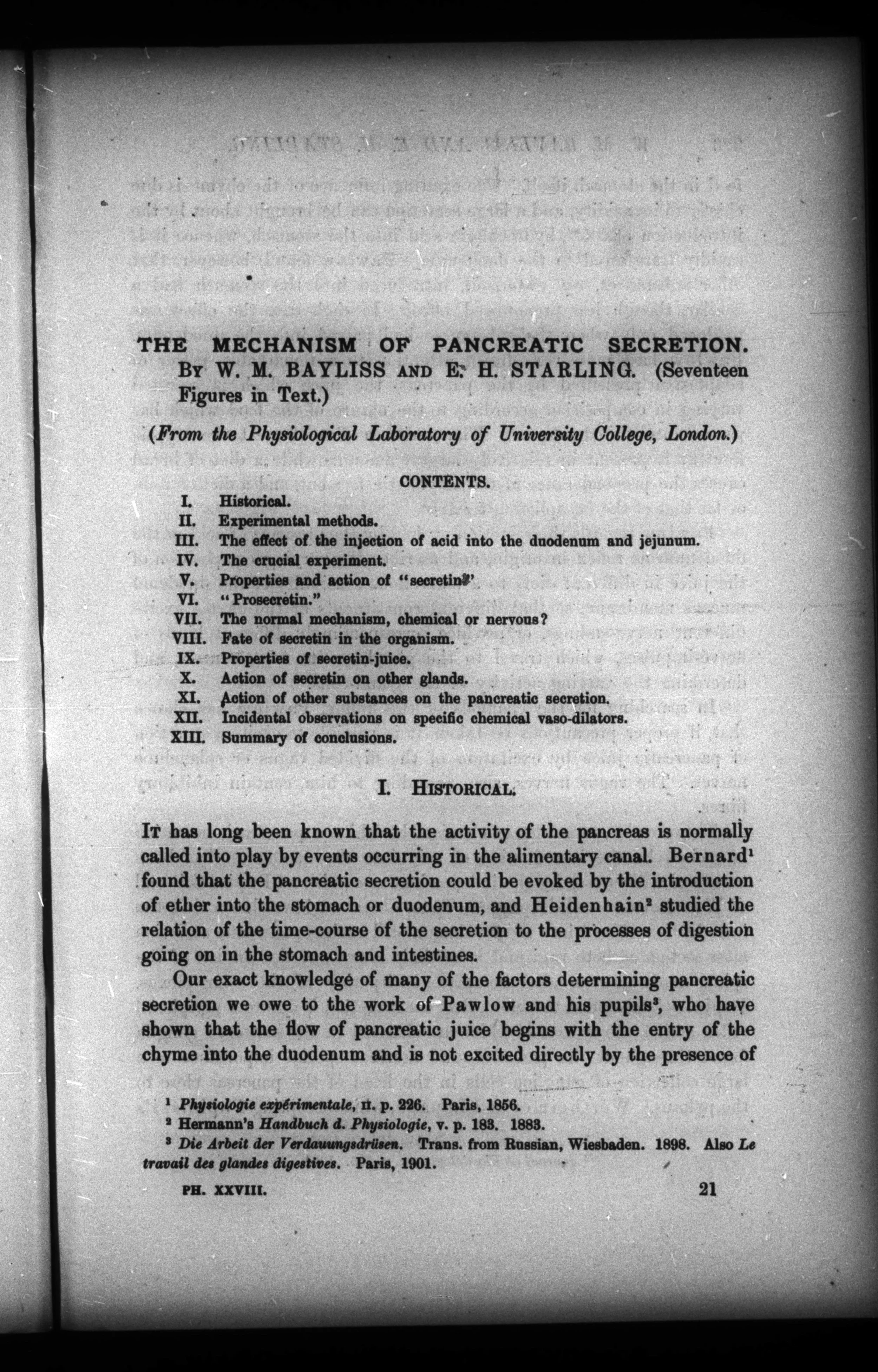
The first page of Bayliss and Starling's 1902 paper in The Journal of Physiology. Public domain (published 1902).
Meanwhile in Berlin, Emil Fischer was building the same kind of molecule from the other end: by hand, in a flask. With Ernest Fourneau he made glycylglycine in 1901, and in 1902 he gave these chains of amino acids their name.
2. The results
A new idea in medicine: secretin proved that the body sends chemical messages through the blood, not only through nerves. In 1905 Starling introduced the word "hormone," from a Greek word meaning to arouse to activity.
Even the skeptics agreed: when Pavlov's lab repeated the experiment, Pavlov said, "Of course they are right."
The 68-year secret: nobody knew what secretin was made of until 1970, when scientists read its sequence: 27 amino acids. The two discoveries of 1902 turned out to be one story.
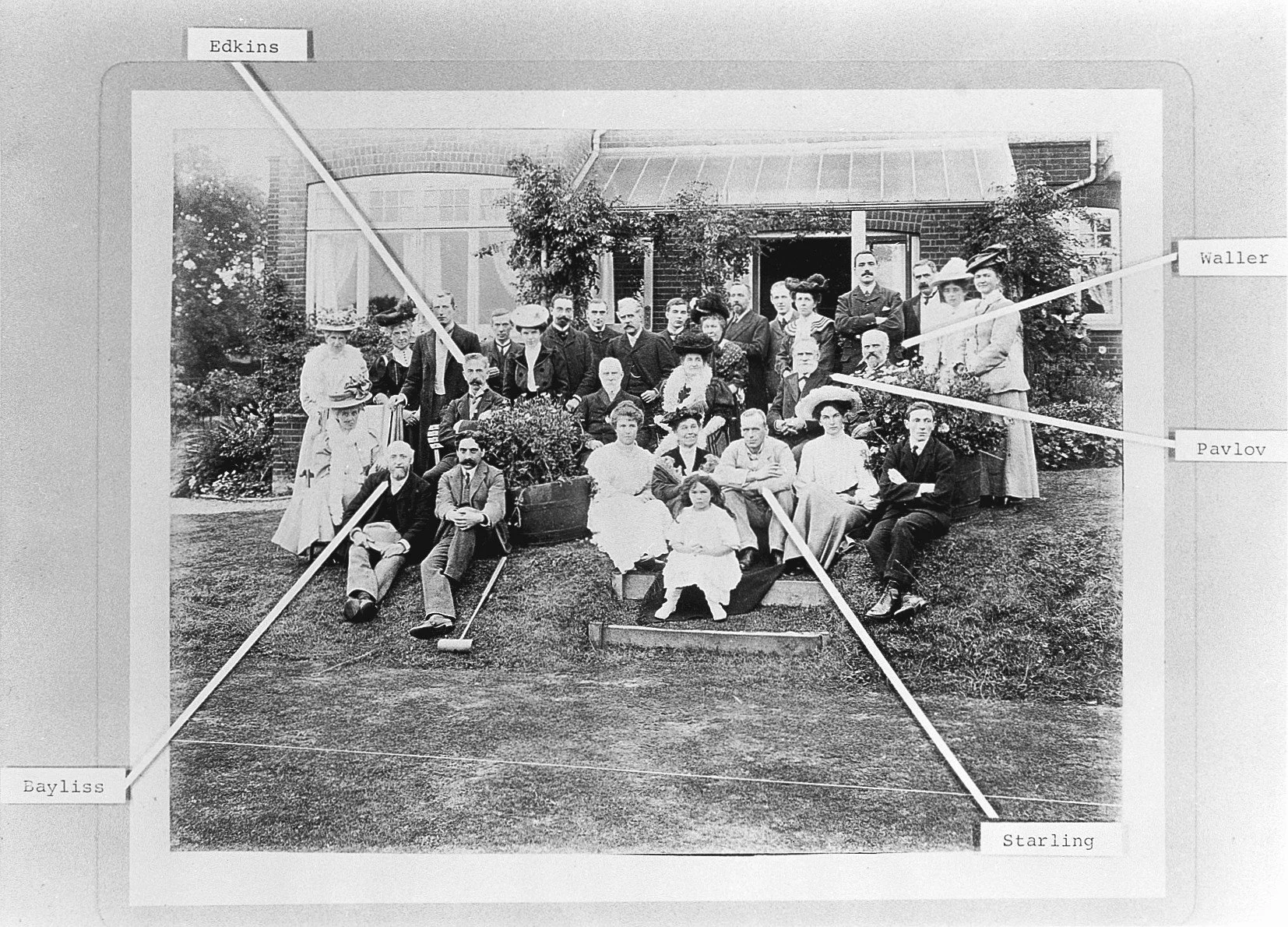
A croquet party that includes Ernest Starling, Ivan Pavlov and William Bayliss. Wellcome Collection, CC BY 4.0.
3. The limits
"First" is rarely simple. Theodor Curtius made a protected dipeptide in 1882, so Fischer's was the first free one. And Fischer's 1902 Nobel Prize was for his work on sugars and purines, not peptides.
Slow science. Making peptides stayed slow and hard for about half a century, until solid-phase synthesis made it fast and automatic in 1963.
Not yet a medicine. Nobody in 1902 could have turned secretin into a treatment. They did not even know what it was.
Nerves matter too. Starling himself later recognized that nerves and hormones both control the pancreas.
4. The possibilities
Today more than 80 peptide drugs have reached the market. Secretin itself is still used, in an FDA-approved test of how well the pancreas works. And the receptor that GLP-1 medicines act on belongs to what scientists call the secretin family. Every peptide medicine you hear about today has a 1902 backstory.
What you can do at your next meal
Your gut still makes peptide messengers every time you eat. Three small, short studies point to simple habits:
Carbohydrates last. In 16 adults with type 2 diabetes, eating the carbohydrates last lowered the after-meal glucose rise by 53% compared with eating them first, and GLP-1 went higher.
Protein in the meal. High-protein meals released the most PYY, a fullness peptide, in people with and without obesity.
Break up long sitting. In seven one-day trials, short walking breaks during long sitting lowered after-meal glucose and insulin.
Vegetables and protein first, bread last. These are small studies; they support your care and do not replace it.
Common questions
What is a peptide? A short chain of amino acids, the same building blocks that make up proteins. Many hormones, including insulin and GLP-1, are peptides.
What is secretin? A gut hormone of 27 amino acids that tells the pancreas to release bicarbonate when stomach acid arrives. It was the first hormone ever discovered.
Why does a 1902 experiment matter now? It showed that the body uses chemical messengers in the blood. That idea is the foundation of every hormone medicine since, including insulin and GLP-1 drugs.
For the more detailed, physician-level read, see my post on my own site: 1902, Secretin and Fischer: A Physician's Read on the Birth of Peptide Science.
Next in the series: the boy who received the first insulin injection.
Each discovery builds on people who asked how the body really works. Be proactive. Learn more at thrivemed.ai.
References
Bayliss WM, Starling EH. The mechanism of pancreatic secretion. J Physiol 1902;28:325-353. doi.org/10.1113/jphysiol.1902.sp000920 (free)
Fischer E, Fourneau E. Ber Dtsch Chem Ges 1901;34:2868-2877. doi.org/10.1002/cber.190103402249
Hirst BH. Secretin and the exposition of hormonal control. J Physiol 2004;560:339. doi.org/10.1113/jphysiol.2004.073056 (free)
Mutt V, Jorpes JE, Magnusson S. Structure of porcine secretin. Eur J Biochem 1970;15:513-519. doi.org/10.1111/j.1432-1033.1970.tb01034.x
Kimmerlin T, Seebach D. 100 years of peptide synthesis. J Pept Res 2005;65:229-260. doi.org/10.1111/j.1399-3011.2005.00214.x
Muttenthaler M, et al. Trends in peptide drug discovery. Nat Rev Drug Discov 2021;20:309-325. doi.org/10.1038/s41573-020-00135-8
Shukla AP, et al. Carbohydrate-last meal pattern lowers postprandial glucose and insulin excursions in type 2 diabetes. BMJ Open Diabetes Res Care 2017;5:e000440. doi.org/10.1136/bmjdrc-2017-000440 (free)
Batterham RL, et al. Critical role for peptide YY in protein-mediated satiation and body-weight regulation. Cell Metab 2006;4:223-233. PMID 16950139.
Buffey AJ, et al. The acute effects of interrupting prolonged sitting time in adults with standing and light-intensity walking on biomarkers of cardiometabolic health. Sports Med 2022;52:1765-1787. doi.org/10.1007/s40279-022-01649-4 (free)
Nobel Prize in Chemistry 1902, Emil Fischer. nobelprize.org
Educational only, not medical advice. The video uses an AI avatar sharing my script. Photos: public domain and Wellcome Collection (CC BY 4.0).