
How a Tiny Green Alga Led to the 2026 Nobel Prize, and Helped One Blind Man Find Objects
By Andres Zuleta, MD, ThriveMed · Patient and family education
At 12:27 in the morning, Pacific time, a phone rang in California. It was Stockholm calling. That morning, Karl Deisseroth told his kids he had won the Nobel Prize, and his young daughters jumped right on him. Stanford shared the moment on X: watch the family video on Stanford's post.
Behind that moment is a discovery that began with a tiny green alga, and has helped one blind man regain some vision. Below, I walk you through the discovery, the results, the drawbacks and the possibilities in plain language, plus what the science says you can do for your own brain today.
The short version
The prize: the 2026 Nobel Prize in Physiology or Medicine went to Karl Deisseroth, Peter Hegemann and Georg Nagel "for their discoveries concerning light-gated ion channels and optogenetics."
The discovery: a protein from a green alga opens like a gate when light hits it. Put its gene into nerve cells, and a flash of blue light makes them fire.
The results: scientists can now switch one type of brain cell on or off in a living animal. In 2021, one blind man could locate, count and touch objects with special goggles after gene therapy in one eye.
The drawbacks: one patient, partial vision, only with the goggles, a 10-person trial still running, and the company developing the therapy funded the study. In the brain, it is still a research tool.
The possibilities: several vision trials are underway, and a real map of which brain cells drive a symptom could one day sharpen care for conditions like depression and Parkinson's.
Watch: the Nobel Prize in optogenetics, explained
Short on time? Watch the 42-second version on YouTube Shorts.
1. The discovery
In the early 1990s, Peter Hegemann asked a simple question: how does a single-celled green alga called Chlamydomonas react to light so fast? The alga swims toward light, and the answer was a protein on its surface.
With Georg Nagel, he showed in 2002 and 2003 that this protein, channelrhodopsin, opens like a gate when light hits it. Charged particles rush in, and that creates an electrical signal. The second version, channelrhodopsin-2, works best in blue light. And here is the surprise: put its gene into other cells, like frog eggs or human kidney cells, and those cells become light sensitive too.
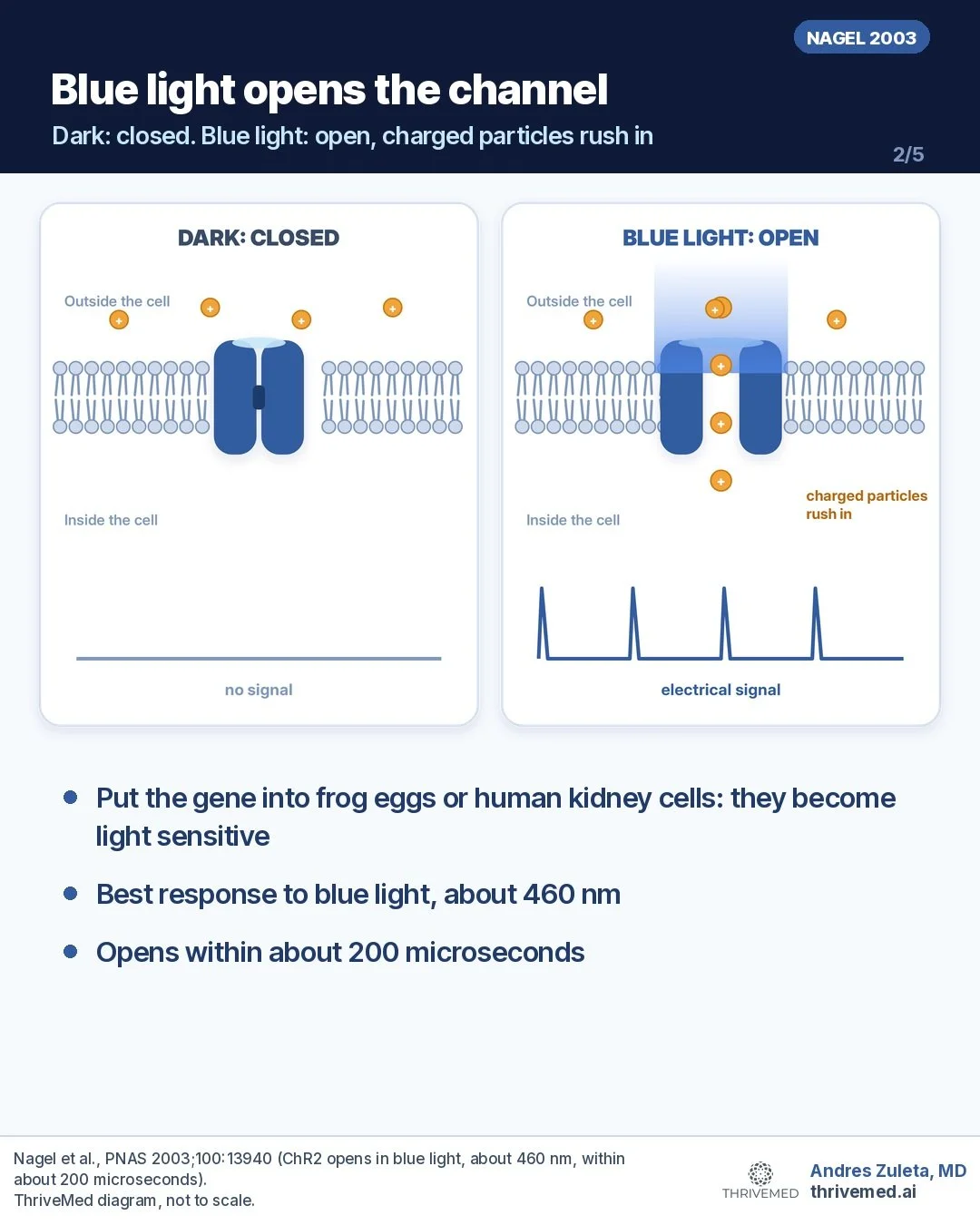
In the dark the channel is closed; blue light opens it and charged particles flow in. ThriveMed diagram, drawn after Nagel et al., PNAS 2003. Not to scale.
Then a young Stanford scientist took the baton. Karl Deisseroth had trained in psychiatry and had seen how rarely treatments helped his patients enough. He wrote to Nagel and asked for the gene. In 2005, his team used an engineered virus to carry it into rat nerve cells growing in a dish. Flash blue light, and the cells fired, pulse by pulse, on a millisecond timescale. In 2006 the method got its name: optogenetics. By 2007, a thin optical fiber carried light into the brains of living mice and moved their whiskers.
2. The results
A switch for brain cells: before optogenetics, scientists could rarely prove which brain cells cause which behavior. Electrical stimulation also fires neighboring cells, and drugs spread widely. Now scientists could switch one specific type of brain cell on or off, in a living animal, at the speed the brain works.
Maps of behavior: labs have since traced circuits behind fear memories, reward, anxiety, sleep, thirst and even parenting in mice. At Stanford, Deisseroth and a colleague reversed Parkinson's symptoms in mice.
The first person: in 2021, researchers described a man blinded by retinitis pigmentosa, an inherited disease that destroys the eye's rods and cones. Doctors injected one eye with an engineered virus carrying a light-sensing gene, a cousin of the alga's protein. He wore special goggles that project pulses of light onto the retina. With them, he could perceive, locate, count and touch objects on a table, and brain recordings showed his visual cortex responding. Before the injection, he could not detect those objects at all.
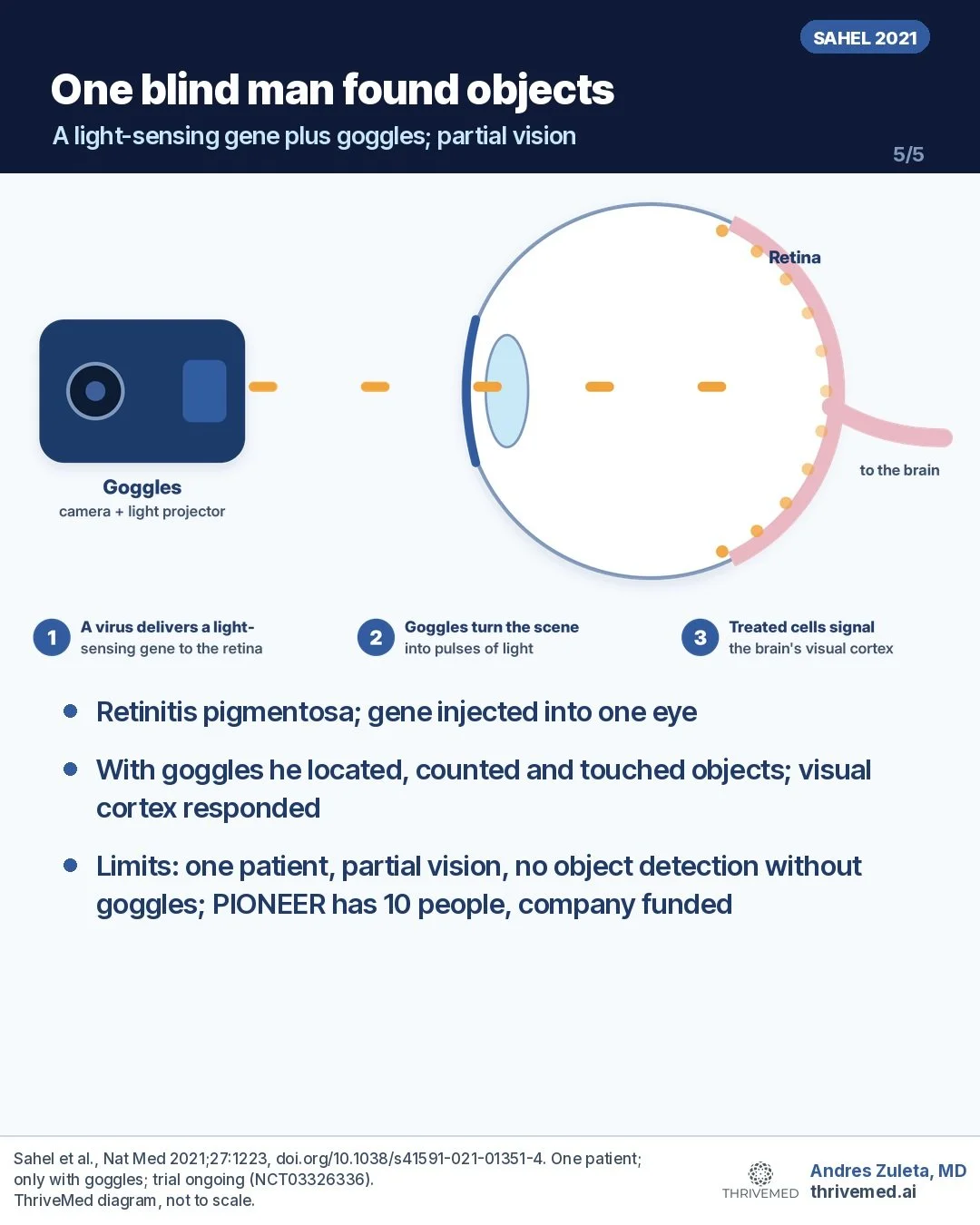
A virus delivers a light-sensing gene to surviving retinal cells; goggles turn the scene into light pulses. ThriveMed diagram, drawn after Sahel et al., Nat Med 2021. Not to scale.
The authors call it the "first reported case of partial functional recovery in a neurodegenerative disease after optogenetic therapy."
3. The drawbacks
One patient. This is a single case, and his vision is partial. He could pick out high-contrast objects, and only with the goggles on. Without them, he still could not detect the objects.
Two extra parts. It needs two things most medicines do not: a virus to deliver a gene, and a light source.
A small trial, still running. The trial behind this case, PIONEER, has just 10 people and will not finish its main phase until 2027.
Funding. The company developing the therapy funded the study, and several authors work for it or have financial ties.
Mostly animals so far. Even the original switch fades under constant light, so labs keep engineering better versions. Most of what we know still comes from animals and cells in a dish. In the brain, optogenetics is a research tool, not a treatment.
4. The possibilities
For vision, the Nobel committee says several optogenetic trials for retinitis pigmentosa are underway. If they hold up, people who have lost their rods and cones might regain some useful sight. For hearing, researchers hope light could make cochlear implants more precise than electricity does.
For the brain, Deisseroth, who still sees patients, says that once you know which cells matter in a symptom, you can design any method you like to target them. This matters for the future because it could mean sharper treatments for depression, Parkinson's, anxiety or addiction, built on a real map of the brain instead of a sketch.
What you can do for your brain today
You do not need a light switch in your head to look after your brain. These steps come from a randomized trial and a major expert review. They support brain health. They cannot prevent every case of dementia and do not replace care.
Keep moving. In a randomized trial of 120 older adults, a year of walking 3 days a week grew the hippocampus, a memory center, by about 2%, and memory improved. The stretching group's hippocampus shrank.
Get your eyes checked. The 2024 Lancet Commission lists untreated vision loss among 14 changeable risk factors for dementia.
Treat hearing loss. Hearing loss is on the same list.
Know your LDL cholesterol. High LDL cholesterol was added to the list in 2024.
Stack the habits. In the FINGER trial, 1,260 adults aged 60 to 77 who combined diet, exercise, brain training and heart-risk care for 2 years had a small thinking benefit.
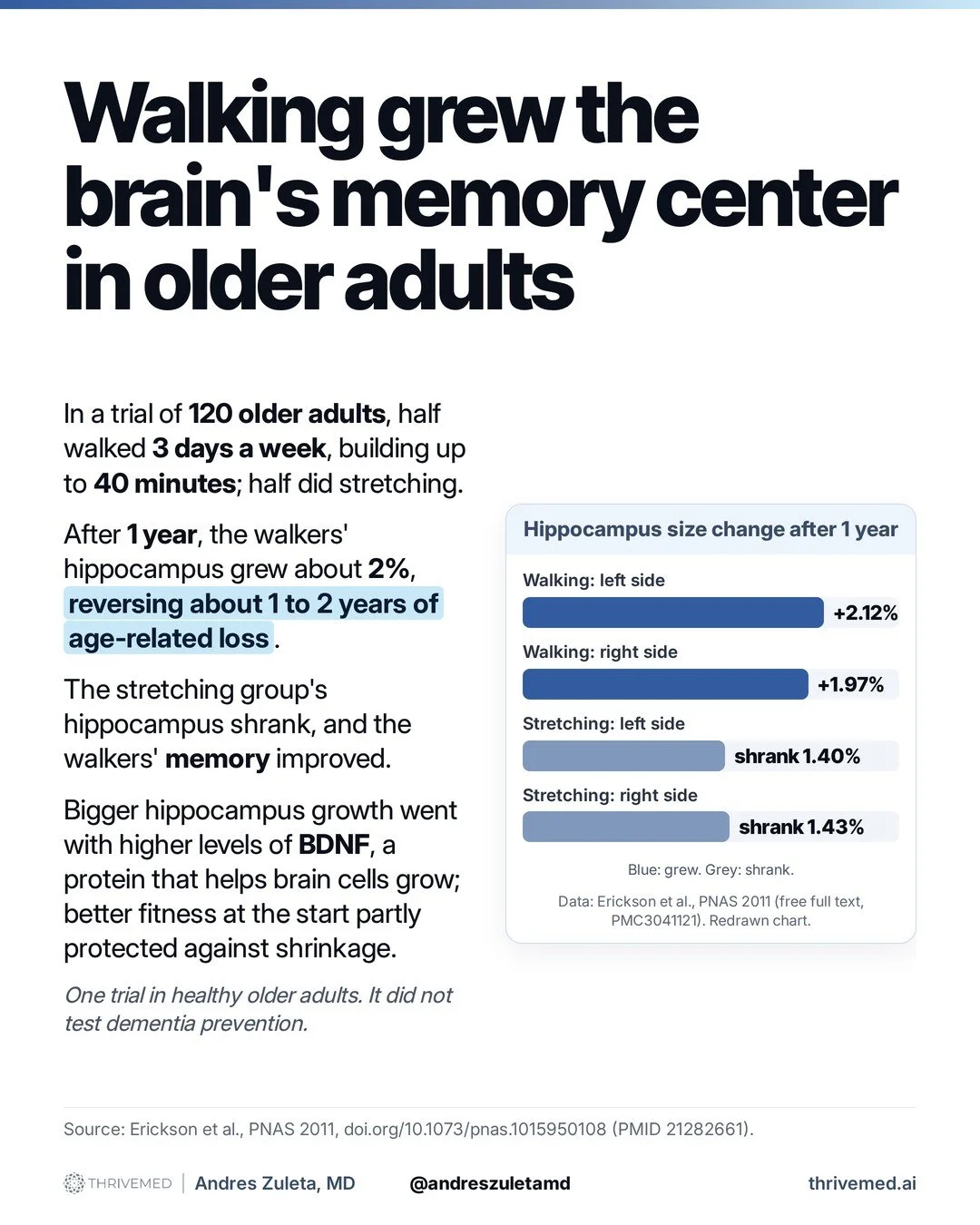
Hippocampus size change after 1 year of walking vs stretching. ThriveMed chart, redrawn from Erickson KI, et al., PNAS 2011 (free full text, PMC3041121).
FAQ
Can optogenetics cure blindness now? No. One patient regained partial vision, only with goggles. Trials are still running.
Is optogenetics used to treat brain conditions in people? Not yet. In the brain it is a research tool that helps scientists learn which cells drive a symptom.
Is this right for me or my family? If you or a loved one has retinitis pigmentosa, bring this article to your eye care team and ask about clinical trials.
If you want the more detailed, physician-level read, I wrote it on my own site: Optogenetics Wins the 2026 Nobel: My Read on the Discovery, the First Patient and the Limits.
Small beginnings can light the way. Be proactive. Learn more at thrivemed.ai.
References
Nobel Assembly at Karolinska Institutet. Press release, October 5, 2026. nobelprize.org/prizes/medicine/2026/press-release
Nobel scientific background. Optogenetics: discovery of a neuronal switch. nobelprize.org (PDF)
Nagel G, et al. Channelrhodopsin-2, a directly light-gated cation-selective membrane channel. PNAS 2003;100:13940-13945. doi.org/10.1073/pnas.1936192100
Boyden ES, et al. Millisecond-timescale, genetically targeted optical control of neural activity. Nat Neurosci 2005;8:1263-1268. doi.org/10.1038/nn1525
Sahel J-A, et al. Partial recovery of visual function in a blind patient after optogenetic therapy. Nat Med 2021;27:1223-1229. doi.org/10.1038/s41591-021-01351-4
PIONEER trial. ClinicalTrials.gov NCT03326336
Erickson KI, et al. Exercise training increases size of hippocampus and improves memory. PNAS 2011;108:3017-3022. doi.org/10.1073/pnas.1015950108
Livingston G, et al. Dementia prevention, intervention, and care: 2024 report of the Lancet standing Commission. Lancet 2024;404:572-628. doi.org/10.1016/S0140-6736(24)01296-0
Ngandu T, et al. (FINGER). Lancet 2015;385:2255-2263. PMID 25771249.
Stanford University on X, family video, October 5, 2026 (linked, not reproduced): x.com/Stanford/status/2107133480220152219
Educational only, not medical advice. The video uses an AI avatar sharing my script. Diagrams are original ThriveMed illustrations drawn after the cited papers.