
Frail and on a Weight-Loss Drug? What a 17,604-Person Heart Study Found
By Andres Zuleta, MD, ThriveMed · Patient and family education
If your mom, your dad or you are frail, you may have heard that weight-loss drugs could make things worse. The worry makes sense: if the body has little reserve, losing weight could leave it weaker. On September 16, 2026, a large new analysis in JAMA Cardiology put that worry to the test in 17,604 people with heart disease.
The answer, so far, is encouraging, with real caveats. Below, I walk you through the study, the results, the drawbacks and the possibilities in plain language, plus simple, science-backed ways to protect strength.

The short version
The study: researchers went back to the SELECT trial, where 17,604 adults with heart disease and overweight, none with diabetes, took weekly semaglutide or a placebo. They sorted everyone by a 31-item frailty score.
The results: protection against heart attack, stroke and heart death held up across frailty levels. After two years, people on semaglutide had about 2.5 times the odds of becoming less frail and about half the odds of becoming more frail.
The drawbacks: the analysis was done after the trial, the frailty score is not a strength test, no one had diabetes, very old adults were few, and the drug's maker funded the trial.
The possibilities: the authors write that frailty status should not rule out considering semaglutide in eligible people.
Your next step: whatever you decide about medication, make strength part of the plan.
Watch: frailty and semaglutide in 5 minutes
Short on time? Watch the 49-second version on YouTube Shorts.
What is frailty?
Frailty is not just about age. It is when small health problems pile up, so the body has less reserve to bounce back from an illness, a fall or a hospital stay. In this study, frailty was measured with a 31-item score that adds up health problems such as conditions, symptoms and limits in daily life. A higher score means less reserve.
Semaglutide is a once-weekly injection in a class called GLP-1 drugs. It mimics a gut hormone that helps control appetite. In the main SELECT trial, published in 2023, it lowered major heart events by 20% in people with heart disease and overweight who did not have diabetes.
1. The study
The researchers used data from SELECT. Everyone had established heart disease and a BMI of 27 or higher, and no one had diabetes. They took semaglutide 2.4 mg once a week or a placebo. The average participant was in their early sixties, and nearly three quarters were men.
Using the frailty score, 31% were not frail, 47% were more frail and 22% were most frail. In other words, about 7 in 10 people in this heart trial already carried some frailty.
2. The results
The heart: people who were more frail had more heart attacks, strokes and heart deaths, as expected. The benefit of semaglutide appeared consistent across all three groups. In the middle group, the rate was about 30% lower.
Other outcomes: semaglutide also reduced heart failure events, hospital stays and deaths from any cause, whatever a person's frailty.
Frailty itself: after two years, people on semaglutide had about 2.5 times the odds of moving to a less frail group, and about half the odds of moving to a more frail one.
How people felt: quality-of-life gains appeared larger in the frailer groups.
Side effects: the extra risk of stopping the drug because of side effects appeared smaller the frailer people were.
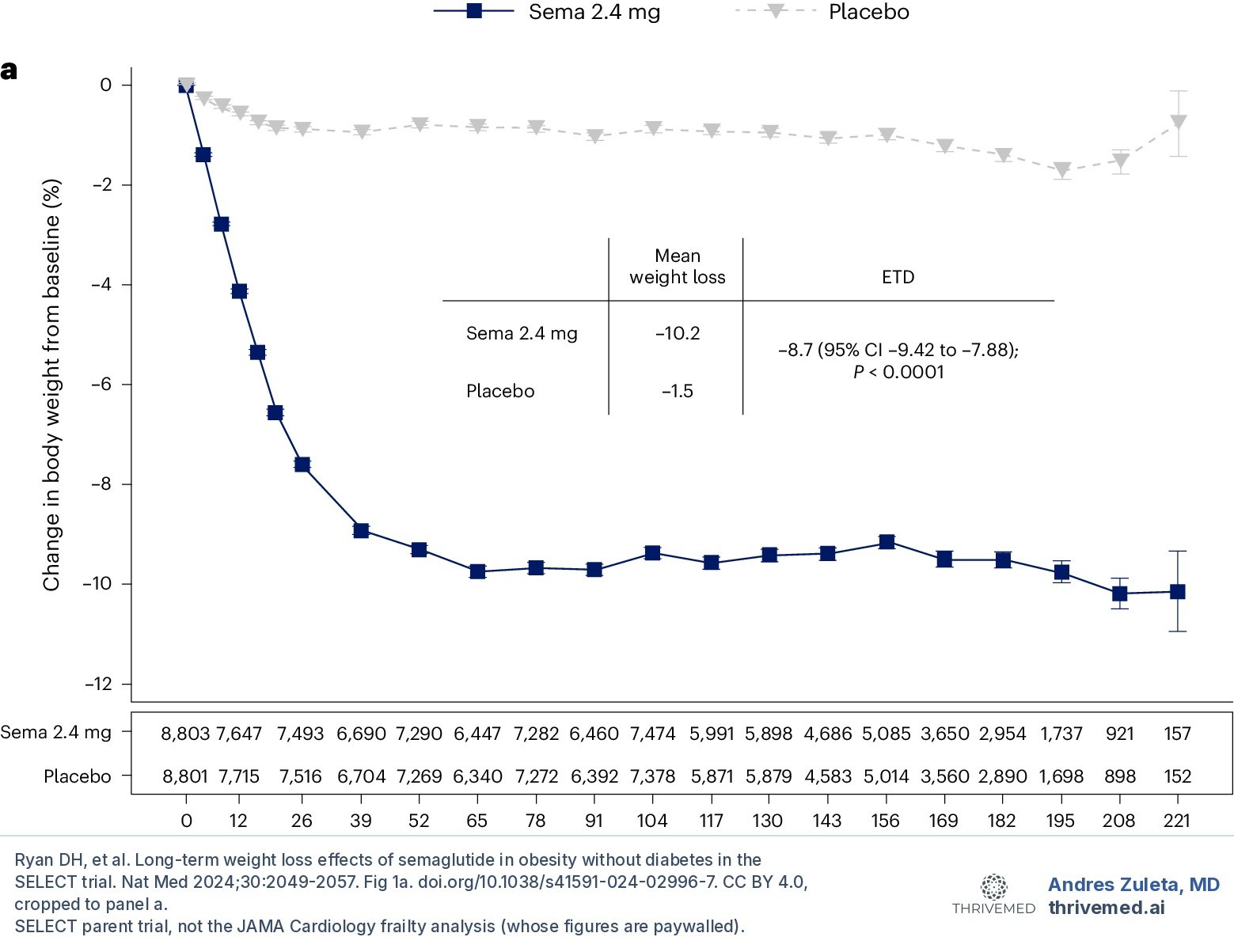
Weight change over about four years in the main SELECT trial (not the frailty analysis). Ryan DH, et al., Nat Med 2024, Fig 1a, CC BY 4.0, cropped.
3. The drawbacks
After the fact. This analysis was done after the trial ended, so the authors call it hypothesis-generating. The lead author, Dr. John Ostrominski, said the findings "should be cautiously interpreted."
Not conclusive in every group. In the least frail and the most frail groups, the heart results alone were not conclusive. The consistency comes from comparing the groups.
A score, not a strength test. The frailty score counts health problems. It does not measure muscle, grip or walking speed, and the study was not designed to tell us whether muscle loss on these drugs raises fall risk.
Who was studied. No one had diabetes, most were men, and very old adults were few.
Funding and side effects. SELECT was funded by Novo Nordisk, the drug's maker, and four authors work for the company. In the main trial, 16.6% of people stopped semaglutide for side effects, compared with 8.2% on placebo.
4. The possibilities
Until now, whether frailty changes the balance of benefits and risks for these drugs was uncertain. The authors conclude that "frailty status should not preclude consideration of semaglutide in eligible people with cardiovascular disease and overweight or obesity."
This matters for the future because it could mean frailer people are no longer left out of treatments that protect the heart, and that care could aim at two goals at once: a stronger heart and a body with more reserve. The next step is trials built for older, frailer adults.
Protecting your strength
These steps come from guidelines, trials and large studies in older adults. They help protect strength and reserve. They do not replace heart care or medication.
Strength training first. International frailty guidelines make exercise with resistance training the first-line treatment. In a Cochrane review of 121 trials, it had a large effect on muscle strength in older adults.
A little goes a long way. In 16 cohort studies, about 30 to 60 minutes a week of muscle-strengthening activity was linked to the lowest risk of death.
Enough protein. An expert group advises at least 1.0 to 1.2 g of protein per kg of body weight a day after age 65, unless kidneys are badly weakened.
Exercise with the drug. In one trial, exercise plus a GLP-1 drug (liraglutide) cut body fat about twice as much as either alone.
Ask for a frailty screen. Guidelines advise screening older adults with a validated tool.
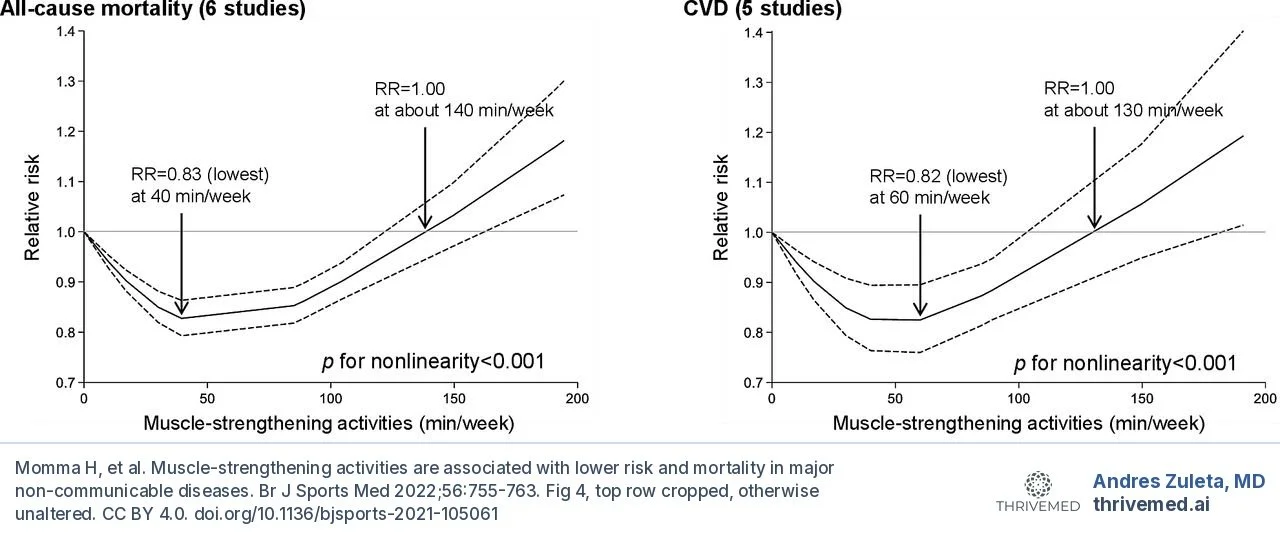
Weekly minutes of muscle-strengthening activity and the risk of death from any cause and from heart disease. Momma H, et al., Br J Sports Med 2022, Fig 4, top row, CC BY 4.0.
FAQ
Does semaglutide treat frailty? No. This study found frailty scores were more likely to improve, but it was not designed to test semaglutide as a frailty treatment.
Does it cause muscle loss? Weight lost on GLP-1 drugs includes some lean mass. This study did not measure muscle, which is why strength training matters.
Is this right for me? That depends on your health, your goals and your medicines. Bring this article to your care team.
If you want the more detailed, physician-level read of this study, I wrote it on my own site: Frailty Should Not Preclude Semaglutide? My Read of the SELECT Frailty Analysis.
Your strength is not fixed. You can build it, later in life too. Be proactive. Learn more at thrivemed.ai.
References
Ostrominski JW, Plutzky J, Scirica BM, et al.; SELECT Trial Investigators. Efficacy and Safety of Semaglutide According to Frailty Status: A Post Hoc Analysis of the SELECT Randomized Clinical Trial. JAMA Cardiol, published online September 16, 2026. doi.org/10.1001/jamacardio.2026.3566 (free abstract: PubMed 42747817)
Lincoff AM, et al. Semaglutide and Cardiovascular Outcomes in Obesity without Diabetes. N Engl J Med 2023;389:2221-2232. doi.org/10.1056/NEJMoa2307563
Ryan DH, et al. Long-term weight loss effects of semaglutide in obesity without diabetes in the SELECT trial. Nat Med 2024;30:2049-2057. doi.org/10.1038/s41591-024-02996-7
Dent E, et al. Physical Frailty: ICFSR International Clinical Practice Guidelines. J Nutr Health Aging 2019. PMID 31641726.
Liu CJ, Latham NK. Progressive resistance strength training for improving physical function in older adults. Cochrane Database Syst Rev 2009. PMID 19588334.
Momma H, et al. Br J Sports Med 2022;56:755-763. doi.org/10.1136/bjsports-2021-105061
Bauer J, et al. (PROT-AGE). J Am Med Dir Assoc 2013. PMID 23867520.
Lundgren JR, et al. N Engl J Med 2021. PMID 33951361.
Educational only, not medical advice. Approximations ("about 30%", "about 2.5 times", "about half", "about 7 in 10") are rounded from the published figures.