Less Chemo, Better Results for Kids With High-Risk Leukemia? What Families Should Know
By Andres Zuleta, MD, ThriveMed · Patient and family education
When a child has high-risk leukemia, the treatment can be as hard as the disease. A large new trial asked a simple question: could an immune drug replace two of the toughest rounds of chemotherapy? On September 17, 2026, the results were published in the New England Journal of Medicine.
The answer, so far, is encouraging, with real trade-offs. Below, I walk you through the trial, the results, the drawbacks and the possibilities in plain language, plus three questions to bring to your child's care team.
The short version
The trial: 709 children and teens with newly diagnosed high-risk B-cell acute lymphoblastic leukemia (ALL) were randomly split into two groups. One got two more rounds of intensive chemotherapy. The other got two cycles of an immune drug called blinatumomab instead.
The results: at 4 years, 83.0% of children in the blinatumomab group were free of a serious setback, compared with 70.3% with chemotherapy. Treatment-related infections fell from 69.4% to 23.9%.
The drawbacks: nerve side effects were about 4 times as common with blinatumomab, the drug is given through a pump for weeks at a time, and the results are from an early, planned look at the data.
The possibilities: for the first time, according to the trial leaders, an immunotherapy replaced part of the harshest first-line chemotherapy for these children.
Your next step: talk it through with your child's care team.
Watch: the blinatumomab trial in 5 minutes
Short on time? Watch the 52-second version on YouTube Shorts.
What is blinatumomab?
ALL is the most common childhood cancer. In B-cell ALL, the cancer starts in young B cells, a type of white blood cell. Most of these cells carry a marker on their surface called CD19.
Blinatumomab is an antibody with two "hands." One hand grabs CD19 on the leukemia cell. The other grabs a T cell, one of the immune system's own killer cells, and pulls the two together so the T cell can destroy the leukemia cell. It is given as a continuous infusion through a small pump, in cycles of 28 days.
1. The trial
The trial is part of a long-running European program called AIEOP-BFM ALL 2017, led by academic doctors at more than 100 hospitals in 8 countries. About 1 in 5 children with ALL fall into the high-risk group, according to the German Cancer Aid, one of the trial's funders.
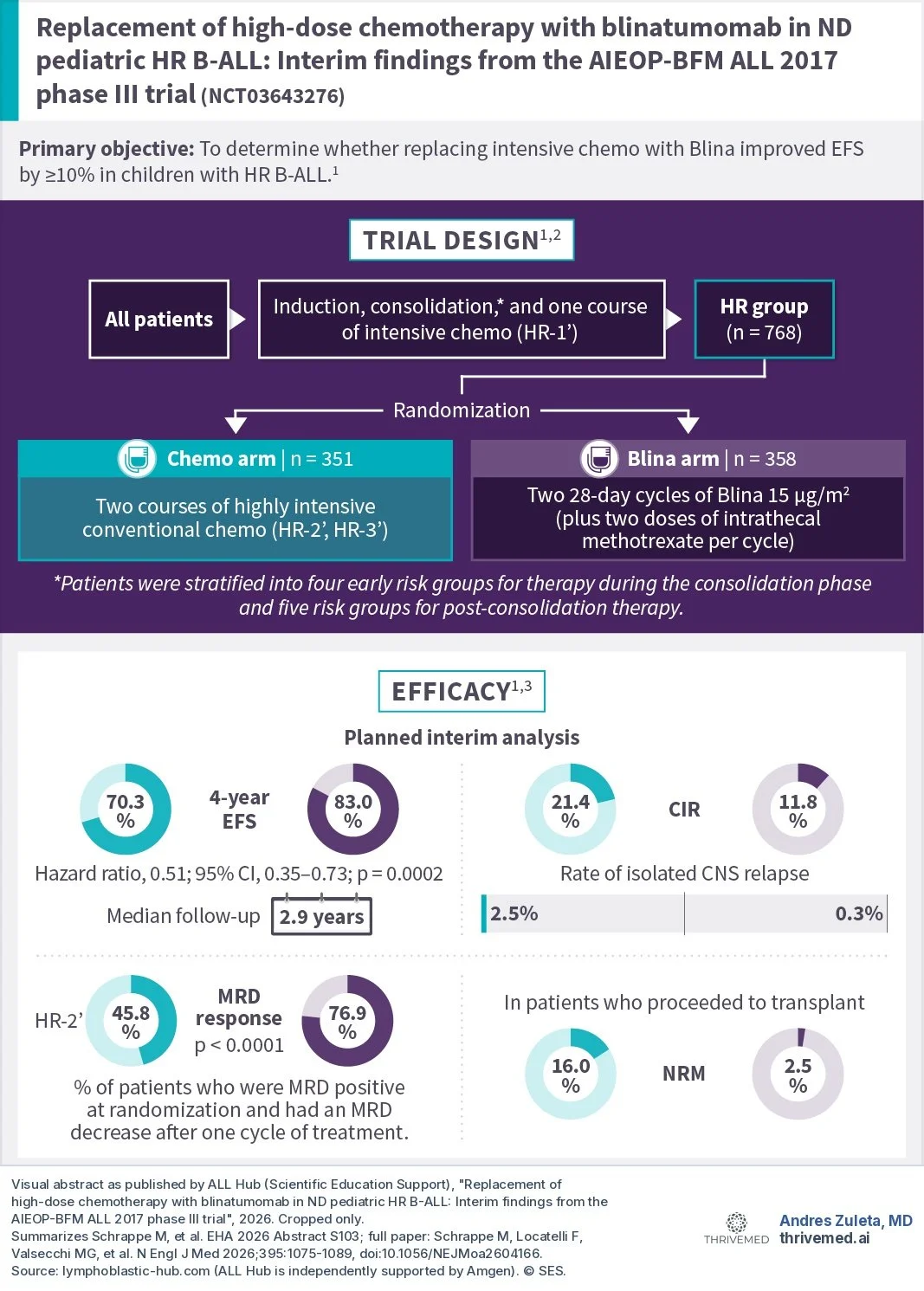
Of 768 eligible children and teens under 18 with newly diagnosed high-risk B-cell ALL, 709 were randomly assigned to one of two groups after the first phases of treatment:
Chemotherapy group (351 children): two more cycles of intensive chemotherapy, the standard approach.
Blinatumomab group (358 children): two cycles of blinatumomab in place of those two chemotherapy cycles.
The main goal was event-free survival: staying free of the leukemia not responding, the leukemia coming back, a second cancer, or death. The researchers hoped blinatumomab would improve this by 10 percentage points at 4 years.
2. The results
These results come from a planned early analysis, after a median follow-up of 2.9 years.
Visual abstract: ALL Hub, Scientific Education Support (SES), 2026, summarizing Schrappe M, et al., EHA 2026 Abstract S103. ALL Hub is independently supported by Amgen. © SES. Shown as published, cropped only. It also shows some conference numbers (such as MRD response) that differ in definition from the journal paper; this article uses the paper's numbers.
More children stayed free of a serious setback. At 4 years, event-free survival was 83.0% with blinatumomab and 70.3% with chemotherapy. That is about half the risk of an event (hazard ratio 0.51).
Relapses nearly halved. The leukemia came back in 11.8% of the blinatumomab group at 4 years, compared with 21.4% with chemotherapy, as presented at the European Hematology Association meeting in June 2026.
Far fewer infections. Treatment-related infections dropped from 69.4% to 23.9%, about a third as many. Life-threatening side effects were rare with blinatumomab: 2 children (0.5%) compared with 16 (4.7%) with chemotherapy. One child in the blinatumomab group died of a treatment side effect (0.3%).
Overall survival is not yet different. At 4 years, 93.6% of children were alive in the blinatumomab group and 91.0% in the chemotherapy group, a difference that is not statistically significant yet. Survival in both groups was high.
3. The drawbacks
I want you to have the full picture, not just the headline.
Nerve side effects were more common. Problems such as seizures, confusion or trouble speaking happened in 12.0% of children with blinatumomab, compared with 3.2% with chemotherapy, about 4 times as common. Why this happens is not fully understood.
Cytokine release syndrome, an inflammatory reaction to the immune activation, happened at grade 2 or higher in 1.1% of the blinatumomab group.
The pump. Blinatumomab runs continuously for 28 days per cycle, which means carrying a small pump and line care at home.
This is an early look. The results come from a planned interim analysis. Longer follow-up will tell us more, including about survival.
Open questions. The best timing for blinatumomab is not yet established, and the analyses of smaller groups of children were small and done after the fact.
Who funded it. This was an academic trial funded by the German Cancer Aid and others. Some authors work for Amgen, the company that makes blinatumomab.
4. The possibilities
For the first time, according to the trial leaders, an immunotherapy replaced part of the most burdensome first-line chemotherapy in childhood ALL. That could mean fewer infections, fewer hospital stays and more normal childhood for children in the future.
An editorial in the New England Journal of Medicine called blinatumomab "a new standard of care" in B-cell ALL. The trial group plans a follow-on study. Could is the key word: longer follow-up will show how lasting these benefits are.
Three questions to bring to your child's care team
Is my child's leukemia considered high risk, and would blinatumomab be an option in their treatment plan?
What would the pump and home care look like for our family?
Which nerve side effects should we watch for, and who do we call if we see them?
If you want the more detailed, physician-level read of this trial, I wrote it on my own site: Less Chemo, Better Results: My Read of the Blinatumomab Trial in High-Risk Childhood ALL.
Be proactive. Learn more about proactive care at thrivemed.ai.
Sources
Schrappe M, Locatelli F, Valsecchi MG, et al. Blinatumomab for Replacing Chemotherapy in Pediatric Acute Lymphoblastic Leukemia. New England Journal of Medicine 2026;395(11):1075-1089, published September 17, 2026. doi.org/10.1056/NEJMoa2604166
Myers RM, Hunger SP. Blinatumomab, A New Standard of Care in Acute Lymphoblastic Leukemia. New England Journal of Medicine 2026 (editorial). doi.org/10.1056/NEJMe2610500
Schrappe M, et al. AIEOP-BFM ALL 2017, European Hematology Association 2026 Congress, plenary abstract S103 (relapse data).
Visual abstract: ALL Hub, Scientific Education Support, 2026.
This article is for education only and is not medical advice. Approximate phrasings ("about half", "about 4 times", "about a third") are rounded from the published numbers shown next to them.