
The First Hormone Built by Chemists, and the Mothers Who Proved It Worked
By Andres Zuleta, MD, ThriveMed · Patient and family education
Picture a new mother in a New York hospital in the early 1950s. A doctor gives her about one millionth of a gram of a hormone. No gland made it. A team of chemists built it in a lab. Within 20 to 30 seconds, her milk begins to flow, exactly as it would with her own hormone.
That hormone was oxytocin, and it was the first peptide hormone ever made by chemists. This is Episode 3 of my 15-part series, The Peptide Breakthroughs.
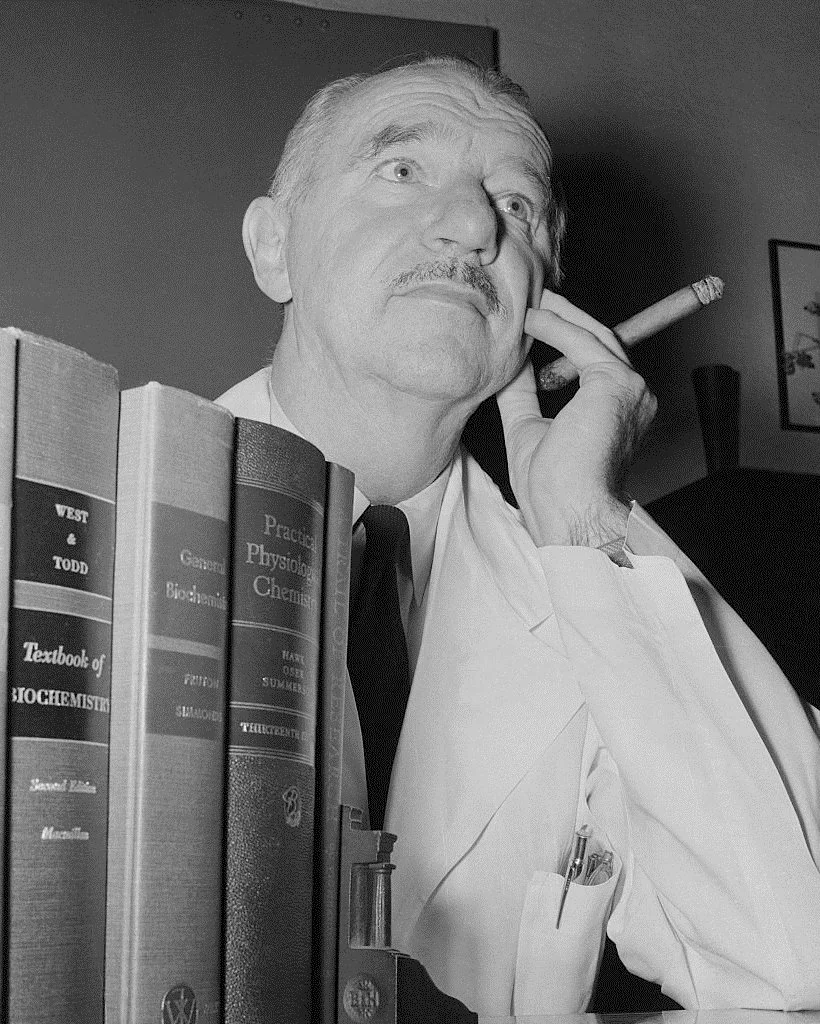
Vincent du Vigneaud, 1955. Public domain.
The short version
- The discovery: in October 1953, Vincent du Vigneaud's team at Cornell reported that they had built oxytocin from scratch. A year later they built vasopressin.
- The results: in new mothers, the lab-made hormone "could not be distinguished" from the natural one. He won the 1955 Nobel Prize in Chemistry.
- The limits: the chemistry was slow, oxytocin needs cold storage, and the popular "love hormone" sprays have not held up in large trials.
- The possibilities: once a hormone can be built, it can be redesigned. Desmopressin followed, and oxytocin now helps prevent the most common cause of maternal death.
Watch
1. The discovery
Oxytocin and its sister hormone vasopressin are made in the back of the pituitary, a gland about the size of a bean under the brain. Oxytocin makes the womb contract during birth and lets milk flow. Vasopressin helps the kidneys hold on to water.
Du Vigneaud had been curious about hormones since 1923, when he heard a lecture about the new insulin from Toronto (that was Episode 2). His team worked out oxytocin's structure: a tiny chain of amino acids closed into a ring by two linked sulfur atoms. The Nobel committee compared it to a combination lock: the right pieces in the wrong order do nothing. Then they built it, one link at a time.
A note on counting: the 1953 paper calls oxytocin an "octapeptide", eight units, because the two sulfur-carrying building blocks were counted as one. Today it is described as nine amino acids.
2. The results
The lab version matched the natural hormone in every test they had, down to the shape of its crystals, which du Vigneaud described as "fine, silky needles." Then came the test in people. At the hospital on the same medical campus, natural and synthetic oxytocin were compared in women who had just given birth. The synthetic hormone started labor and made milk flow, and in du Vigneaud's words it "could not be distinguished from the natural oxytocin in its action."
3. The limits
- Slow chemistry. Building it took many careful steps with low yields. Faster methods came a decade later (Episode 5).
- A fridge-dependent medicine. Oxytocin needs cold storage, which many places in the world do not have.
- The hype. You may see oxytocin sold as a "love hormone" spray. A 2016 review found most of those studies too small to trust, and a 2021 trial in 290 children and teens with autism found the spray did no better than placebo over 24 weeks.
4. The possibilities
In 1967, chemists in Prague changed two small pieces of vasopressin. The result, desmopressin, lasted longer and barely raised blood pressure. In 1968 it helped patients with diabetes insipidus, a condition where the body cannot hold water, and in 1978 it was approved in the United States as a nasal spray.
Heavy bleeding after birth is the most common cause of maternal death, and oxytocin is the standard way to prevent it. In 2018, a World Health Organization trial in 29,645 women in 10 countries found that a heat-stable cousin of oxytocin worked about as well, which matters where fridges are scarce. More than 80 peptide drugs have now reached the market.
Two ideas you can use
- If you are expecting, plan for skin-to-skin contact after birth. In a 2016 Cochrane review, mothers who held their newborn skin to skin were about a quarter more likely to still be breastfeeding one to four months later.
- Ask for the trial in people. Du Vigneaud tested his hormone side by side with the real one. When a peptide is sold with a big promise, hold it to the same standard.
Want a proactive plan for your own health? Join Thrive Nation.
Sources: du Vigneaud V, et al. J Am Chem Soc, Oct 1953 (doi.org/10.1021/ja01115a553); du Vigneaud V, et al. J Am Chem Soc 1954 (doi.org/10.1021/ja01647a089); Nickerson K, et al. Am J Obstet Gynecol, May 1954 (PMID 13148259); du Vigneaud V, Nobel lecture, Dec 12, 1955; Vávra I, et al. Lancet, May 4, 1968 (PMID 4171585); Walum H, et al. Biol Psychiatry 2016 (PMID 26210057); Sikich L, et al. NEJM, Oct 14, 2021 (PMID 34644471); Widmer M, et al. NEJM, Aug 23, 2018 (PMID 29949473); Moore ER, et al. Cochrane, Nov 25, 2016 (PMID 27885658). Images: public domain; Nationaal Archief / Anefo, CC0. Educational only, not medical advice.