
Should You Get an Lp(a) Test? What a New Lancet Study Means for Your Care at ThriveMed
By Andres Zuleta, MD, Clinical Writer, ThriveMed · Patient education · Published September 29, 2026
If you have had your cholesterol checked, you probably assumed the panel covered everything that matters. It usually does not. One of the most important inherited heart risk markers, lipoprotein(a) or Lp(a), sits outside the standard cholesterol panel. It has to be ordered on its own, and most people have never had it.
A new study in The Lancet has put this lab back in the spotlight. Below, I walk you through what Lp(a) is, what the new research found, and most importantly, what it means for your care here at ThriveMed.

The short version
Lp(a) is mostly genetic. About 80 to 90% of your level is inherited, so diet and exercise barely move it.
You cannot feel it. High Lp(a) usually causes no symptoms. A blood test is the only way to know.
A new drug showed a big drop. In an early trial, one shot of an investigational siRNA called Kylo-11 lowered Lp(a) by about 95 to 97% at the highest doses, for nearly a year.
It is not a treatment you can get. Kylo-11 is not FDA approved and has not been shown to prevent heart attacks or strokes.
Your next step is simple. Ask for the Lp(a) lab. For most people, it is a once-in-a-lifetime test.
What is Lp(a), and why is it not on your usual cholesterol panel?
Lp(a), pronounced "L-P-little-a," is a particle that carries cholesterol through your blood, a lot like LDL, the "bad cholesterol" you may already know. Because of how it is built, a high Lp(a) level can contribute to plaque in your arteries and make blood more likely to clot. That is why it is linked to heart attack and stroke risk.
What makes Lp(a) different is where it comes from. Your LDL responds to food, activity, weight, and medicine. Your Lp(a) is largely set by the genes you were born with. That has two practical consequences for you:
Healthy habits will not fix a high Lp(a), even though they still protect your heart in many other ways.
Your level tends to stay stable, which is why one test usually tells the story.
Right now, there is no approved medication designed specifically to lower Lp(a). According to the National Heart, Lung, and Blood Institute, a one-time screening is sufficient for most people because the level does not change much over time. The American Heart Association also offers a helpful patient overview.
The new Kylo-11 study, in plain language
On August 28, 2026, The Lancet published a first-in-human Phase 1 trial of Kylo-11, led by Ashish Sarraju, MD, of Cleveland Clinic (read the study via its DOI).
Who was in it: 71 people enrolled in China, and 70 received a single injection of either Kylo-11 or a placebo. They were followed for about 48 weeks.
How the drug works: Kylo-11 is a small interfering RNA, or siRNA. Think of it as a mute button for your liver's Lp(a) factory. It sends a gene-silencing signal to liver cells that turns down production of apo(a), one of the building blocks of Lp(a). Less apo(a) means your body makes far less Lp(a).
What happened: One shot lowered Lp(a) by roughly 53 to 97% at 48 weeks, depending on the dose. At the highest doses, the drop was about 95 to 97%, and it lasted nearly a year. Doses of 225 mg and higher held their effect, and the 600 mg group showed a median reduction of about 97%. The placebo group, by comparison, stayed essentially flat.
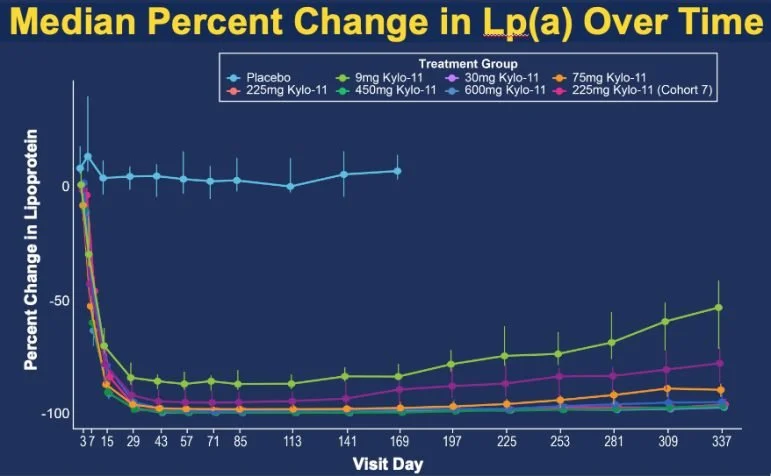
Median percent change in Lp(a) over time by dose group in the Kylo-11 Phase 1 trial (educational use from published Phase 1 materials; Sarraju et al., The Lancet, 2026). Placebo stays near zero while every Kylo-11 group drops sharply.
Safety: The drug was generally well tolerated, and no serious drug-related adverse events were reported.
Why this study is getting attention
For the first time, people with an inherited risk marker that lifestyle cannot touch saw it drop by as much as 95 to 97% after a single shot, and stay down for nearly a year. For a number doctors have long considered essentially untreatable, that is a real clinical advance.
This matters for the future because it could mean that someday, if you were born with high Lp(a), you might have a treatment that targets the actual source of that risk. If larger trials show that lowering Lp(a) this way prevents heart attacks and strokes, it could reshape how we plan heart disease prevention for families where high Lp(a) runs. We are not there yet, and I want to be straightforward with you about that.
What this study does not tell you yet
When I talk with ThriveMed patients about research news, I always separate the promise from the proof:
This was a small, early trial. Phase 1 studies check safety and whether a drug moves a lab number.
It is not proven to reduce heart attacks or strokes. That takes larger outcome trials.
It is not FDA approved, and it is not available at ThriveMed or anywhere else for routine care.
The research continues. A Phase 2 trial is already underway by the sponsor, Kylonova Biopharma, in collaboration with Cleveland Clinic.
What this means for your care at ThriveMed
You do not need to wait for a new drug to take the most useful step available today. Here is how we approach Lp(a) with our patients.
Step 1: Get the Lp(a) lab
Ask us to add a lipoprotein(a) test to your blood work. It is a simple blood draw, and for most people it only needs to be done once unless something changes clinically.
Step 2: Put your number in context
Lp(a) is one piece of your heart disease risk, not the whole picture. We look at it alongside your family history, LDL and full cholesterol lab results, blood pressure, blood sugar, smoking history, and markers of inflammation.
Step 3: Tighten what you can control
If your Lp(a) is high, the plan today is to manage every other risk factor more aggressively. That can mean a closer look at your LDL, blood pressure, and metabolic health, with a plan built around you.
Step 4: Follow the science together
As Phase 2 and Phase 3 results come in, we will keep watching. If an Lp(a) therapy is ever approved, knowing your number now means you will already be ready for that conversation.
Who should especially ask about Lp(a)?
Consider bringing it up at your next visit if you have a family history of early heart attack or stroke, a personal history of heart disease, high LDL that has been hard to bring down, or you simply have never had it checked. The NHLBI notes that testing is recommended for people with a family history of premature heart disease and for some people whose LDL has not responded to statins.
Want a physician's deeper read on the trial data itself? I break down the dose-by-dose results on my personal site: One Shot, Nearly a Year of Lower Lp(a): My Honest Read of the Kylo-11 Lancet Study. You might also like our earlier ThriveCity piece, Your Heart Is Not the Same Age as Your Brain.
Watch: Lp(a) and Kylo-11 in 3 minutes
Want more? Watch the full 5-minute breakdown or the 45-second Short.
More from me: YouTube at Andres Zuleta, MD, Instagram at @andreszuletamd (see the Kylo-11 Reel), and my LinkedIn post on the study. You can also explore the full Kylo-11 study one-pager with figures.
Frequently asked questions
What is an Lp(a) test?
An Lp(a) test is a blood test that measures lipoprotein(a), a cholesterol-carrying particle linked to heart attack and stroke risk. It is not part of a standard cholesterol panel, so it usually has to be requested separately.
How often do I need an Lp(a) test?
For most people, once. Because about 80 to 90% of your Lp(a) level is inherited, it tends to stay stable over your life. Your clinician may recheck it if something changes clinically.
Is Kylo-11 available at ThriveMed?
No. Kylo-11 is an investigational siRNA drug that has only completed a small Phase 1 trial. It is not FDA approved and is not available for routine care anywhere.
If my Lp(a) is high, what can I do now?
Work with your clinician to manage the risk factors you can change: LDL cholesterol, blood pressure, blood sugar, smoking, and inflammation. Lowering your overall heart disease risk is the practical plan while Lp(a) drugs are still being studied.
Did the Kylo-11 study prove it prevents heart attacks?
No. The Phase 1 study showed large, lasting drops in Lp(a) and no serious drug-related adverse events, but it did not measure heart attacks or strokes. Larger trials are needed to answer that question.
Book your visit
Ready to know your number? Schedule a visit with ThriveMed and ask us to add the Lp(a) lab to your next blood work. We will review the result with you and build a heart-health plan around your full risk picture.
Sources
Sarraju A, Du X, Zhou L, et al. Safety and lipoprotein(a)-lowering effects of Kylo-11: a first-in-human, randomised, double-blind, placebo-controlled, phase 1 trial. The Lancet. Online Aug 28, 2026; 408(10558):899-909. DOI: 10.1016/S0140-6736(26)01484-4. PMID 42664979.
Cleveland Clinic Newsroom. First in Human Long-Acting Gene Silencing Therapy Significantly Lowers Heart Disease Risk Marker with One Injection. Aug 28, 2026.
National Heart, Lung, and Blood Institute (NIH). Lipoprotein(a): What to know about elevated levels.
American Heart Association. Lipoprotein(a).
Educational content from ThriveMed, written by Andres Zuleta, MD. Not medical advice. Please discuss testing and treatment decisions with your own clinician.
Know your number. Ask for the lab.