
Your Heart Is Not the Same Age as Your Brain
A landmark paper proves every organ has its own biological clock, and we can now read them all.
Picture two people sitting side by side in a waiting room. Both are 55 years old. Both look roughly the same. But under the surface, at the cellular, molecular, epigenetic level, one of them has a heart that is biologically 62, and a brain that is biologically 48. The other has the opposite profile. Both will receive the same standard of care. Neither knows the difference.
That is the gap between where medicine has been and where it needs to go.
A landmark paper just published in Nature Aging (Vol. 6, pp. 961–969, 2026) by researchers Andrew Zalesky, Junhao Wen, and Ye Tian outlines exactly why this gap exists, and how science is closing it. The paper, titled "From whole-body to organ-specific biological age clocks", represents a synthesis of the most advanced work in aging biology and makes a compelling case for a paradigm shift: we must stop measuring aging as a single number and start mapping it organ by organ.
The Problem With a Single Biological Age
The concept of biological age, your body's physiological and molecular age as distinct from your chronological birthdate, has transformed longevity research over the past decade. DNA methylation clocks like GrimAge and DunedinPACE, proteomic panels, and multi-omics algorithms now allow us to estimate how quickly a person's biology is deteriorating relative to the population average.
But every one of these tools produces a single number. One age. For the whole body.
The problem is that your body is not one system. It's approximately eleven organ systems, each with its own cell types, its own metabolic demands, its own epigenetic landscape, its own rate of wear and repair. The liver processes toxins and regenerates. The brain consumes 20% of your oxygen on cognitive and emotional labor. The heart beats 100,000 times per day under hemodynamic pressure. These organs do not age together, and measuring them together obscures the most clinically important information.
What Organ-Specific Clocks Reveal
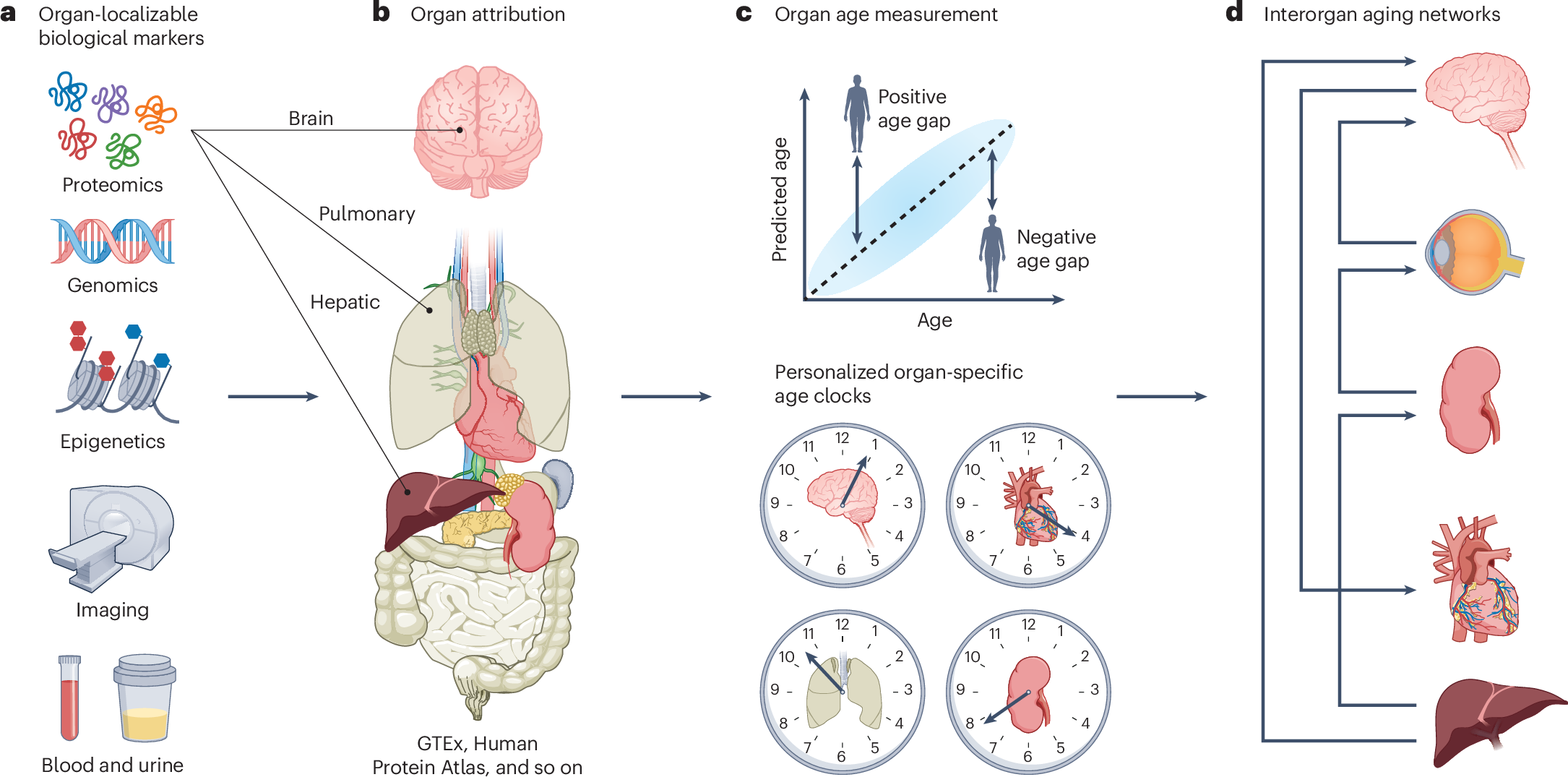
Figure 1 — Organ-specific biological age clock network. Each organ maintains a distinct aging trajectory, with interconnected "driver" organs influencing system-wide aging rates. Source: Nature Aging, Vol. 6, 2026.
Zalesky and colleagues synthesize a growing body of research using proteomics, epigenomics, metabolomics, and AI-powered imaging to demonstrate that each major organ has a measurable, distinct biological aging signature. Blood-based panels of organ-specific proteins — released into plasma in amounts that reflect the molecular state of their tissue of origin, now allow us to estimate the biological age of the heart, brain, liver, kidneys, gut, and immune system from a single blood draw.
Organ aging is asynchronous. In large cohort studies (including the UK Biobank and Whitehall II observational cohort), researchers consistently find that individual organs can diverge by 5–15 years from a person's chronological age, and from each other.
"Driver" organs matter disproportionately. The heart, brain, and kidneys appear to function as hubs in a multi-organ aging network. When these central organs accumulate excess biological age, what researchers call an "organ age gap," they send molecular distress signals through systemic circulation that measurably accelerate aging in connected systems. The analogy is not a collection of independent clocks. It's a power grid. When a central substation fails prematurely, it dims the lights across the network.
Organ age gaps predict disease decades in advance. A five-year organ age gap in the cardiovascular system predicts a significantly elevated risk of heart failure, stroke, and metabolic disease, often 15–20 years before clinical presentation. (See related ThriveMed analysis: SGLT2 genetics and heart failure prevention.)
Environment shapes organ-specific aging differentially. Diet, air quality, physical activity, sleep, and stress don't affect all organs equally. Recent work on the glymphatic system and sleep, for example, shows that brain biological age responds disproportionately to sleep quality, a finding with direct preventive implications for neurodegeneration.
From Clocks to Action: The Precision Medicine Opportunity
What makes this paper particularly important for clinical medicine is not just the biology, it's the framework it establishes for actionable intervention.
The authors outline a path toward "personalized organ aging maps": longitudinal assessments that track each patient's organ-specific biological age over time, identify which systems are accelerating, and guide targeted interventions before irreversible damage occurs. This is the same architecture that powers the ThriveMed Digital Twin, a continuous, organ-resolved model of your physiology updated as new data arrives.
There are honest limitations to acknowledge. Most current organ-specific aging studies are cross-sectional, snapshots in time rather than longitudinal tracks. We still need population-level reference ranges for organ age gaps across diverse demographics. And clinical implementation infrastructure is still developing. But the biological framework is sound. The measurement tools are here. The question now is translation.
What This Means for the Future of Medicine
The implications of this science extend across every specialty. A cardiologist who knows a patient's cardiac biological age, not their chronological age, can calibrate risk and intervention windows with a precision that current clinical tools simply don't offer. A neurologist tracking brain biological age over time gains a longitudinal signal for neurodegeneration risk years before imaging changes. A nephrologist measuring renal clock acceleration can intervene long before creatinine begins to climb.
Not a single number. A map.
That map tells us which systems are aging on schedule, which are running ahead, and where to intervene, with targeted nutrition, precision supplementation, sleep optimization, stress physiology coaching, or specialist referral, before the disease announces itself. This is what proactive, evidence-based medicine looks like when the tools finally match the ambition.
Frequently Asked Questions
What is an organ-specific biological age clock?
An algorithm — typically built on blood-based proteomic panels, epigenetic markers, or AI imaging — that estimates the biological age of an individual organ (heart, brain, liver, kidney, immune system) independently of chronological age. Unlike a whole-body biological age (one number), organ-specific clocks produce a map.
How accurate are organ-specific clocks in 2026?
Leading clocks now achieve correlations of 0.7–0.9 with chronological age in large biobanks and predict organ-specific disease 5–20 years before clinical presentation. Most are still research-grade; a small subset has begun translation into longitudinal clinical workflows like the ThriveMed Digital Twin.
Why does my heart age differently from my brain?
Each organ has distinct cell types, metabolic demands, repair capacity, and exposure profile. Sleep quality affects brain biological age (via glymphatic clearance). Cardiometabolic stressors affect cardiovascular aging. Differential exposures cause organs to diverge by 5–15 years.
What is an organ age gap?
The difference between an organ's measured biological age and the person's chronological age. A 5-year cardiovascular age gap is associated with significantly elevated risk of heart failure, stroke, and metabolic disease — often 15–20 years before symptoms.
Can organ-specific biological age be improved?
Emerging longitudinal data suggest that targeted interventions — precision nutrition, sleep optimization, structured exercise, stress physiology training, and selective pharmacology — can reduce organ-specific age gaps. The clinical translation is early but the framework is sound.
See your organ-specific biological age
The ThriveMed Digital Twin uses the same organ-resolved framework described in this paper — continuously updated, clinically supervised, personalized to you.
Your age is not one number. It never was. For the first time, we have the science and technology to measure the real story — the one your heart, brain, and gut have been quietly telling all along.
The evolution of medicine is from reactive to proactive. From average to personal. From one number to a living, breathing map of who you actually are, biologically — and who you have the potential to become. The body has been telling this story all along. We're finally learning to read it. Stay vital.
References & Further Reading
Zalesky A, Wen J, Tian Y. From whole-body to organ-specific biological age clocks. Nature Aging. 2026;6:961–969. doi:10.1038/s43587-026-01113-2
Lu AT, et al. DNA methylation GrimAge strongly predicts lifespan and healthspan. Aging. 2019. PubMed
Belsky DW, et al. DunedinPACE, a DNA methylation biomarker of the pace of aging. eLife. 2022. PubMed
Oh HS-H, et al. Organ aging signatures in the plasma proteome track health and disease. Nature. 2023;624:164–172. Nature
UK Biobank — large-scale population biomedical database
Whitehall II Study — longitudinal cohort of British civil servants
Horvath S. DNA methylation age of human tissues and cell types. Genome Biology. 2013. Genome Biology