
Insulin’s Quiet Partner: Amylin, CagriSema and What the REDEFINE Trials Found
By Andres Zuleta, MD, ThriveMed · Patient and family education
Last time, one molecule spoke for three hormones. This time, I want you to meet a quieter one. It comes from the same cells that make insulin, and for most of the twentieth century nobody knew it was there.
This is Episode 14 of my 15-part series, The Peptide Breakthroughs. Every time your pancreas releases insulin after a meal, it releases a second, smaller peptide right alongside it. That peptide is amylin.
The short version
- 1987: Garth Cooper's team at Oxford purifies amylin, a peptide of 37 amino acids, from clumps of amyloid in the pancreas. Per Westermark's group in Sweden finds it too.
- 2005: pramlintide, a version of amylin that does not clump, is approved in the United States as a mealtime shot for people with diabetes who use insulin.
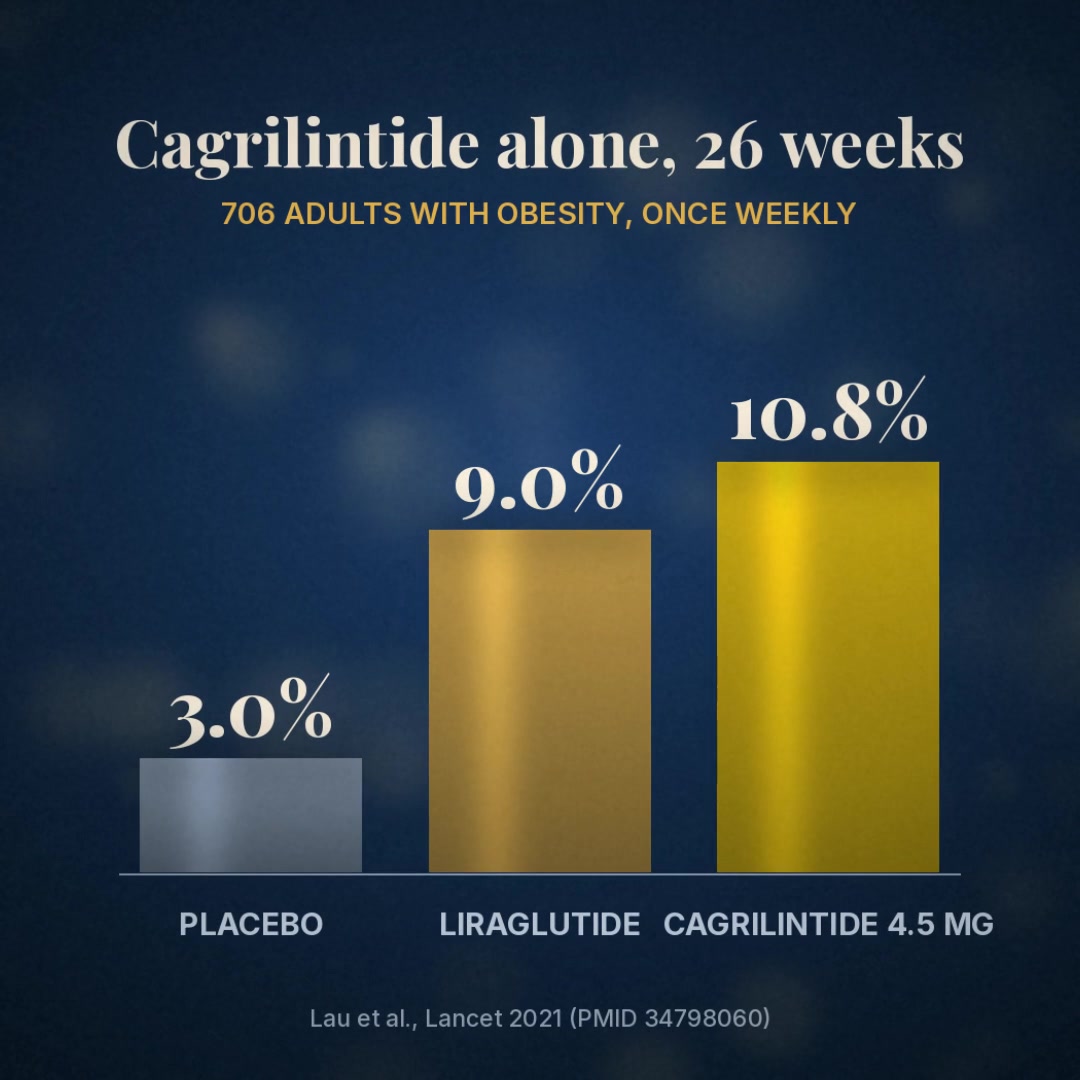
- 2021: cagrilintide, a weekly amylin medicine, leads to about 11% average weight loss at 26 weeks on the highest dose.
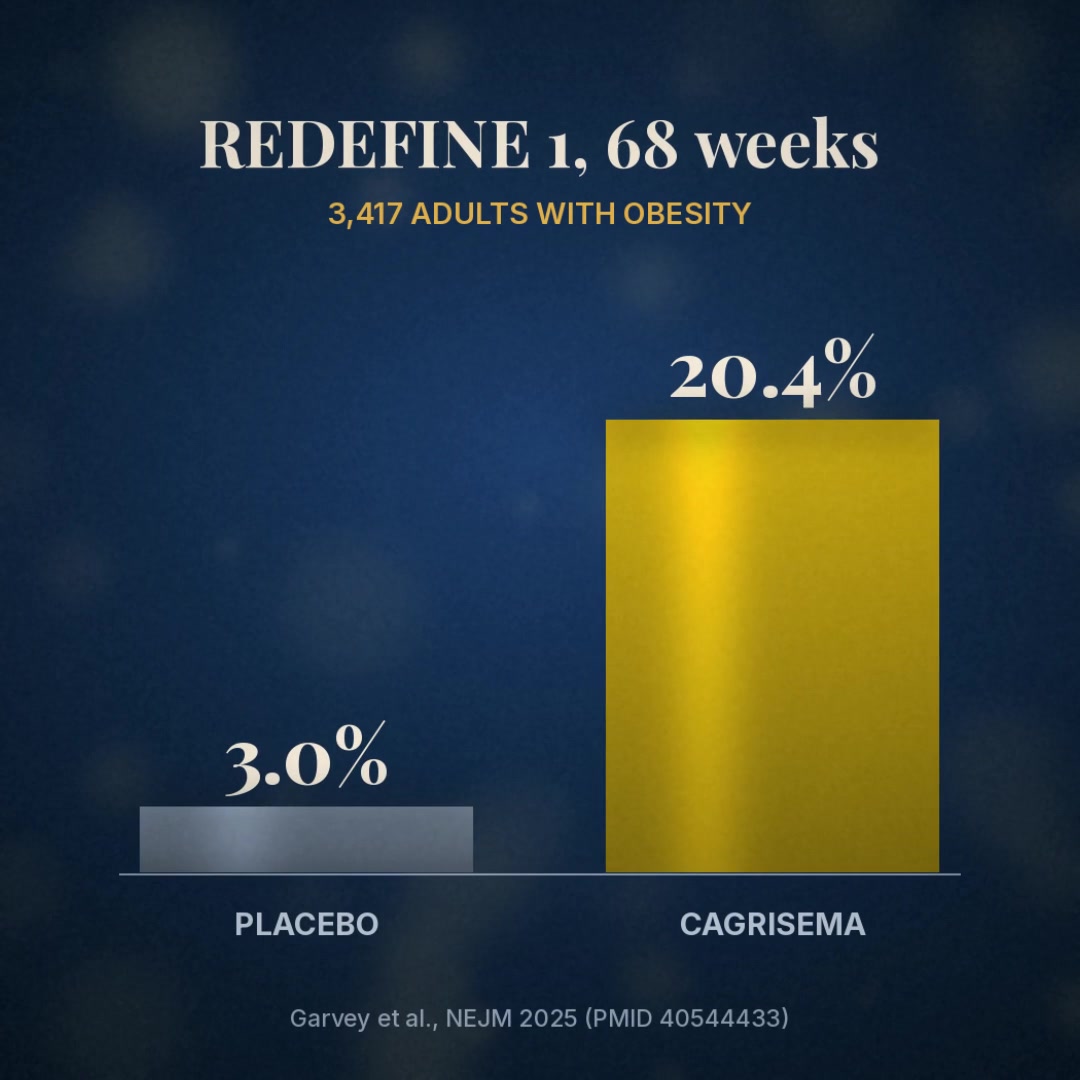
- 2025: CagriSema, cagrilintide plus semaglutide, leads to about 20% average weight loss at 68 weeks in the REDEFINE 1 trial, compared with about 3% on placebo. It is under review and not approved.
Watch the 5-minute story.
A hormone hiding in the amyloid
For decades, pathologists saw clumps of amyloid in the pancreas of many people with type 2 diabetes. In 1987, Garth Cooper and his colleagues at Oxford purified the main protein in those clumps. It was a peptide of 37 amino acids, and it turned out to be a hormone made by the same beta cells that make insulin. Per Westermark's group in Sweden described it independently. It was named amylin, for the amyloid it was hiding in.
Insulin's partner at the dinner table
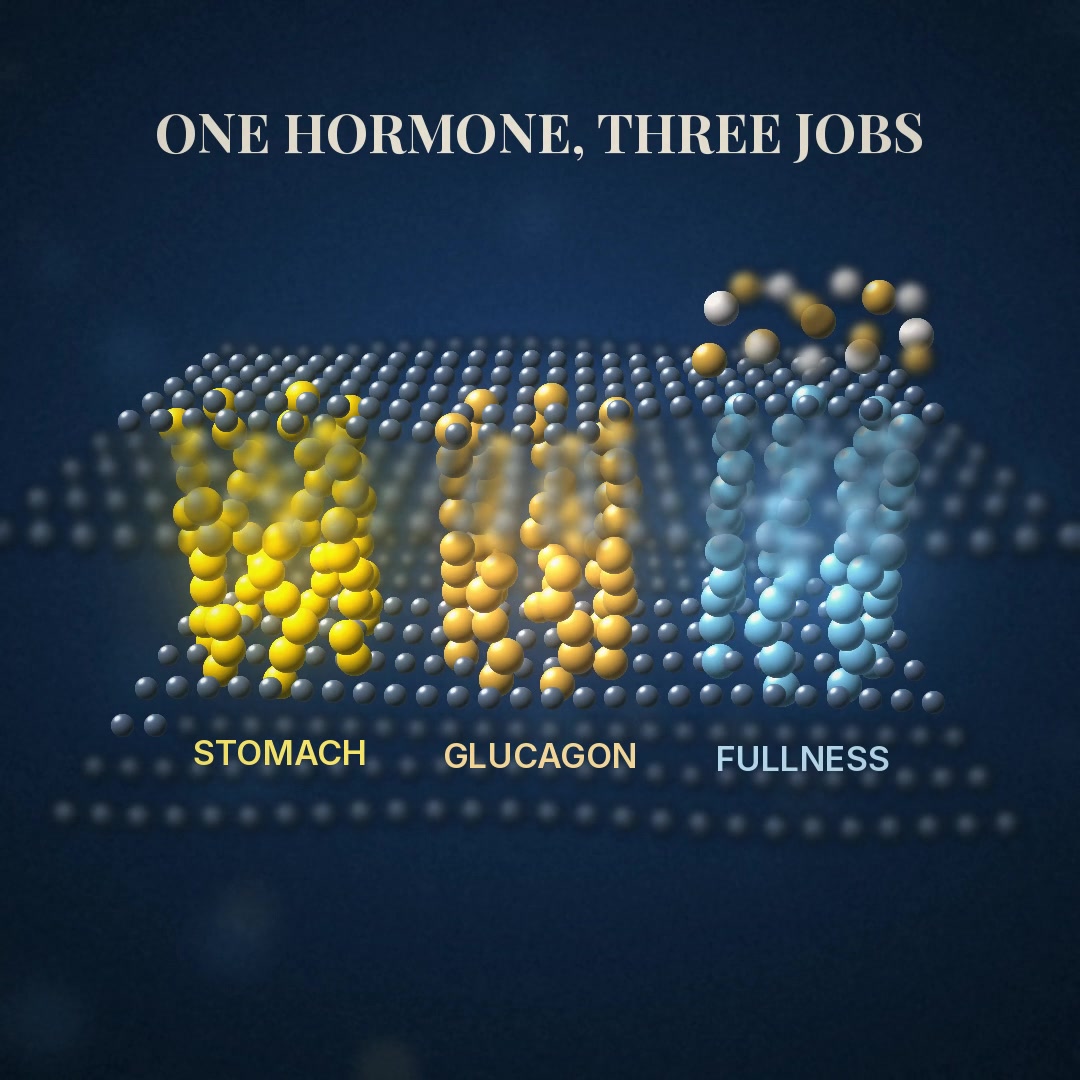
I think of amylin as insulin's partner at the dinner table. Insulin moves sugar from your blood into your cells. Amylin paces what is still coming:
- It slows how fast your stomach empties.
- It keeps glucagon, the hormone that raises blood sugar, quiet after a meal.
- It tells a small area in your brain stem that you have had enough.
The sticky problem, and the rat fix
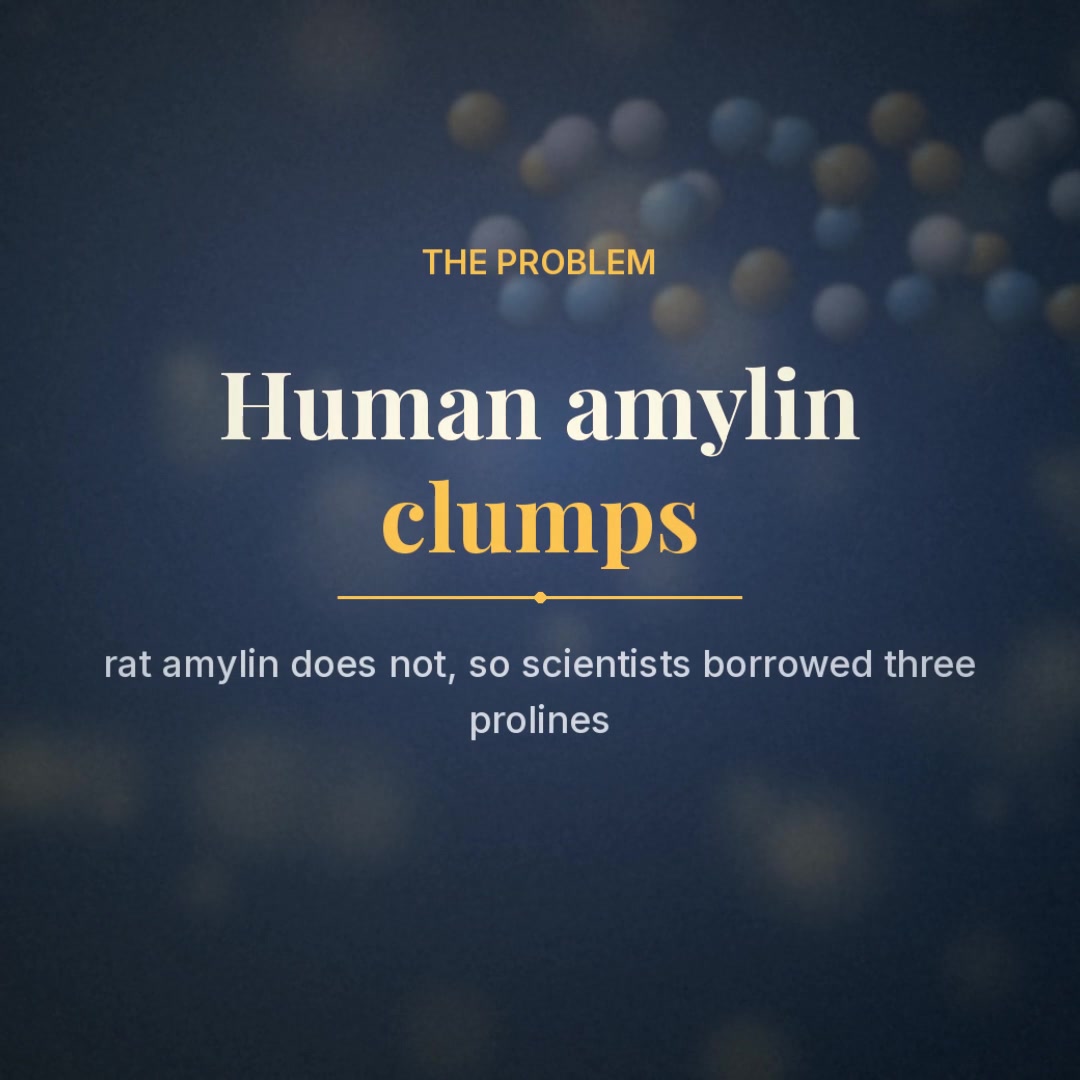
Human amylin had a problem as a medicine: it clumps into sticky fibers. Scientists noticed that rat amylin does not. So they borrowed three building blocks from the rat version, three prolines, and placed them into the human sequence. The result was pramlintide, approved in 2005 as a mealtime shot for people with diabetes who use insulin. It worked, but it wore off fast, so people needed a shot with every meal.
A week instead of a few hours
Then came the same trick we met with semaglutide. At Novo Nordisk, scientists gave amylin a fatty acid tail, so it rides on albumin in the blood and lasts about a week. They called it cagrilintide. In a phase 2 trial published in 2021, 706 adults with obesity took it once a week for 26 weeks. On the highest dose, people lost about 11% of their body weight, compared with about 3% on placebo.
Two partners, one weekly shot
Amylin and GLP-1 act on different areas of the brain, so the idea was that two partners might add up. CagriSema is cagrilintide plus semaglutide in one weekly shot.
- REDEFINE 1 (2025): 3,417 adults with obesity, 68 weeks. People on CagriSema lost about 20% of their body weight on average, compared with about 3% on placebo. Blood pressure came down too.
- REDEFINE 2 (2025): in people with obesity and type 2 diabetes, about 14% weight loss compared with about 3% on placebo, and about three in four people reached a healthy blood sugar target (HbA1c of 6.5% or lower).
One molecule for both
Scientists have now gone one step further: a single molecule that speaks for both amylin and GLP-1, called amycretin. In an early trial published in 2025, people on the highest dose lost about 24% of their body weight in 36 weeks, compared with about 1% on placebo. It was a small, early study at one site, so these numbers still need larger trials.
The honest part
- CagriSema is not approved. It is under review, and it is still an investigational medicine. Amycretin is even earlier.
- Stomach side effects were very common: about 8 in 10 people on CagriSema had nausea, vomiting, diarrhea, constipation or belly pain, mostly mild to moderate and mostly early on.
- These trials were funded by the maker, and a large heart outcomes trial is still running.
- We do not yet have published data on what happens after people stop.
- Anything sold online as cagrilintide or as an amylin peptide is not the medicine that was studied.
Two things you can use
- Insulin never works alone. Your body pairs it with a quieter partner that helps you feel full and keeps the rise after a meal gentle.
- When a new combination makes headlines, ask what each part does, and bring that question to your doctor.
For a more technical take, read my physician's version: Amylin, the second beta cell hormone: a physician's read
Stay curious, look closely, and keep learning how your body works. Be proactive.
Sources
- Cooper GJ et al. Purification and characterization of a peptide from amyloid-rich pancreases of type 2 diabetic patients. PNAS 1987 (PMID 3317417).
- McQueen J. Pramlintide acetate. Am J Health Syst Pharm 2005 (PMID 16278328).
- Lau DCW et al. Once-weekly cagrilintide for weight management. Lancet 2021 (PMID 34798060).
- Garvey WT et al. Coadministered cagrilintide and semaglutide in adults with overweight or obesity (REDEFINE 1). NEJM 2025 (PMID 40544433).
- Davies MJ et al. Cagrilintide-semaglutide in adults with overweight or obesity and type 2 diabetes (REDEFINE 2). NEJM 2025 (PMID 40544432).
- Verma S et al. CagriSema reduces blood pressure (REDEFINE 1). Hypertension 2026 (PMID 41328546).
- Dahl K et al. Amycretin, phase 1b/2a. Lancet 2025 (PMID 40550231).
- Cavender MA et al. Design of the CagriSema cardiovascular outcomes trial (REDEFINE 3). Am Heart J 2026 (PMID 42838477).
Educational only, not medical advice. Andres Zuleta, MD, ThriveMed.