
The AI That Learned the Language of Life and What It Means for Your Health
A foundation model trained on 1.5 billion years of evolution just changed what's possible in precision medicine. Here's what TranscriptFormer is, how it works, and why it matters to you.
I want you to picture something.
You're sitting across from me in my exam room, and I tell you: "We have a map. Not just of your genome, of the cellular logic that has been refined by every living thing on Earth over the last billion and a half years. And an AI has learned to read it."
That's not a hypothetical anymore. That's TranscriptFormer, and it represents a category shift in how we can understand the biology underneath your health.
What Is TranscriptFormer, Exactly?
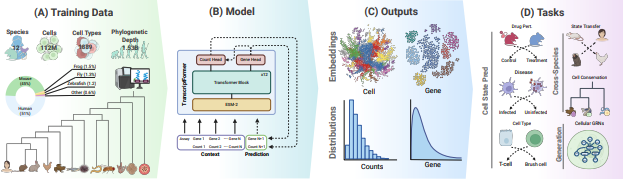
TranscriptFormer is a generative foundation model for single-cell transcriptomics, technology that measures which genes are turned on in individual cells, one at a time. What separates it from everything before it is the scale of its training data.
Make it stand out

Make it stand out
Whatever it is, the way you tell your story online can make all the difference.
From yeast and sponges to fruit flies, zebrafish, mice, and humans, the model learned what cellular rules have been maintained across all of that evolutionary time.

Make it stand out
Whatever it is, the way you tell your story online can make all the difference.
Treating Gene Expression Like a Language
Gene expression is treated, mathematically, like a language. Each cell’s expression profile becomes a “cell sentence,” the active genes are the words, the pattern of activity is the grammar. The transformer architecture learns which genes co-express, which are mutually exclusive, and how those relationships shift across species and cell types.
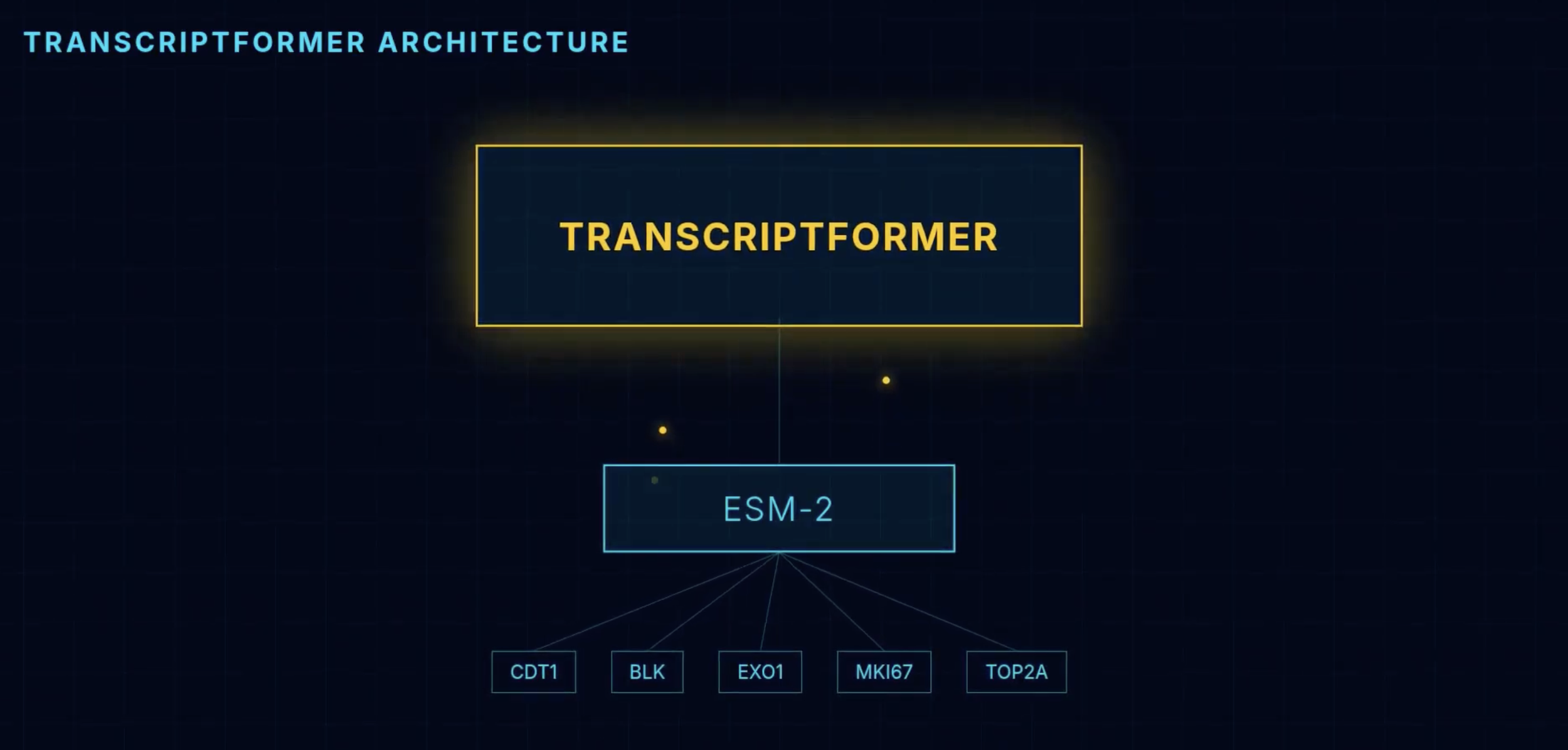
The transformer architecture processes gene expression as “cell sentences” — learning the fundamental grammar of how cells behave across species.
What the Model Can Actually Do

What This Means for You
TranscriptFormer is a research tool today. But the trajectory is clear. The vision is a true digital twin of your biology: simulate how a medication interacts with your cells before you take it, predict side effects from your gene expression patterns, and catch cellular changes before any symptom appears.

The vision: a personalized biological simulation, updated by AI in real time, tailored to your unique evolutionary legacy.
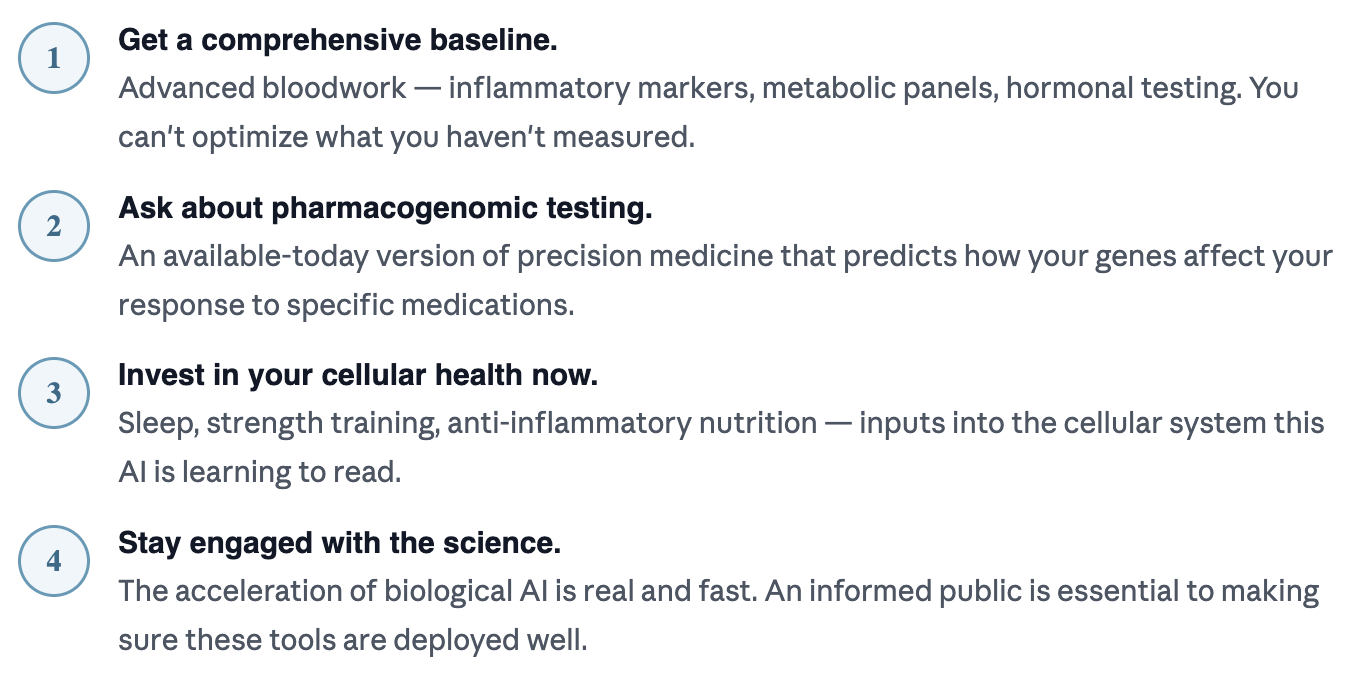
4 Practical Things You Can Do Starting Now
If this hit home for you, share it with someone who needs to read it. For more deep-dives like this one on brain health, longevity, and what the science is actually saying, follow me.
Stay well.
— Dr. Andres Zuleta, MD
Family Medicine Physician | Founder, ThriveMed
Key References
Haque A, et al. TranscriptFormer: A generative cell atlas across 1.5 billion years of evolution. Science. 2025. doi:10.1126/science.aec8514.
Read the study → · bioRxiv preprint →Regev A, Teichmann SA, Lander ES, et al. The Human Cell Atlas. eLife. 2017;6:e27041. doi:10.7554/eLife.27041.
Read the study →Vaswani A, Shazeer N, Parmar N, et al. Attention Is All You Need. Advances in Neural Information Processing Systems. 2017;30.
Read the study →Luecken MD, Theis FJ. Current best practices in single-cell RNA-seq analysis: a tutorial. Molecular Systems Biology. 2019;15(6):e8746. doi:10.15252/msb.20188746.
Read the study →
This article is for educational purposes and is not a substitute for personalized medical advice. If you have specific concerns, please consult a qualified healthcare provider.