
A Peptide for a Broken Hunger Switch: How Setmelanotide Works
By Andres Zuleta, MD, ThriveMed · Patient and family education
Last time, we met a peptide built to last a whole month by riding on an antibody. Today, we leave the gut and go into the brain, to the switch that tells you that you have eaten enough.
This is Episode 18 of my series, The Peptide Breakthroughs. Today's breakthrough is a peptide made for a broken hunger switch.
The short version
- The switch: deep in your brain, a receptor called MC4R sends the message that you have had enough.
- The problem: in some children, one broken gene in this pathway cuts the signal, so hunger never stops.
- The key: setmelanotide is a small ring of eight amino acids that switches MC4R on directly.
- The results: in trials, most people with one of these rare causes lost at least 10% of their body weight in about a year.
- Today: it is approved for a few rare causes, including, since March 2026, hunger after damage to the brain's hunger center. It is not for common obesity.
Watch the 5-minute story.
How the fullness switch works
Deep in your brain sits a small region called the hypothalamus. When you have eaten, cells there make a gene product called POMC and cut it into a small hormone. That hormone presses a receptor called MC4R. When MC4R is on, the message is simple: you have had enough.

When the signal never arrives
In 1997, scientists switched off MC4R in mice, and the mice became severely obese. One year later, doctors in Berlin described children with a broken POMC gene. They were hungry all the time, gained weight from infancy, and some had striking red hair. The same year, two teams found broken MC4R genes in families with inherited obesity. For these children, more willpower cannot fix a missing signal.
A key for a broken switch
Scientists built a small ring of eight amino acids, shaped to press MC4R directly and skip the broken steps above it. Its name is setmelanotide.

What the trials found
- 2016: doctors in Berlin treated two patients with POMC deficiency. Their hunger dropped, and one lost 51 kilograms in 42 weeks.
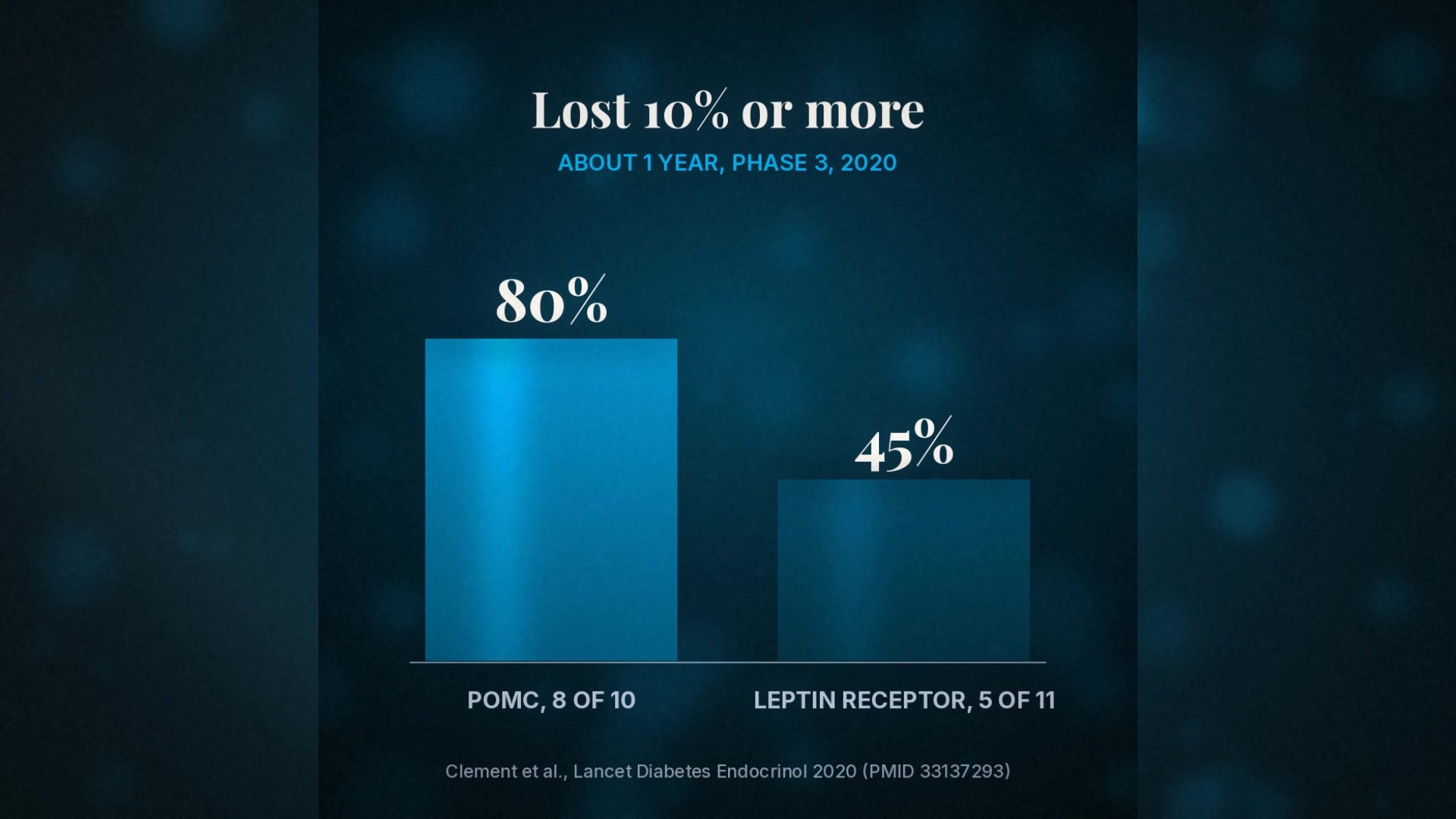
- 2020: in phase 3 trials, 8 of 10 people with POMC deficiency, and 5 of 11 with a broken leptin receptor, lost at least 10% of their body weight in about a year. The FDA approved setmelanotide that year.
- 2022: in a trial for Bardet Biedl syndrome, a rare genetic condition, about 1 in 3 patients aged 12 and older lost at least 10%.
- 2026: in a phase 3 trial of 120 people whose hunger center was damaged by a brain tumor or injury, body mass index fell about 16.5% on setmelanotide and rose about 3% on placebo over a year. The FDA approved that use in March 2026.
The honest part
- Setmelanotide works only when the problem sits in this pathway. It is not approved for common obesity, and it is not expected to work there.
- It is a daily injection.
- Most people see their skin darken, and moles can darken too, so doctors check the skin.
- Nausea, vomiting and headache are common, and mood needs watching.
- The trials were small, and they were funded by the maker.
Two things you can use
- Hunger is biology. For some people, a single gene sets how hungry they feel.
- If severe obesity and constant hunger started in early childhood, ask your doctor whether genetic testing makes sense.
For a more technical take, read my physician's version: Setmelanotide: a physician's read
Stay curious, look closely, and keep learning how your body works. Be proactive.
Sources
- Huszar D et al. Targeted disruption of the melanocortin-4 receptor results in obesity in mice. Cell 1997 (PMID 9019399).
- Krude H et al. Severe early-onset obesity, adrenal insufficiency and red hair pigmentation caused by POMC mutations in humans. Nat Genet 1998 (PMID 9620771).
- Yeo GS et al. A frameshift mutation in MC4R associated with dominantly inherited human obesity. Nat Genet 1998 (PMID 9771698).
- Vaisse C et al. A frameshift mutation in human MC4R is associated with a dominant form of obesity. Nat Genet 1998 (PMID 9771699).
- Kuhnen P et al. Proopiomelanocortin deficiency treated with a melanocortin-4 receptor agonist. NEJM 2016 (PMID 27468060).
- Clement K et al. Efficacy and safety of setmelanotide in individuals with severe obesity due to LEPR or POMC deficiency. Lancet Diabetes Endocrinol 2020 (PMID 33137293).
- Haqq AM et al. Efficacy and safety of setmelanotide in patients with Bardet-Biedl syndrome and Alstrom syndrome. Lancet Diabetes Endocrinol 2022 (PMID 36356613).
- Miller JL et al. Setmelanotide for the treatment of acquired hypothalamic obesity. NEJM 2026 (PMID 42418774).
- FDA prescribing information, IMCIVREE (setmelanotide), revised March 2026.
Andres Zuleta, MD, ThriveMed.